

Quick Answer
Yes. A Florida condo special assessment can affect mortgage approval if it raises your monthly housing expense, reflects major building repairs or weak reserves, creates significant owner delinquencies, or causes the condo project to fall outside standard financing requirements. An assessment by itself doesn’t automatically prevent approval.
A special assessment can turn what looks like a straightforward Florida condo purchase into a much more complicated financing decision. The assessment might be relatively minor, or it could be connected to a multimillion-dollar roof, concrete restoration, insurance shortfall, structural repair, or reserve funding problem. The key is understanding why the assessment exists and how it affects both your monthly costs and the building itself.
This matters in a sizable Florida condo market. According to August 2026 Florida Realtors housing data, the statewide median condo and townhouse sale price was just under $298,000, up nearly 3% from a year earlier, while inventory declined 11.5%.
A Personal Story
I’ve worked with buyers who had excellent credit, strong income, and plenty of money for their down payment, then discovered that the condo association had recently approved a large special assessment. At first, they assumed the only question was whether they could afford their share. The bigger issue was why the assessment had been created and what it told us about the building.
My advice is to investigate the assessment immediately. I want the amount, remaining balance, payment schedule, purpose, repair status, association budget, reserve information, and any related engineering or inspection reports before we assume the condo will fit a particular financing program.
What Is a Condo Special Assessment in Florida?
A condo special assessment is an additional charge imposed on unit owners when regular association dues and available funds aren’t enough to cover a particular expense.
Florida condo associations may use assessments for expenses such as:
- Roof replacement
- Concrete restoration
- Elevator replacement
- Plumbing or electrical work
- Hurricane damage
- Insurance deductibles
- Structural repairs
- Reserve funding
- Major common-area improvements
The assessment could be due as 1 lump sum or divided into monthly, quarterly, or annual installments.
That distinction matters when you’re buying. A $20,000 assessment already paid in full creates a different financing situation than a $20,000 balance requiring $1,000 per month for the next 20 months.
Can a Condo Special Assessment Affect Mortgage Approval?
Yes, a condo special assessment can affect mortgage approval through both the individual buyer review and the condo project review.
First, the payment may affect your qualifying housing expense. Under Fannie Mae’s current housing expense rules, special assessments are included in the monthly housing expense for the subject property. That means a monthly assessment can increase the payment used when calculating debt to income.
Second, the association itself is reviewed. Current Fannie Mae project standards generally allow no more than 15% of the total units in a project to be 60 days or more past due on each special assessment. A large number of delinquent owners can therefore become a project eligibility problem.
This is one reason Florida condo mortgage rules go beyond the buyer’s credit and income. Association finances, reserves, insurance, structural condition, assessments, and other project details may all matter.
What Does the Mortgage Review Look for?
The review looks at the assessment itself, the buyer’s obligation, and what the assessment reveals about the building.
We typically want to know:
- Total assessment amount
- Your unit’s remaining balance
- Monthly or installment payment
- Whether the seller will pay any portion
- Purpose of the assessment
- Number of owners who are delinquent
- Whether repairs are complete
- Whether structural concerns remain
- Association reserve levels
- Whether another assessment may be coming
Fannie Mae also has specific rules for unpaid assessments. If a special assessment has already been levied and won’t be paid before or at closing, the available mortgage amount can be affected unless sufficient funds are being collected to cover the obligation.
That’s why I don’t treat every assessment the same. A fully funded cosmetic improvement is one thing. An unfinished structural repair with weak reserves and widespread owner delinquencies is something very different.
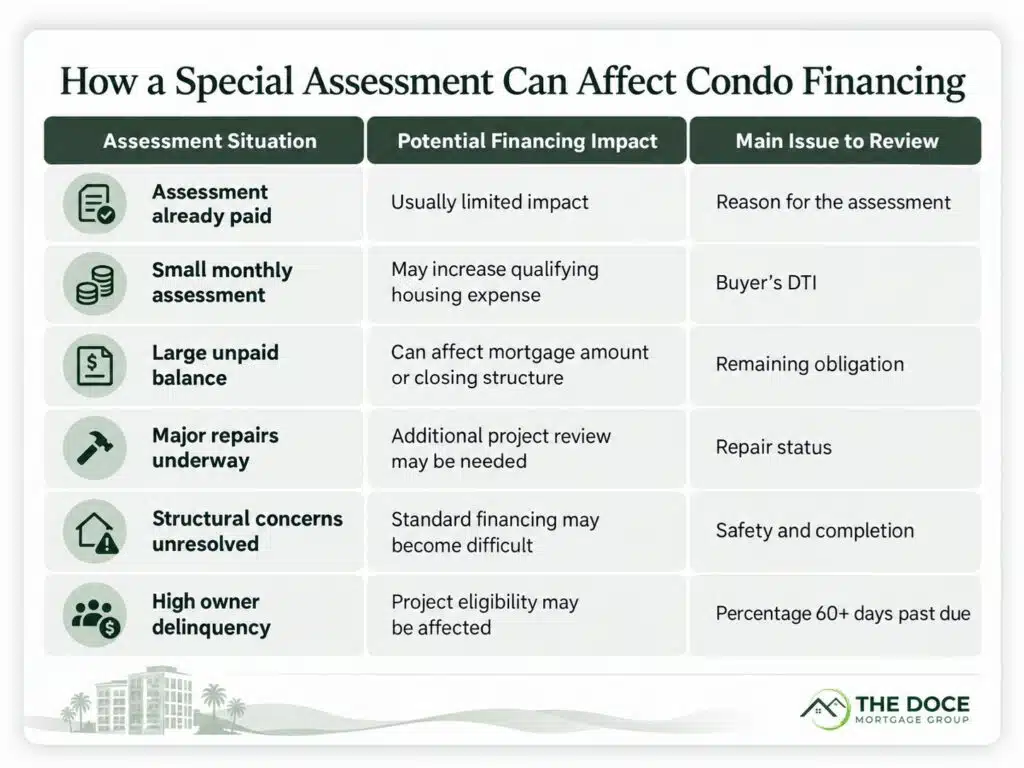
We work with both warrantable and non-warrantable Florida condo financing, so a problem with a standard condo approval doesn’t necessarily mean the transaction is over.
You can also use our Mortgage Payment Calculator to estimate your base payment, taxes, insurance, HOA dues, and PMI. If there’s an active special assessment, we’ll separately add that obligation when evaluating the real monthly cost and qualification.
How Does a Special Assessment Affect DTI and Loan Amount?
A condo special assessment can increase the monthly housing expense used to calculate your debt to income ratio, which may reduce the mortgage amount you qualify for.
For example, suppose your regular HOA dues are $650 per month and the association adds a $750 monthly special assessment for the next 24 months. That additional $750 can matter when your total housing expense is calculated.
The effect depends on how the assessment is structured, whether it remains your obligation after closing, and the mortgage program being used. If the seller pays the assessment in full before or at closing, the impact can be very different from an assessment that transfers to you.
This is why I always want the assessment documents early. A buyer might comfortably afford the purchase price but run into a qualification problem after a large monthly assessment is added.
Can a Special Assessment Make a Condo Non-Warrantable?
Yes, the circumstances behind a special assessment can contribute to a condo becoming non-warrantable.
The assessment itself isn’t necessarily the problem. What matters is what caused it and what’s happening inside the association.
Possible concerns include:
- Inadequate reserves
- Significant deferred maintenance
- Critical repairs
- Structural deficiencies
- Large numbers of owners unable to pay the assessment
- Insurance problems
- Major unfinished projects
Current Freddie Mac condominium guidance generally allows no more than 15% of units to be 60 or more days delinquent on each special assessment. Fannie Mae applies a similar 15% standard under its Full Review requirements.
The broader financial picture is becoming increasingly important. In its 2026 condo project standards update, Fannie Mae specifically connected underfunded reserves with critical repairs and warned that unexpected special assessments can create financial hardship for unit owners.
If a project falls outside conventional requirements, that doesn’t automatically end the purchase. Our guidance on warrantable vs. non-warrantable condos explains why the financing path can change even when the individual buyer has excellent credit and income.
What if the Assessment Is Paying for Structural Repairs?
An assessment connected to structural repairs deserves much closer review because unresolved critical repairs can make standard financing unavailable.
We’ll want to know exactly what work is required, whether construction has started, how much has been completed, how the work is funded, and whether an engineer or other qualified professional has identified unresolved safety concerns.
Florida buyers should also determine whether the repairs are related to a milestone inspection or Structural Integrity Reserve Study. In older condominium buildings, these documents can reveal whether the association is dealing with ordinary maintenance or a more serious structural issue.
I don’t assume a building is unacceptable simply because concrete restoration or another major project is underway. The important distinction is between a properly funded project progressing toward completion and a building with unresolved critical problems and no clear financial plan.
Can You Still Finance a Condo With an Active Assessment?
Yes, many condos with active special assessments can still be financed.
The best financing route depends on the assessment, building condition, association finances, and buyer profile. A warrantable project may continue to qualify for conventional financing when applicable requirements are satisfied.
If the project doesn’t qualify through Fannie Mae or Freddie Mac standards, we can also evaluate non-warrantable Florida condo financing. Our specialty condo options can accommodate certain buildings that fall outside conventional guidelines, although down payment requirements and pricing can be different.
Standard vs. Specialty Condo Financing
| Issue | Standard Financing | Specialty Condo Financing |
|---|---|---|
| Small manageable assessment | May still qualify | Usually not necessary |
| Weak association reserves | Could create eligibility problems | May offer another path |
| Non-warrantable project | Generally unavailable | May be possible |
| Major assessment | Depends on cause and documentation | Evaluated case by case |
| Critical unresolved repairs | Often problematic | May still be restricted |
| Down payment | Can be relatively low | Often 20% to 30% or more |
Assessment Risk and Financing Path
| Assessment Situation | Likely Next Step |
|---|---|
| Paid assessment, completed repairs | Normal project review |
| Active assessment, adequate reserves | Review payment and project documents |
| Large assessment, repair work underway | Detailed project and repair review |
| Reserve shortage or non-warrantable characteristics | Compare specialty condo financing |
| Unresolved critical structural repairs | Financing may need to wait |
If you already have a specific condo building in mind, you can start our secure mortgage application, and we can evaluate the buyer and building together before you get too far into the transaction.
Pros and Cons of Buying a Condo With a Special Assessment
A special assessment isn’t automatically a reason to avoid a condo.
Potential advantages include recently completed major improvements, a newer roof or building systems, and greater clarity about how necessary repairs are being funded.
The disadvantages can be more significant. You may inherit an additional monthly payment, face financing restrictions, or discover that the assessment reflects deeper reserve or structural problems.
I look beyond the assessment amount. A $30,000 assessment funding a well-managed project can sometimes concern me less than a $5,000 assessment in a building that still has major unfunded repairs.
Common Mistakes
The biggest mistake is asking only, “How much is the assessment?”
Buyers should also avoid:
- Assuming the seller paying the assessment eliminates every financing concern
- Ignoring why the assessment was created
- Failing to verify whether repairs are complete
- Overlooking association reserve levels
- Ignoring owner delinquency rates
- Assuming non-warrantable means impossible to finance
- Waiting until late in the transaction to request condo documents
The earlier we identify these issues, the more options we usually have.
Myths Vs Facts
A Florida condo special assessment can look alarming, but the amount alone doesn’t tell you whether the condo can be financed.
| Myth: Any special assessment prevents mortgage approval | Fact: Many condos with assessments can still qualify when the project and buyer meet program requirements |
| Myth: The seller paying the assessment solves every problem | Fact: Payment may solve the buyer’s obligation, but the reason behind the assessment can still affect project eligibility |
| Myth: A large assessment always means the association is poorly managed | Fact: An assessment may fund planned improvements, storm repairs, or required structural work |
| Myth: Only unpaid assessments matter | Fact: Repair status, reserves, owner delinquencies, and structural conditions can all matter |
| Myth: A non-warrantable condo can’t be financed | Fact: Specialty condo financing may provide another option for certain projects |
I tell buyers to separate 2 questions. First, what does the assessment cost you? Second, what does the assessment tell us about the building? The second question is often more important.
Key Facts
- Special assessments can increase the monthly housing expense used for qualification
- The reason for the assessment may matter more than its dollar amount
- Seller payment doesn’t necessarily eliminate project eligibility concerns
- Structural repairs deserve closer review than ordinary cosmetic improvements
- Association reserves, insurance, delinquencies, and repair status can all affect approval
- Specialty financing may help when a condo doesn’t satisfy conventional project standards
- Buyers should request assessment documents before getting deep into the transaction
Florida’s condo market remains active even as buyers become more selective. Florida Realtors reported 7,291 existing condo and townhouse sales statewide in August 2026, while the median sale price reached $298,000. The same report showed a 7.7 month supply of condo and townhouse inventory.
Special Assessment Due Diligence
| What to Request | What You Want to Know | Why It Matters |
|---|---|---|
| Assessment notice | Total amount and purpose | Defines the obligation |
| Payment schedule | Lump sum or installments | Can affect monthly qualification |
| Seller payment agreement | Who owes the remaining balance | Determines buyer responsibility |
| Association budget | Whether normal income covers operations | Helps evaluate financial stability |
| Reserve information | Whether future repairs are funded | May reveal additional assessment risk |
| Engineering reports | What repairs are required | Helps identify structural concerns |
| Repair contracts | Whether work is funded and underway | Shows progress toward completion |
| Delinquency information | How many owners aren’t paying | Can affect project eligibility |
Understanding these documents also becomes easier when you understand the broader special rules that apply to Florida condo mortgages. Condo approval evaluates the building as well as the individual buyer.
How Should You Decide Whether to Buy a Condo With an Assessment?
Focus on the cause, remaining financial obligation, repair status, and overall condition of the association before making the decision.
Buyer Decision Chart
| Situation | What I’d Investigate Next |
|---|---|
| Assessment paid, repairs completed | Confirm documentation and continue project review |
| Assessment unpaid but manageable | Determine monthly qualification impact |
| Seller agrees to pay balance | Confirm payment terms and underlying project condition |
| Major repairs underway | Review engineering reports, funding, and completion timeline |
| Weak reserves and another assessment possible | Evaluate total future ownership risk |
| Critical structural work unresolved | Determine whether financing must wait |
| Project doesn’t meet standard requirements | Compare specialty condo options |
Current Fannie Mae condo project standards have increased the focus on reserves, critical repairs, and the financial health of condo associations. This is why I recommend getting project documents early rather than treating the condo review as something to handle right before closing.
How We Help Florida Condo Buyers Move Forward
A special assessment doesn’t tell us by itself whether you should buy the condo or whether it can be financed. We look at the entire picture, including the assessment, reserves, structural condition, insurance, repair status, buyer qualifications, and available mortgage programs.
When standard financing doesn’t fit, we can also evaluate specialty condo options rather than assuming the transaction is finished. If you already have a property in mind, you can get a free mortgage quote and we’ll review the numbers along with the condo circumstances.
You can see what buyers have said about working with us through our customer reviews. The Doce Mortgage Group recently received the prestigious WalletHub Award and was recognized as one of the best mortgage brokers in several cities throughout Florida.
Our goal is to identify the issue early, explain what it actually means, and help you determine whether standard financing, specialty condo financing, or a different property makes the most financial sense. When you’re ready, you can Get Started Now, or connect with a loan officer live at 305-661-3434.
Frequently Asked Questions
No. The assessment amount, purpose, payment structure, repair status, association finances, and mortgage program all help determine whether financing remains available.
Potentially, yes. The purchase contract can address who is responsible for an existing assessment. Paying it off may remove the buyer’s ongoing payment obligation, but project related issues still need to be reviewed.
It can. When an assessment remains the buyer’s responsibility, the required payment may be included when calculating monthly housing expenses.
Possibly. We offer specialty Florida condo financing for certain non-warrantable projects, although down payment, pricing, and project requirements can differ from conventional financing.
No. A large assessment deserves careful investigation, but it can be funding a well-managed repair project. The underlying condition of the building is more important than simply labeling the assessment as large.