
Quick Answer
A delayed financing mortgage allows eligible Florida homebuyers who purchased a property with cash to obtain a cash-out refinance without waiting the usual six-month ownership period. Under Fannie Mae’s delayed financing exception, the new loan cannot exceed the buyer’s documented initial investment plus eligible refinancing costs, and applicable loan-to-value limits still apply.
For the purchase-price-based financing examples in this article, borrowing calculations do not use a valuation higher than the original purchase price.

Buying a Florida home with cash can make an offer more attractive and eliminate mortgage-related delays at closing. However, paying entirely in cash can also leave a substantial amount of money tied up in the property.
Delayed financing provides a way to purchase first and arrange mortgage financing afterward. At The Doce Mortgage Group, we help Florida buyers explore this strategy while understanding its documentation requirements, costs, and borrowing limitations.
A Personal Story
One situation I frequently discuss with Florida homebuyers involves someone who has enough savings to purchase a property outright but doesn’t want to leave all that money tied up in real estate.
Imagine buying a $400,000 home with cash to secure the property quickly. After closing, you realize you would prefer to have some of that money available for renovations, investments, or emergencies.
Delayed financing may provide an option.
Instead of treating the cash purchase as a permanent commitment to having no mortgage, we can evaluate whether you qualify to refinance and recover part of your investment.
The important part is planning ahead. I encourage buyers to discuss delayed financing before making their cash purchase so they understand how the purchase must be documented and what they may realistically recover.
What Is a Delayed Financing Mortgage?
A delayed financing mortgage is a cash-out refinance completed shortly after purchasing a property without mortgage financing.
Ordinarily, conventional cash-out refinances have an ownership seasoning requirement. Fannie Mae provides an exception for qualifying cash purchases completed within the previous six months.
The six-month period is measured from the original purchase date to the disbursement date of the new mortgage.
The borrower must satisfy specific eligibility requirements, and the refinance cannot exceed the documented initial investment plus permitted refinancing costs.
Importantly, this is not an opportunity to borrow unlimited amounts against appreciation. The financing examples in this article use the original purchase price as the maximum valuation for calculating the available mortgage, consistent with the purchase-price-based approach described here.
Why Is Delayed Financing Especially Useful for Florida Cash Buyers?
Florida’s housing market includes primary residences, vacation homes, investment properties, and properties purchased for renovation.
According to Florida Realtors, cash transactions remain an important part of the state’s residential real estate market.
Delayed financing may be useful when buyers want to:
- Make a competitive cash offer without a mortgage contingency.
- Close quickly on a property.
- Restore cash reserves after purchasing a home.
- Access funds for improvements or other investments.
- Preserve financial flexibility after buying a vacation or investment property.
For example, someone purchasing a Florida home before selling another property might prefer to buy with cash and refinance later rather than wait for the sale proceeds.
However, delayed financing is not guaranteed. The buyer must still qualify for the new mortgage.
How Does the Delayed Financing Process Work?
The process generally follows five steps.
Step 1: Purchase the property with cash. Complete an arm’s-length purchase without mortgage financing secured by the property being acquired.
Step 2: Preserve your documentation. Keep the closing statement and records establishing where the purchase funds originated.
Step 3: Apply for delayed financing. Work with a lender to evaluate your credit, income, property, and loan eligibility.
Step 4: Complete underwriting and valuation. The lender reviews the property’s value, verifies the purchase, and determines the permitted loan amount.
Step 5: Close the refinance. If approved, the new mortgage is funded and the eligible proceeds are distributed according to the transaction requirements.
| Stage | What Happens |
|---|---|
| Cash Purchase | Buyer acquires the property without mortgage financing on that property |
| Financing Review | Lender verifies eligibility, purchase funds, and allowable loan amount |
| Mortgage Funding | Approved refinance closes and permitted proceeds are disbursed |
Because the exception has a six-month window, buyers should begin discussions well before the deadline.
Who Qualifies for a Delayed Financing Mortgage in Florida?
Eligibility depends on the loan program and lender, but Fannie Mae’s delayed financing exception generally requires:
- An arm’s-length original purchase.
- Documentation showing that no mortgage financing was used to acquire the subject property.
- A title review confirming there are no existing liens on the property.
- Documentation of the source of purchase funds.
- Compliance with the lender’s credit, income, and other underwriting requirements.
- A refinance completed within the applicable six-month period.
The exception can apply to qualifying primary residences, second homes, and investment properties, subject to applicable program rules.
If borrowed funds secured by another asset were used for the purchase, additional repayment requirements apply. Gift funds used for the purchase cannot be reimbursed through the new mortgage.
Explore Florida home loan options to understand which financing approaches may fit your situation.
What Documents Do You Need for Delayed Financing?
Lenders typically request documentation establishing both the original purchase and your ability to repay the new mortgage.
Common documents include:
- Original purchase closing statement.
- Bank or investment account statements showing the source of funds.
- Proof of ownership and title information.
- Identification and credit authorization.
- Income documentation, such as pay stubs or tax returns.
- Homeowners insurance information.
- Documentation of any borrowed funds used for the purchase.
For self-employed borrowers, additional business and tax documentation may be necessary.
Keep complete records of transfers between accounts. Unexplained deposits or incomplete records can delay underwriting.
How Much Cash Can You Get Back With Delayed Financing?
The amount you may recover depends on the documented original investment, the applicable loan-to-value limit, lender requirements, and eligible financing costs.
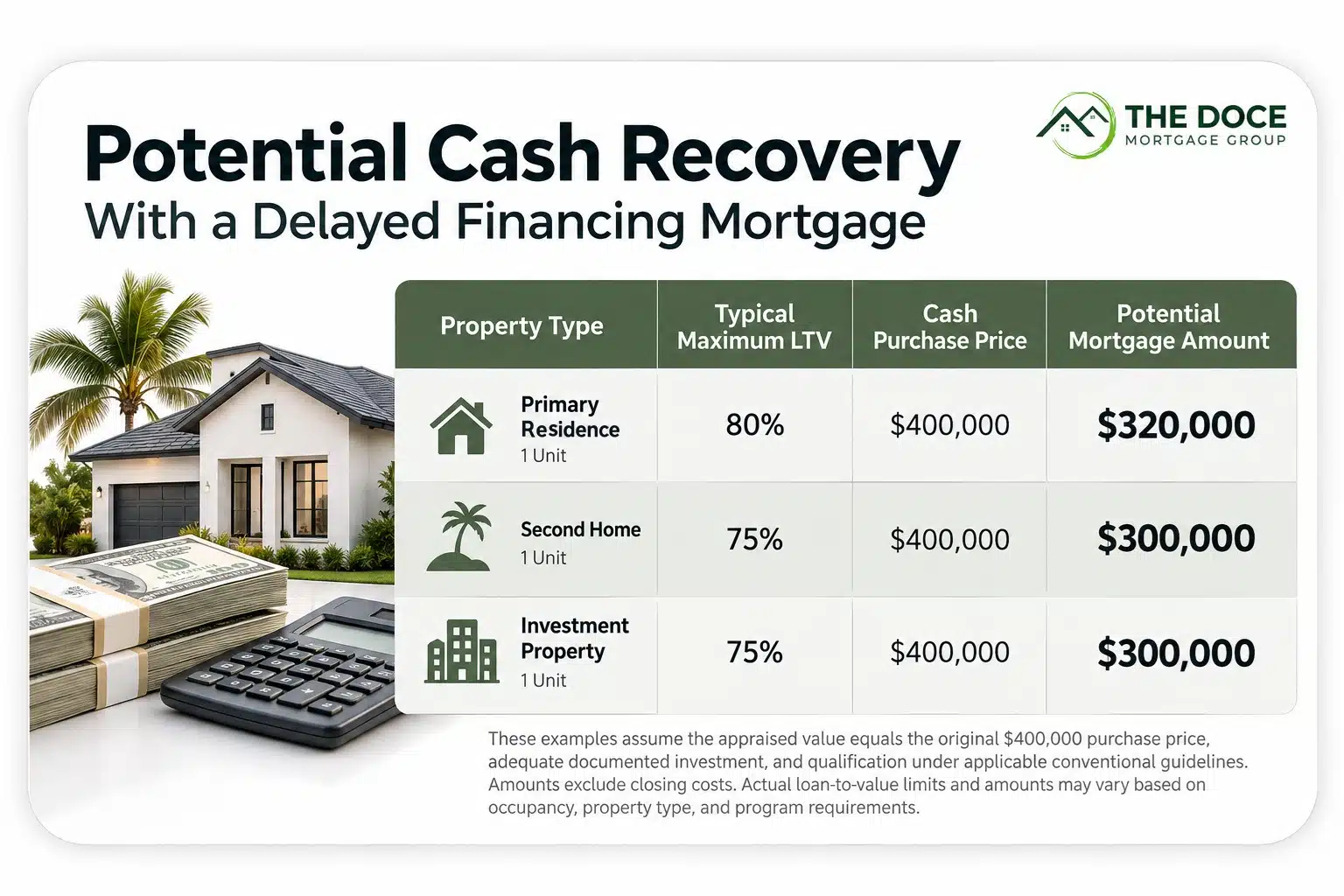
For the purchase-price-based example below, the original purchase price is used for the borrowing calculation. A higher appraisal is not substituted to increase the amount available.
Example of a Florida Delayed Financing Mortgage
| Transaction Details | Amount |
|---|---|
| Original cash purchase price | $400,000 |
| Assumed maximum loan-to-value ratio | 75% |
| Maximum mortgage under this assumption | $300,000 |
| Cash potentially recovered before closing costs | $300,000 |
| Equity remaining in the property | $100,000 |
In this hypothetical example, the buyer pays $400,000 in cash. Applying the assumed 75% financing limit to the original purchase price produces a maximum mortgage of $300,000.
The buyer could potentially recover $300,000 before closing costs, leaving $100,000 in equity measured against the original purchase price. The 75% figure is an illustrative assumption, not a universal delayed financing limit.
Actual proceeds may be lower depending on underwriting, lender requirements, and transaction expenses.
Understanding Interest Rates and Closing Costs in Florida
Delayed financing is generally priced as a cash-out refinance rather than a standard purchase mortgage.
Interest rates depend on factors including credit profile, property occupancy, loan amount, loan-to-value ratio, and market conditions.
For market context, review Freddie Mac’s Primary Mortgage Market Survey.
Potential closing expenses include:
| Expense | Description |
|---|---|
| Lender fees | Charges associated with originating the mortgage |
| Appraisal | Property valuation when required |
| Title services | Title search, settlement, and related charges |
| Recording fees | Government recording expenses |
| Prepaid expenses | Applicable interest, insurance, and escrow funding |
Florida mortgage transactions may also involve documentary stamp taxes and intangible taxes, depending on the transaction.
Use our Mortgage Payment Calculator to estimate payments and compare possible financing scenarios.
Pros and Cons of a Delayed Financing Mortgage
| Advantages | Considerations |
|---|---|
| Enables a cash purchase followed by financing | Requires mortgage qualification |
| May help buyers close quickly | Involves refinance closing costs |
| Restores access to some invested cash | Does not guarantee recovery of the full purchase price |
| Can preserve funds for other purposes | Creates a new monthly mortgage payment |
| May be available within six months | Requires detailed purchase-fund documentation |
Delayed financing is most useful when the benefits of recovering liquidity justify the cost of borrowing.
Myths vs Facts About Delayed Financing
Myth: You must wait six months after buying a home with cash to refinance.
Fact: Eligible borrowers may qualify under Fannie Mae’s delayed financing exception before the six-month ownership period has passed.
Myth: You can automatically recover every dollar you paid for the property.
Fact: Loan proceeds are subject to documented investment, applicable financing limits, closing costs, and underwriting.
Myth: A higher appraisal automatically lets you borrow more than your original investment.
Fact: Fannie Mae limits the new loan to the documented initial investment plus eligible refinancing costs. Under the purchase-price-based financing approach used in this article, an appraisal above the original purchase price does not increase the valuation used in the borrowing calculation.
Myth: Paying cash means you will automatically qualify for delayed financing.
Fact: Borrowers must still meet mortgage eligibility and documentation requirements.
Common Mistakes Florida Cash Buyers Should Avoid
Failing to document purchase funds. Keep statements and transaction records that clearly establish the source of the money used to purchase the property.
Waiting too long to apply. The six-month exception is measured through the new mortgage’s disbursement date, not simply the application date.
Assuming a higher appraisal increases available proceeds. Under the purchase-price-based calculations described here, appreciation above the original purchase price is not used to increase the financing amount.
Overlooking closing costs. The mortgage amount and cash received after transaction expenses are not necessarily identical.
Using borrowed or gifted funds without understanding the rules. Certain borrowed funds must be repaid through refinance proceeds, while purchase gift funds cannot be reimbursed.
Planning ahead with a knowledgeable mortgage professional can help prevent these problems.
Key Facts
| Topic | Important Detail |
|---|---|
| Loan type | Cash-out refinance |
| Timing | Qualifying purchase within the previous six months |
| Purchase requirement | Original transaction must satisfy cash-purchase documentation rules |
| Borrowing example | Based on the original purchase price, not a higher appraisal |
| Maximum proceeds | Subject to documented investment and applicable loan limits |
| Qualification | Credit, income, title, and other underwriting requirements apply |
For additional mortgage planning tools, visit our mortgage refinancing resources.
Get Your Cash Back With The Doce Mortgage Group
Alex Doce has spent more than 38 years helping people navigate mortgage decisions with a focus on clear communication, preparation, and avoiding last minute surprises. Our goal isn’t simply to get you to closing. We want you to understand the mortgage you’re choosing and feel confident about the decision.
Our customer reviews include more than 1,500 five star reviews, and WalletHub currently recognizes Alex Doce among its best mortgage brokers in Fort Lauderdale for 2026, alongside other highly rated Florida professionals.
When you’re ready to compare your options, you can also get a free quote from our team.
When you’re ready to take the next step, you can Get Started Now, or connect with a loan officer live at 305-661-3434.
Frequently Asked Questions
Yes. If you meet the applicable requirements, delayed financing may allow you to obtain a cash-out refinance within six months of the original purchase.
Not necessarily. The available mortgage depends on documented investment, loan-to-value limits, eligible costs, and lender underwriting. Many borrowers recover only part of their original cash investment.
Under the purchase-price-based financing approach described in this article, a higher appraisal does not increase the valuation used to calculate the available mortgage. Fannie Mae separately uses the current appraised value when determining applicable refinance LTV ratios, while limiting the loan amount to the documented initial investment plus eligible refinancing costs.
Potentially, yes. Eligible investment properties may qualify, although loan-to-value limits, pricing, and other requirements can differ from those for primary residences.
A property valuation is generally part of underwriting, although whether a full appraisal is required depends on the loan program and applicable valuation rules.
Ideally, discuss financing before the purchase and begin the refinance process promptly afterward. This helps provide enough time for underwriting and closing within the applicable period.
Possibly. Fannie Mae permits certain documented funds borrowed against another asset, but the refinance proceeds must be applied toward repayment of that borrowing as required by its guidelines.