
Quick Answer
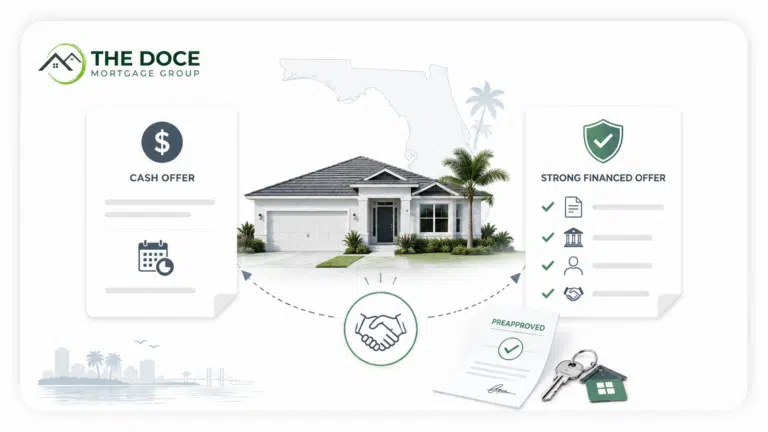
CRNAs may qualify for doctor loans, Florida Hometown Heroes, conventional, FHA, VA, jumbo, and HomeZero financing. For an eligible Florida CRNA, Hometown Heroes can be especially attractive because it can provide 5% of the first mortgage amount, from $10,000 to $35,000, through a 0% deferred second mortgage with no monthly payment.
Certified Registered Nurse Anesthetists often have strong earnings alongside graduate school debt or limited savings after years of training. The U.S. Bureau of Labor Statistics reports a $236,590 median annual wage for nurse anesthetists in May 2025, with 36% projected employment growth for nurse anesthetists, nurse practitioners, and nurse midwives from 2025 through 2035.
That’s why CRNA Mortgage Loans deserve side-by-side comparison.
A Personal Story
I’ve worked with medical professionals who assumed they had to wait 2 or 3 more years to buy because they hadn’t saved 20% down. Their income was strong, but student loans and years spent building their careers made their finances look very different from those of a typical buyer.
My advice is to compare doctor financing, Hometown Heroes, and standard options before deciding what you can afford.
What Mortgage Options Are Available for CRNAs?
CRNAs can potentially use specialized doctor financing, Florida Hometown Heroes, conventional, FHA, VA, jumbo, HomeZero, and other qualifying programs.
The main options are doctor loans, Florida Hometown Heroes, conventional, FHA, VA, jumbo, and HomeZero financing.
For an eligible CRNA, I’d put Hometown Heroes near the top of the comparison. It provides 5% of the first mortgage amount, from $10,000 to $35,000, toward down payment and eligible closing costs through a 0% deferred second mortgage with no monthly payment.
Our doctor loan programs for medical professionals may offer 0% down financing up to $2,000,000, no PMI, favorable student debt treatment, and larger financing amounts for qualifying CRNAs.
CRNA Mortgage Options at a Glance
| Mortgage Option | Potential Strength | Main Limitation |
|---|---|---|
| Hometown Heroes | 5% assistance, up to $35,000, no monthly second-mortgage payment | Income, employment, credit, first-time buyer, and program limits apply |
| Doctor loan | Low or 0% down, no PMI on select programs, medical professional flexibility | Specialty eligibility and pricing vary |
| Conventional | Broad property eligibility and competitive pricing | PMI may apply with lower down payments |
| FHA | 3.5% down and flexible qualification | Mortgage insurance applies |
| VA | 0% down and no monthly PMI | Military eligibility required |
| Jumbo | Higher mortgage amounts | More reserves or down payment may be required |
| HomeZero | 100% financing for qualified buyers | Separate eligibility requirements apply |
How Do CRNA Doctor Loans Work?
CRNA doctor loans are specialized programs that recognize the earnings and debt profile of qualifying medical professionals.
Our medical professional mortgage options include CRNAs under certain programs, with some requiring credentials such as a DNAP or DNP. Doctor loans may help with future employment, student debt, low down payments, or loan amounts above conforming limits.
If Hometown Heroes eligibility fits, however, HTH may require less cash at closing. You can compare payment scenarios with our Home Affordability Calculator.
Why Is Hometown Heroes So Attractive for Eligible CRNAs?
Hometown Heroes can substantially reduce the cash an eligible Florida CRNA needs at closing while avoiding a monthly payment on the assistance.
CRNAs generally fit the program’s healthcare worker category as APRNs when they work full-time for an eligible Florida-based employer and meet the other requirements. The Florida Hometown Heroes Housing Program provides 5% of the first mortgage amount, from $10,000 to $35,000, for down payment and eligible closing costs.
The second mortgage charges 0% interest, doesn’t amortize, and has no monthly payment. It isn’t forgivable. Repayment is generally deferred until the home is sold, the first mortgage is refinanced or paid off, the deed is transferred, or the property stops being the borrower’s primary residence.
Current Florida Housing program guidance also states that the first and second notes and mortgages are exempt from Florida documentary stamp tax and nonrecurring intangible tax. The deed itself isn’t exempt. That creates additional closing-cost savings beyond the assistance.
With a 3% conventional or 3.5% FHA structure, 5% assistance can often cover the minimum down payment and leave funds for eligible closing costs.
Eligibility still matters. Current rules include a 640 minimum FICO in standard automated scenarios, county income limits, primary-residence requirements, qualifying full-time Florida employment, and first-time buyer rules with exceptions.
Florida Housing reported in 2026 that more than 1,500 healthcare professionals benefited from the prior Hometown Heroes funding cycle, with average assistance of about $16,000.
Can CRNAs Qualify With Student Loan Debt?
Yes, CRNAs can qualify for a mortgage while carrying substantial student loan debt, but how that debt is counted can significantly change the result.
This is one of the biggest reasons to compare CRNA Mortgage Loans rather than looking only at the interest rate. Conventional financing follows specific rules for calculating student loan payments. Under Fannie Mae’s August 2026 student loan guidelines, an actual documented payment can generally be used when it appears on the credit report or current loan documentation. An income driven payment documented at $0 may also be counted as $0 in qualifying circumstances. For deferred loans without a qualifying payment, a calculated payment may be required.
Certain doctor loan programs can be more flexible. Some of the medical professional programs we offer can use favorable treatment of student debt, which may materially reduce the amount counted toward your debt to income ratio.
In my experience, this is where 2 CRNAs with identical salaries can receive very different qualification results. The student loan payment used in the calculation can matter more than the outstanding balance itself.
Can Future CRNA Income Be Used to Qualify?
Yes, some CRNA doctor loan programs may allow qualification using an executed employment contract before your new position actually begins.
That can be especially helpful for a CRNA finishing a program, relocating for a hospital position, or changing health systems. You may have a strong contract in hand but not yet have the pay stubs that a standard mortgage would normally rely on.
Our current medical professional mortgage programs can accommodate future employment contracts under qualifying circumstances. Program rules vary, so the start date, contract terms, credentials, and other financial factors all need to be reviewed.
This flexibility is also discussed in our guidance on doctor home loans with little or no down payment, which specifically includes qualifying CRNAs with advanced credentials among eligible medical professionals. Hometown Heroes generally requires active full-time eligible Florida employment at closing, so an offer alone may not qualify.
How Do Conventional, FHA, VA, Jumbo, and HomeZero Options Compare?
Each program solves a different problem, so a CRNA shouldn’t assume that a doctor loan is automatically the best choice.
A conventional mortgage can be attractive if you have strong credit, manageable debt, and enough cash for the down payment. First time buyers may qualify with as little as 3% down under certain programs.
FHA financing may offer more flexibility with credit and debt ratios, although mortgage insurance is part of the structure. Eligible veterans and active duty CRNAs should also compare VA financing, which can provide 0% down and no monthly PMI.
Hometown Heroes can pair approved conventional, FHA, VA, or USDA financing with its 5% assistance, no monthly second-mortgage payment, and Florida mortgage tax exemptions. For larger purchases, our Florida jumbo options and doctor loans can extend beyond conforming limits.
For CRNAs purchasing higher priced homes, our Florida jumbo options can finance amounts beyond standard conforming limits. Qualified buyers who don’t fit the medical professional program may also want to evaluate our HomeZero program, which offers 100% financing under its own eligibility rules.
CRNA Loan Qualification Factors
| Factor | Why It Matters | What We Review |
|---|---|---|
| CRNA credentials | Determines specialty program eligibility | License, degree, DNAP or DNP when required |
| Employment | Establishes qualifying income | Current income or eligible future contract |
| Student loans | Can change DTI substantially | Actual payment and program treatment |
| Credit profile | Influences available programs and pricing | Score, history, and recent obligations |
| Cash reserves | Affects down payment choices | Funds available after closing |
| Home price | Determines suitable loan range | Conventional, doctor, or jumbo structure |
Which Mortgage May Fit Different CRNA Situations?
The best mortgage depends on what financial obstacle you’re trying to solve.
CRNA Financing Decision Chart
| CRNA Situation | Option Worth Comparing First |
|---|---|
| Eligible Florida CRNA, first home, limited cash | Hometown Heroes |
| Significant student debt affects DTI | Doctor loan |
| Wants to preserve savings and fits HTH rules | Hometown Heroes |
| Excellent credit and substantial savings | Conventional and HTH |
| Eligible veteran or active-duty service member | VA and Hometown Heroes |
| Buying above conforming limits | Doctor loan or jumbo |
| New Florida job hasn’t started yet | Doctor loan |
| Needs 100% financing but HTH doesn’t fit | HomeZero |
HTH is powerful, but its first mortgage pricing and deferred second mortgage should still be compared with doctor or conventional financing.
I usually tell CRNAs not to choose based on one feature. A 0% down option sounds attractive, but you should compare the total monthly payment, cash left after closing, rate, mortgage insurance if applicable, and how long you expect to keep the home.
Pros and Cons of CRNA Doctor Loans
The biggest advantage is flexibility. Depending on the program, an eligible CRNA may be able to preserve savings, avoid PMI, receive more favorable treatment of student debt, and qualify using a future employment contract.
The tradeoffs are that specialty programs have specific eligibility rules, rates can differ from conventional financing, and not every CRNA or property will fit every program.
Hometown Heroes can reduce the down payment, contribute toward closing costs, preserve reserves, eliminate a monthly payment on the second mortgage, and reduce certain Florida mortgage taxes. Its main limitation is that the assistance must eventually be repaid and strict eligibility rules apply.
Common Mistakes
A common mistake is assuming high CRNA income automatically makes a doctor loan the best choice.
Other mistakes include:
- Skipping a Hometown Heroes eligibility check
- Comparing only rates instead of cash to close
- Forgetting the HTH second mortgage must eventually be repaid
- Ignoring student debt treatment differences
If you’re preparing to buy, you can start our secure mortgage application, and we can compare Hometown Heroes, doctor financing, and the other options side by side.
Myths Vs Facts
| Myth: CRNAs can only use standard mortgages | Fact: Eligible CRNAs may have access to doctor loans and Florida Hometown Heroes |
| Myth: Hometown Heroes is a grant | Fact: The 0% second mortgage is deferred but not forgivable |
| Myth: You need 20% down to avoid PMI | Fact: Some doctor and VA options avoid PMI, while HTH can sharply reduce upfront cash |
| Myth: Hometown Heroes always beats every other mortgage | Fact: Eligibility, first mortgage pricing, payment, and long-term plans still need comparison |
Key Facts
- Hometown Heroes offers 5% assistance, from $10,000 to $35,000
- The HTH second mortgage has 0% interest and no monthly payment
- HTH assistance can fund down payment and eligible closing costs
- Current HTH first and second notes and mortgages receive Florida tax exemptions
- Doctor loans may offer 0% down, no PMI, and specialized student debt treatment
- Future employment contracts may work with certain doctor programs
- The 2026 baseline conforming loan limit is $832,750 for most 1-unit properties
Doctor Loan vs. Hometown Heroes vs. Conventional
| Feature | Hometown Heroes | CRNA Doctor Loan | Conventional |
|---|---|---|---|
| Down payment help | 5% assistance, up to $35,000 | May allow 0% down | Certain options start around 3% |
| Monthly payment on assistance | None | Not applicable | Not applicable |
| PMI | Depends on first mortgage structure | May be waived | Often applies with lower equity |
| Student debt treatment | Follows first mortgage rules | May be more flexible | Standard agency rules |
| Future employment contract | Generally active employment required | May be accepted | More restrictive |
| Florida mortgage tax savings | Yes under current HTH structure | No special HTH exemption | No HTH exemption |
CRNA Home Financing Priorities
Understanding the mortgage underwriting process can help prevent surprises. With a CRNA file, we pay close attention to compensation, student debt, employment timing, available reserves, and whether Hometown Heroes eligibility changes the best financing path.
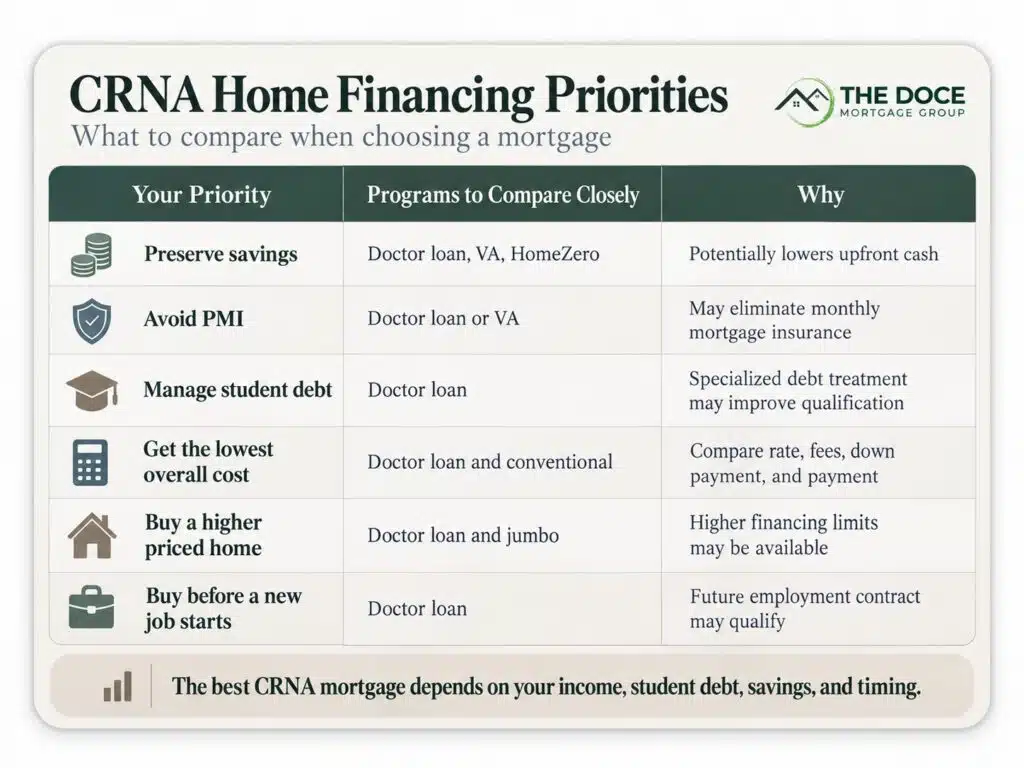
When your financial documents are submitted, understanding the mortgage underwriting process can also help prevent surprises. With a CRNA file, we pay particular attention to how compensation is structured, student debt is documented, and any future employment terms fit the selected program.
People Also Ask
Why can Hometown Heroes be better than a 3% down conventional mortgage for a CRNA?
An eligible CRNA can receive 5% assistance, which can cover the minimum down payment on many conventional purchases and potentially contribute toward closing costs. The second mortgage has no monthly payment, and current program documents also provide Florida documentary stamp and intangible tax exemptions on the first and second notes and mortgages.
Should an eligible CRNA use Hometown Heroes even if they have savings?
It deserves serious comparison because preserving cash for emergency reserves, moving, repairs, or other goals can be valuable. You should still compare first mortgage pricing and long-term cost.
What credit score does a CRNA need for Hometown Heroes?
The current program generally requires at least a 640 FICO for automated qualification, with additional income, DTI, employment, and program rules.
How We Help CRNAs Choose the Right Mortgage
CRNAs have more financing choices than many buyers realize. For an eligible Florida CRNA, our comparison should include Hometown Heroes alongside doctor financing, conventional, FHA, VA, jumbo, and HomeZero.
If you qualify for HTH, we’ll show you how the 5% assistance changes cash to close and whether the first mortgage pricing still makes it the strongest overall option.
You can get a free mortgage quote and see our customer reviews. The Doce Mortgage Group recently received the prestigious WalletHub Award and was recognized as one of the best mortgage brokers in several cities throughout Florida.
Whether you’re established, relocating, or buying your first home, we’ll compare CRNA Mortgage Loans with every realistic option. When you’re ready, you can Get Started Now, or connect with a loan officer live at 305-661-3434.