
Quick Answer
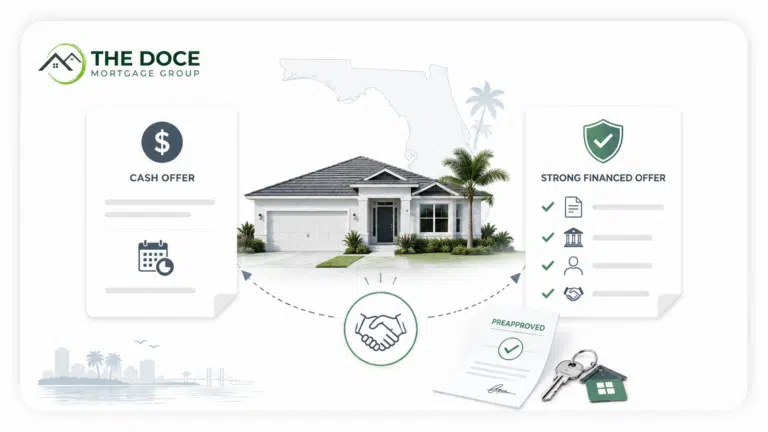
Yes. A foreign buyer can qualify for a Florida mortgage without a U.S. credit score by using a foreign national mortgage that evaluates international income, assets, banking history, and other financial documentation
Florida remains one of the most active U.S. markets for international homebuyers, so having no American credit history doesn’t automatically mean you need to pay cash. Specialized mortgage programs can evaluate the financial history you’ve already established in your home country.
A Personal Story
I’ve worked with international buyers from more than 40 countries, and I see the same concern repeatedly. A buyer may have excellent income, substantial savings, and years of responsible financial history overseas, yet assume that having no U.S. credit score makes financing impossible. Canadian snowbirds looking at Naples condos and international investors purchasing in South Florida often start with that exact question.
My advice is to have us evaluate your foreign financial profile before assuming you need an all cash purchase. The documentation looks different from a traditional U.S. mortgage, but different doesn’t necessarily mean more difficult. Understanding how foreign nationals can buy a Florida home with financing early can prevent unnecessary surprises later.
Can Foreign Buyers Get a Florida Mortgage Without U.S. Credit?
Yes, qualified foreign nationals can obtain a Florida mortgage without having a U.S. credit score.
Our Florida foreign national mortgage programs are specifically designed for international buyers who may not have a Social Security number, Green Card, or established U.S. credit file. Depending on the program, qualification can instead rely on your passport, immigration or visitor documentation, foreign income, bank statements, assets, and financial references.
This is different from simply overlooking credit. The goal is still to establish that you’re financially capable of handling the mortgage. We just use documentation that makes sense for someone whose financial life exists primarily outside the United States.
The opportunity is especially relevant in Florida. The National Association of REALTORS® 2026 international transactions report found that Florida attracted 20% of all foreign buyers purchasing U.S. existing homes from April 2025 through March 2026, more than any other state.
What Replaces a U.S. Credit Score?
Foreign financial documentation can replace a traditional U.S. credit score in programs designed for international buyers.
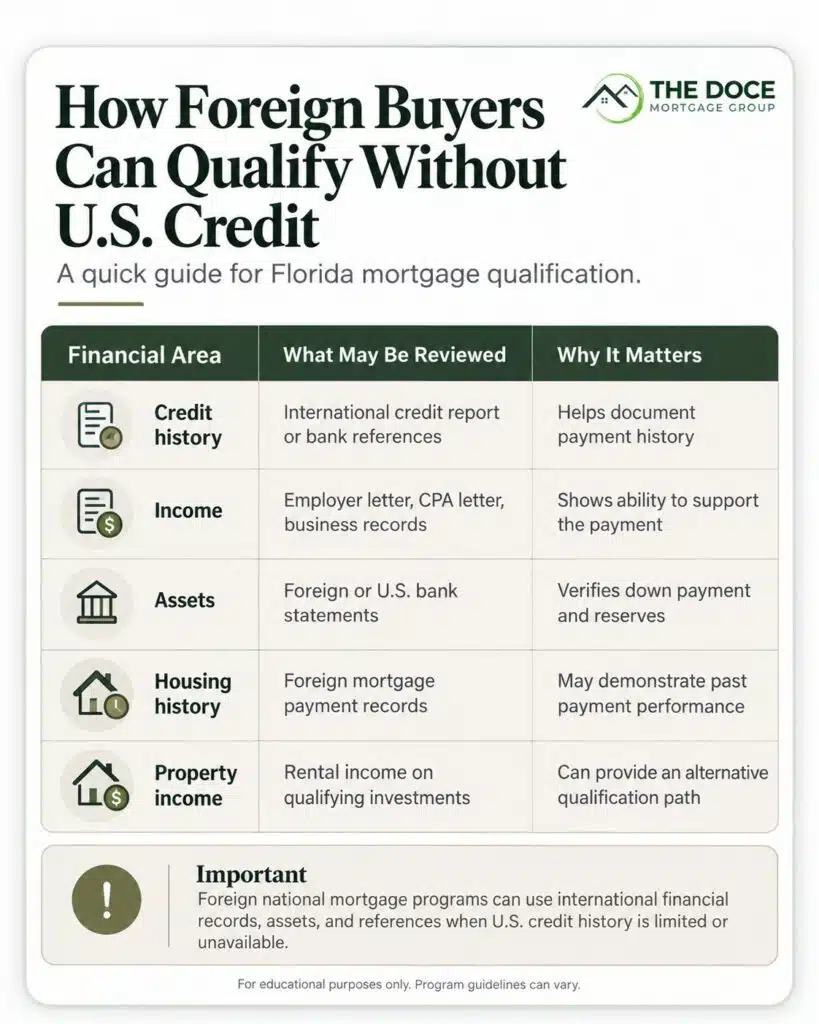
Depending on your situation, the financial review may use an international credit report, foreign bank reference letters, mortgage payment history from your home country, bank statements, income verification, or a combination of those items.
Some programs don’t require an international credit report at all. Instead, stronger cash reserves, documented income, banking relationships, and a larger down payment may provide the financial evidence needed.
I tell foreign buyers not to worry about creating a U.S. credit history at the last minute just because they’re buying property here. If a program doesn’t require U.S. credit, the more important task is organizing the foreign records that accurately demonstrate your finances.
What Documents Do Foreign Buyers Need?
Foreign buyers generally need identification, proof of funds, and documentation showing their income or another acceptable method of qualification.
For our foreign national programs, that can include a valid foreign passport, applicable visitor visa or visa waiver documentation, approximately 2 to 3 months of bank statements, and income documentation from your home country. Depending on the program, an employer letter, accountant letter, business documents, or property rental income may be used.
Documents written in another language may need translation, and international bank records need to clearly show account ownership and balances. We can help coordinate the documentation so you know what will be needed before you’re deep into a purchase.
Down payment is also important. Foreign national programs commonly require about 25% to 30% down, depending on the property, financial documentation, available reserves, and program structure. Our Mortgage Payment Calculator lets you enter different purchase prices and down payments while also accounting for Florida property taxes, insurance, and HOA expenses.
If you already know the Florida property or general price range you’re considering, you can also start through our application portal so we can evaluate the documents you already have rather than guessing what your lack of U.S. credit means.
How Much Down Payment Is Usually Required?
Foreign buyers should generally expect a larger down payment than buyers using traditional U.S. mortgage programs.
Our current Florida foreign national mortgage programs generally require about 25% to 30% down. A 25% down payment may be possible with stronger reserves and well documented income, while 30% is a more common structure.
For example, on a $600,000 Florida property:
Typical Foreign Buyer Down Payment Examples
| Purchase Price | 25% Down | 30% Down | Mortgage Amount at 30% Down |
|---|---|---|---|
| $400,000 | $100,000 | $120,000 | $280,000 |
| $600,000 | $150,000 | $180,000 | $420,000 |
| $800,000 | $200,000 | $240,000 | $560,000 |
| $1,000,000 | $250,000 | $300,000 | $700,000 |
Down payment isn’t the only cash requirement. You may also need documented reserves after closing. Current Doce foreign national programs commonly call for several months of housing payments to remain available after the purchase.
I always tell international buyers to avoid moving all of their available cash into the transaction just because they can. Maintaining adequate reserves can strengthen the application and also gives you a financial cushion for insurance, taxes, repairs, HOA costs, and other expenses after you own the property.
Can Foreign Income Be Used to Qualify?
Yes, income earned outside the United States can often be used to qualify for a foreign national mortgage in Florida.
The exact documentation depends on how you earn your income. An employee may be able to provide an employer verification letter along with bank statements. A business owner may need a CPA or accountant letter, business records, or other documentation that supports income and ownership.
Foreign bank statements can also help confirm that the income is actually being received. Currency conversion may be required so the income and assets can be evaluated in U.S. dollars.
This is one area where preparation matters. A document that makes perfect sense in your home country’s banking or accounting system may not immediately explain the same thing to a U.S. mortgage underwriter. Clear translations, consistent account names, and organized records can make the process much smoother.
I’ve found that the strongest international applications aren’t necessarily the ones with the most paperwork. They’re the ones where the documents tell a clear financial story.
A lack of U.S. credit remains one of the most common issues international buyers encounter, which is why understanding how foreign national mortgage challenges can be addressed before making an offer can be so useful.
What If You’re Buying a Florida Investment Property?
Foreign buyers purchasing an investment property may have another qualification option based primarily on the property’s rental income.
Our Florida DSCR mortgage programs evaluate whether qualifying rental income can support the property’s housing payment. This can reduce the importance of documenting your personal employment income.
That can be particularly useful for an international investor purchasing a Miami condo, Orlando vacation rental, Tampa property, or another income-producing Florida home.
Foreign Buyer Qualification Paths
| Purchase Situation | Primary Qualification Focus | Potential Fit |
|---|---|---|
| Second home | Foreign income, assets, reserves | Foreign national mortgage |
| Investment property | Foreign income and assets | Foreign national mortgage |
| Income-producing investment | Property rental income | DSCR financing |
| Limited U.S. credit history | International references or other documentation | Foreign national mortgage |
| Strong assets but complex income | Assets, reserves, overall financial profile | Alternative documentation program |
Florida’s international demand remains highly concentrated in several markets. According to Florida Realtors’ June 2026 international buyer data, Miami accounted for 10.3% of all U.S. international online home-shopping activity during the first quarter of 2026. Orlando captured 3% and Tampa 2.8%. That continuing demand helps explain why Florida has such an established financing market for overseas buyers.
If you’re evaluating a second home or investment property and want actual numbers based on your country, down payment, property, and documentation, you can request our free mortgage quote and we’ll compare the programs that fit your situation.
Pros and Cons of a Foreign National Mortgage
A foreign national mortgage can make Florida property ownership possible without requiring years of U.S. credit history, but the tradeoffs should be understood before you choose a program.
Pros include:
- No established U.S. credit score is required
- A Social Security number is not be required
- Foreign income and assets can potentially be used
- Second homes and investment properties can qualify
- International bank references may help establish financial history
- Financing allows you to preserve more cash for investments or reserves
Potential drawbacks include:
- Down payments are often larger
- Reserve requirements may be higher
- Interest rates can differ from standard U.S. mortgage programs
- Foreign documents may require translation
- International transfers need a clear paper trail
- Some property types can have additional requirements
I’ve worked with buyers who could have purchased entirely with cash but preferred financing because they didn’t want to move a large portion of their wealth out of their home country. For another buyer, paying more cash and reducing the mortgage produced a better overall structure. There isn’t one correct approach for every foreign buyer.
Myths Vs Facts
Myth: You can’t finance a Florida property without a U.S. credit score.
Fact: Foreign national programs can qualify eligible buyers using international financial records and other documentation.
Myth: Foreign buyers must purchase Florida real estate with cash.
Fact: Financing is available for qualified international buyers, including buyers without established U.S. credit.
Myth: You need a Green Card to get a Florida mortgage.
Fact: Foreign national programs are specifically designed for buyers who may not have permanent U.S. residency.
Myth: All foreign buyers qualify the same way.
Fact: Country of residence, income type, assets, property use, down payment, and documentation can all affect the available mortgage structure.
Myth: Personal income is always required for a foreign investor.
Fact: Certain investment property programs can qualify primarily using the property’s rental income instead.
Common Mistakes
Foreign buyers can avoid many mortgage delays by organizing international financial records before making an offer.
One of the biggest mistakes is assuming that having no U.S. credit is the same as having bad U.S. credit. It isn’t. The Consumer Financial Protection Bureau explains that a U.S. credit score is calculated from information contained in a U.S. credit report. If you simply haven’t established that history here, a foreign national program can use other ways to evaluate your finances.
Other common mistakes include:
- Moving large sums between countries without maintaining clear transfer records
- Making an offer before confirming how your foreign income will be documented
- Assuming every foreign bank statement format will be accepted without clarification
- Converting all available cash into the down payment and leaving insufficient reserves
- Forgetting to budget for Florida insurance, taxes, condo fees, and flood coverage
- Assuming every condo or investment property qualifies for the same financing
- Waiting until the final weeks before closing to obtain translated documents
Immigration status can also change the available options. A permanent resident, temporary visa holder, and true foreign national aren’t necessarily evaluated under the same rules. Understanding mortgage options for non-U.S. citizens in Florida before you shop can help identify the correct path from the beginning.
I’ve learned that international transactions become much easier when we solve the documentation questions before there’s a closing deadline. A buyer who’s organized early can often move through the process far more smoothly than someone trying to collect overseas records after signing a contract.
Foreign Buyer Closing Readiness Chart
| Before Making an Offer | What to Prepare | Why It Matters |
|---|---|---|
| Verify identity | Passport and applicable visa documents | Establishes foreign national eligibility |
| Organize income records | Employer, accountant, or business documentation | Supports foreign income qualification |
| Document assets | Recent foreign and U.S. bank statements | Confirms down payment and reserves |
| Review credit alternatives | International references or other acceptable records | Replaces missing U.S. credit history |
| Evaluate the property | Property type, HOA, rental use, insurance | Confirms the property fits the program |
| Plan international transfers | Clear account ownership and transfer records | Creates an understandable funds trail |
Key Facts
- Foreign buyers can qualify without an established U.S. credit score
- A Social Security number isn’t required for foreign national programs
- Foreign income and overseas assets may be used
- Down payments commonly start around 25% to 30%
- Reserve requirements can add to the cash needed after closing
- Bank references may help document financial history
- Investment properties may qualify through rental income
- Foreign documents may require certified or acceptable translations
- Program requirements can vary based on property, and financial profile
People Also Ask
Can I qualify using only foreign bank statements?
Possibly. Some programs use foreign bank statements along with other documentation to establish assets, reserves, income, or financial history. The exact requirements depend on how you’re qualifying.
Can foreign buyers get mortgages for short term rental properties?
Yes. Investment properties qualify through foreign national programs or, in some cases, DSCR financing based primarily on qualifying rental income.
Is it better for a foreign buyer to pay cash or get a mortgage?
It depends on your goals. Paying cash eliminates mortgage payments, while financing may allow you to keep more capital invested or available for other purposes. We can show you the financing numbers so you can compare both approaches.
Finding the Right Florida Mortgage as a Foreign Buyer
We’re also proud that The Doce Mortgage Group recently received the prestigious WalletHub Award for being one of the best mortgage brokers in several cities throughout Florida. That recognition has also been highlighted across our recent Florida mortgage resources.
Our customer reviews reflect more than 1,500 5-star reviews across multiple platforms. (The Doce Mortgage Group) For an international buyer, that experience matters because cross-border documentation, foreign income, and property requirements can add details that aren’t part of an ordinary Florida home purchase.
If you’re considering a Florida home, condo, second home, or investment property and don’t have established U.S. credit, we’ll help you understand what you can qualify for using the financial history you already have, you can Get Started Now, or connect with a loan officer live at 305-661-3434.