
Quick Answer
You may be able to return to the housing market by correcting credit report errors, rebuilding recent payment history, reducing debt, meeting any required waiting period, and choosing a mortgage program that fits your current finances.

Bankruptcy, foreclosure, collections, missed payments, or high credit card balances can make homeownership feel out of reach. The right recovery plan depends on what happened, when it happened, and what your finances look like today.
Alex’s Professional Insights
I worked with a buyer who believed a past bankruptcy meant several more years of renting. After reviewing the discharge date, current housing payments, income, debts, and savings, I found a possible mortgage path the buyer didn’t know existed. The credit event mattered, but it wasn’t the only part of the story.
My advice is to begin with a mortgage-focused review before making random changes. Paying an account, closing an old card, or opening new credit can affect the file differently than expected. A clear plan helps you spend time and money on actions that actually improve your position.
What Counts As Credit Difficulties?
Credit difficulties include more than a low credit score.
They may involve:
- Late payments
- Collections or charge-offs
- High revolving balances
- Chapter 7 or Chapter 13 bankruptcy
- Foreclosure
- Short sale
- Deed-in-lieu of foreclosure
- Mortgage modification
- Limited credit history
- Identity theft or reporting errors
An isolated late payment usually receives a different review than a major housing-related credit event. Timing also matters. A problem from several years ago followed by clean payment history may be viewed differently from a recent pattern of missed obligations.
The first step is identifying exactly what appears on all 3 credit reports. Confirm balances, dates, account ownership, payment history, and whether closed or settled accounts are reported accurately. Dispute genuine errors, but don’t dispute accurate information simply because it is negative.
Can You Still Buy A Home With Damaged Credit?
Yes, buying a house after credit difficulties may be possible when your current financial picture supports the payment.
Credit scores matter, but they aren’t the only factor considered. A complete review may also examine:
- Stable income
- Employment history
- Monthly debt payments
- Down payment funds
- Cash reserves
- Recent rent or mortgage payments
- The cause of the past hardship
- Evidence that the hardship has ended
Credit challenges are common. In the Federal Reserve’s May 2026 report, 33% of adults applied for some type of credit during 2025, and 1 in 3 applicants were denied or approved for less than they requested. That survey covered several forms of credit, not only mortgages, but it shows that many consumers face approval obstacles.
FHA financing may offer more flexibility than some conventional options. The exact result depends on the complete application, but understanding the minimum FHA credit score requirements in Florida can help you see why a lower score doesn’t automatically end the conversation.
Before focusing on a purchase price, estimate how your income and current debts affect affordability. You can test different debt, down payment, tax, insurance, and HOA scenarios using our Home Affordability Calculator.
How Long Must You Wait After Bankruptcy Or Foreclosure?
The required waiting period depends on the credit event, mortgage program, completion date, and whether qualifying extenuating circumstances apply.
| Credit Event | Traditional Program Consideration | Possible Earlier Path |
|---|---|---|
| Chapter 7 bankruptcy | FHA generally reviews after 2 years, conventional often after 4 | Recent Credit Event financing |
| Chapter 13 bankruptcy | Payment history, discharge, dismissal, and court status matter | Case-specific review |
| Foreclosure | Traditional waiting periods are often longer | Specialty financing |
| Short sale | Requirements vary by program and event date | Earlier options may exist |
| Collections | Type, balance, age, and payment plan matter | Resolution may not require waiting |
Fannie Mae eligibility guidance generally lists a 4-year waiting period after Chapter 7 or Chapter 11 bankruptcy, reduced to 2 years when documented extenuating circumstances apply. HUD’s FHA bankruptcy guidance generally requires 2 years after a Chapter 7 discharge for standard FHA consideration, although the complete application must still qualify.
The date that starts the clock is critical. It may be the bankruptcy discharge, dismissal, foreclosure completion, or property transfer date, not the day financial trouble began. Keep every discharge order, deed, closing statement, and court document.
Traditional waiting periods don’t describe every possible option. The Doce Mortgage Group’s Recent Credit Event Loan may offer a route after bankruptcy, foreclosure, deed-in-lieu, or short sale when current income, savings, and post-event stability support the application.
Your First 90-Day Reentry Plan
The first 90 days should focus on identifying problems, correcting errors, and building stable recent payment history.
A 90-day plan won’t erase a bankruptcy, foreclosure, or long pattern of missed payments. Its purpose is to replace guesswork with a clear sequence.
90-Day Housing Market Reentry Timeline
Days 1–15 → Pull all 3 credit reports and list each negative item
Days 16–30 → Dispute genuine errors and collect supporting records
Days 31–60 → Lower revolving balances and stabilize spending
Days 61–90 → Maintain perfect payments and review eligibility
During the first 15 days, compare account numbers, balances, dates, payment histories, and account ownership. Save bankruptcy papers, foreclosure records, settlement letters, and proof of paid accounts.
From days 16 through 30, dispute only inaccurate or incomplete information. Broad disputes against accurate accounts can delay a mortgage review.
During days 31 through 60, focus on balances affecting monthly payments and revolving utilization. The final 30 days are about consistency. Pay every account before the due date, avoid new financing, and keep bank activity easy to document.
Which Credit Actions Usually Help Most?
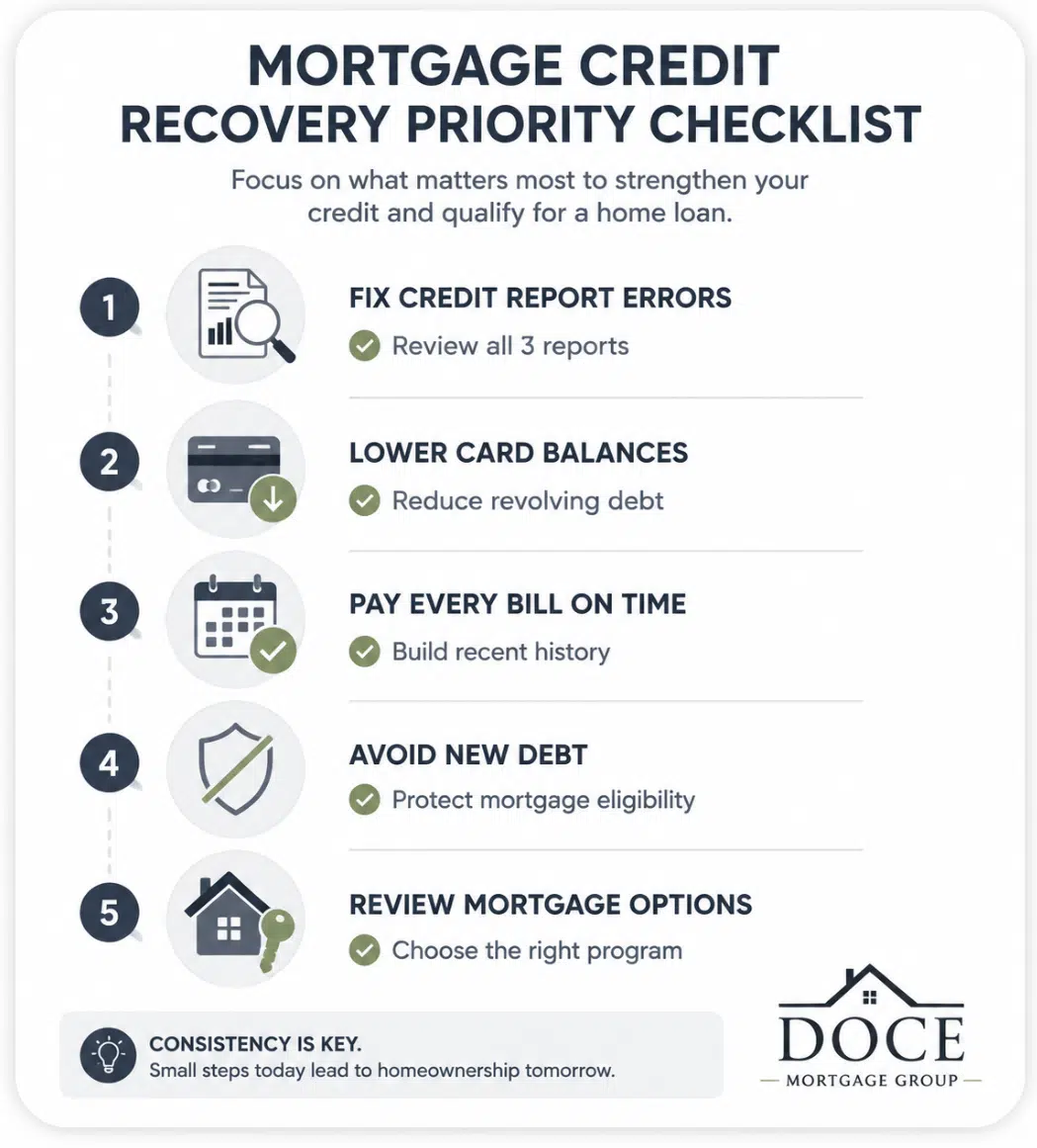
Correcting report errors, making every payment on time, and reducing revolving balances are usually the strongest starting actions.
| Credit Action | Potential Value | Main Caution |
|---|---|---|
| Correct inaccurate reporting | High | Dispute only genuine errors |
| Reduce card balances | High | Don’t create new balances |
| Build on-time history | High | Improvement takes consistency |
| Open new accounts | Limited | Creates inquiries and new debt |
| Close established accounts | Often limited | May affect utilization |
| Pay collections immediately | Case-specific | Review the impact first |
Don’t assume every collection should be paid before applying. The account type, age, balance, reporting status, and mortgage program can all matter. Paying an old account may not remove it, while using cash to settle it may reduce reserves.
HUD’s January 2026 FHA report states that FHA policy permits scores of 580 or higher, while scores as low as 500 may be considered when the equity position is at least 10%. Approval still depends on income, debt, recent history, and the complete application.
I often tell buyers not to chase a score without understanding what is holding it down. Lowering 2 nearly maxed-out cards may help more than opening a new account or paying a small collection with no required monthly payment.
How Do Debt And Monthly Payments Affect Eligibility?
Monthly debt can limit buying power even after your credit score improves.
Debt-to-income ratio compares recurring monthly obligations with gross monthly income. For example, $1,800 in monthly debt divided by $6,000 in gross income equals 30% before adding the proposed housing payment.
Common debts include credit card minimums, auto payments, student loans, personal loans, support obligations, and payments on other properties.
The balance alone doesn’t determine the effect. A small account with a large required payment may reduce buying power more than a larger account with a low payment. Our explanation of calculating your debt-to-income ratio shows how recurring obligations and the proposed housing cost work together.
Before paying anything off, compare how much cash the payoff requires with how much monthly debt it removes. Protecting emergency savings can be as important as reducing obligations.
Which Mortgage Programs May Work After Credit Problems?
FHA, VA, conventional, USDA, Recent Credit Event, and Non-QM programs may evaluate past credit problems differently.
| Program | Potential Strength | Important Consideration |
|---|---|---|
| FHA | More flexible credit treatment | Mortgage insurance applies |
| Conventional | Broad long-term options | Waiting periods may apply |
| VA | Flexible for eligible buyers | Service eligibility required |
| USDA | Potential 0% down | Income and location rules |
| Recent Credit Event | May allow earlier return | Different pricing and down payment |
| Non-QM | Individual file review | Costs may be higher |
The right program depends on the event type, date, payment history since the event, income, debt, down payment, and reserves. A lower minimum score doesn’t automatically make a program the best choice.
When you’re ready for a review based on your actual dates and finances, you can securely begin through our application portal.
What Documents Should You Prepare?
Clear records can turn a complicated credit history into an understandable timeline.
Prepare bankruptcy discharge documents, foreclosure records, short-sale papers, Chapter 13 payment records, settlement letters, rental history, pay stubs, tax documents, and bank statements.
Keep hardship explanations short and factual. Explain what happened, when it ended, and why the same problem is unlikely to continue. A clear 1-page explanation is usually more useful than an emotional account that doesn’t connect the event to your current stability.
Pros And Cons Of Buying Before Credit Fully Recovers
Buying before your credit fully recovers can make sense when the available mortgage program creates a manageable payment and leaves you financially stable.
| Potential Advantages | Potential Disadvantages |
|---|---|
| Return to homeownership sooner | Higher rate or fees may apply |
| Begin building equity earlier | Larger down payment may be required |
| Avoid more years of rent | Fewer mortgage choices may be available |
| Use recent-event financing | Refinancing later may be needed |
Waiting may improve your score, expand program choices, or reduce your monthly cost. Buying sooner may work when your income is stable, recent payments are clean, and the payment fits comfortably.
Cash reserves matter too. The Federal Reserve reported that 55% of adults had enough emergency savings to cover 3 months of expenses during 2025. Protecting savings after a credit setback can be as important as qualifying for the home.
Myths Vs Facts
Myth: Bankruptcy prevents homeownership for 7 years
Fact: Mortgage waiting periods don’t always match credit-report timelines
Myth: Paying every collection immediately guarantees approval
Fact: The effect depends on the account, available cash, and mortgage program
Myth: A higher credit score guarantees approval
Fact: Income, debt, assets, employment, and recent payment history also matter
Myth: FHA is the only option after credit trouble
Fact: Conventional, VA, USDA, Recent Credit Event, and Non-QM options may also apply
Myth: Checking your own credit lowers your score
Fact: Reviewing your own report is generally a soft inquiry
Common Mistakes
Avoid actions that create new problems while rebuilding.
- Waiting without a plan
- Disputing accurate negative accounts
- Paying collections without guidance
- Opening several new accounts
- Running card balances back up
- Co-signing new debt
- Financing a vehicle before applying
- Using all savings to eliminate debt
- Hiding a past credit event
I have seen buyers delay themselves by following generic advice that didn’t fit their mortgage goal. The right move depends on the report, possible program, and cash you need to protect.
Building a good credit score requires steady habits rather than a quick fix. Make every payment on time, control revolving balances, and avoid unnecessary obligations.
Key Facts
- A past credit event doesn’t create a lifetime ban
- Waiting periods vary by event and program
- Recent payment behavior matters
- Genuine reporting errors should be corrected
- Lower card balances may strengthen the file
- Monthly debt can matter as much as score
- Specialty programs may allow earlier purchasing
- The final payment must remain sustainable
How Can The Doce Mortgage Group Help You Return To Homeownership?
We help buyers understand their options after bankruptcy, foreclosure, collections, missed payments, and other hardships. With more than 38 years of experience, our team compares FHA, VA, conventional, Recent Credit Event, and Non-QM options using your actual dates and current finances.
We can also help you decide whether buying now makes sense or whether a focused credit, debt, and savings plan could produce a better result. Our customer reviews reflect the guidance and communication we provide in complicated situations.
The Doce Mortgage Group recently received the prestigious WalletHub Award for being recognized as one of the best mortgage brokers in several cities throughout Florida. You can get a free quote to begin reviewing your options without assumptions about eligibility.
When you’re ready to move forward, you can Get Started Now, or connect with a loan officer live at 305-661-3434.