
Quick Answer
Choose a Florida neighborhood by comparing your total housing budget with the area’s home prices, insurance, taxes, HOA costs, flood exposure, commute, property types, and everyday amenities. Then visit your finalists at different times of day before deciding.

Finding the right Florida neighborhood to buy a home is about much more than choosing an attractive street or being close to the beach. Florida can change quickly from one community to the next. A neighborhood 10 miles away may offer different home prices, insurance costs, flood exposure, HOA fees, commute times, and property types. Your goal is to find the location that fits both the life you want and the payment you can comfortably carry.
That balance matters in the current market. According to the latest August 2026 Florida housing data, the statewide median sale price for an existing single family home reached $415,000, while single family inventory fell 13% from a year earlier. Local conditions can still vary widely by community and price range. (Florida Realtors)
A Personal Story
I recently worked with a Florida buyer who had done a great job saving for a down payment and felt ready to start shopping. The problem was that the buyer had focused mostly on the purchase price. Once we added realistic insurance, property taxes, and the monthly housing payment, the original target would have made the budget much tighter than expected. (The Doce Mortgage Group)
That experience is why I tell buyers to establish the payment first and the neighborhood second. A slightly less expensive area may give you a much more comfortable financial life, while another neighborhood may justify a higher cost because it substantially improves your commute or fits your priorities better.
How Do You Choose the Right Florida Neighborhood to Buy a Home?
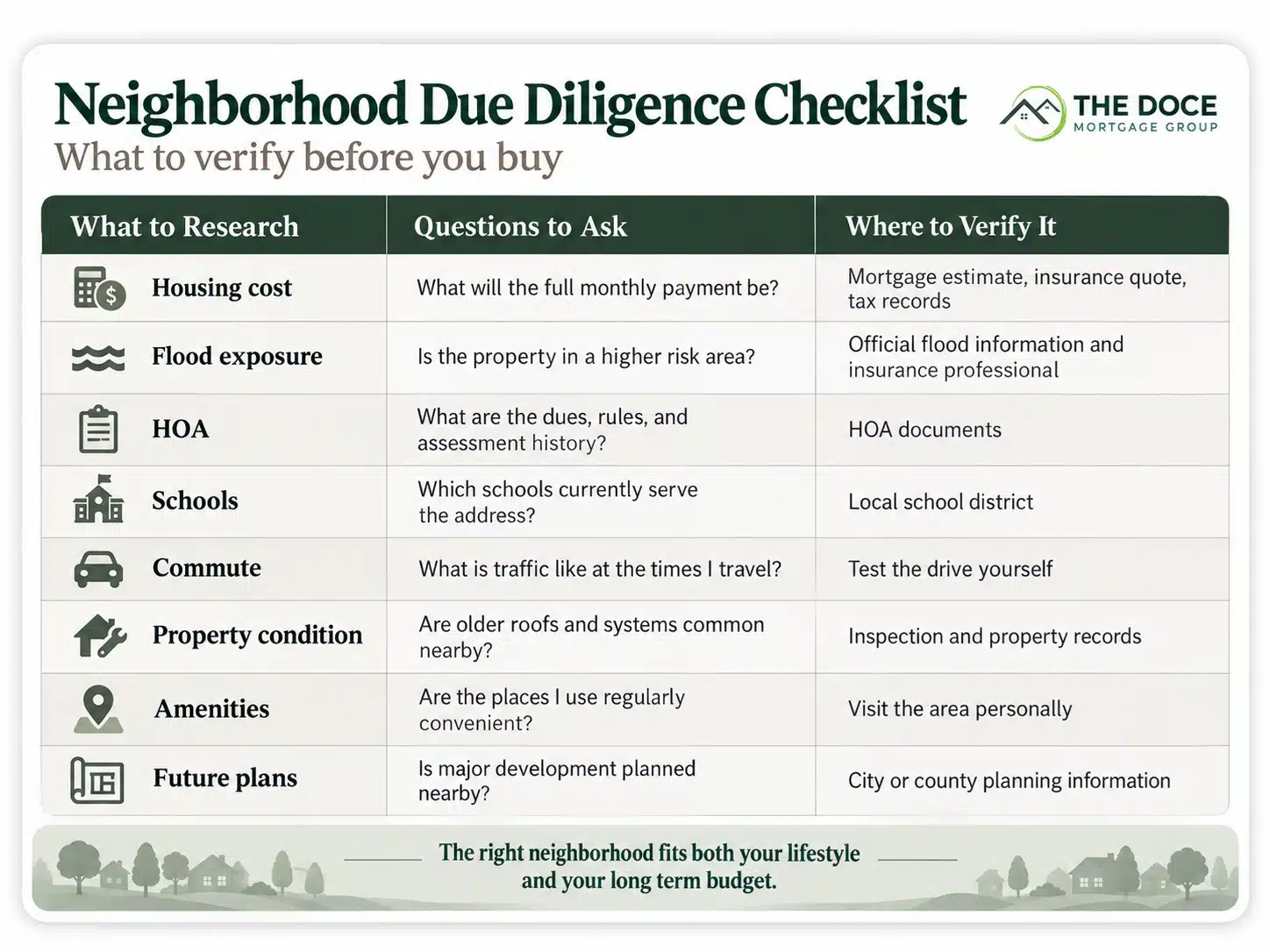
Start by deciding which 3 or 4 neighborhood characteristics matter most to you, then compare communities using the same criteria.
The Doce Mortgage Group’s existing guidance on choosing the right neighborhood recommends looking at factors such as walkability, commute time, school district boundaries, privacy, noise, and access to shopping, restaurants, parks, and other amenities. It also emphasizes thinking about both your current needs and what you may need several years from now. (The Doce Mortgage Group)
I’d add several Florida specific questions:
- What will homeowners insurance realistically cost for this property?
- Is the home in or near a higher risk flood area?
- Does the community have HOA or condo fees?
- Is the housing stock mostly newer construction, older homes, condos, or townhomes?
- How long will your commute actually take during rush hour?
- Are the property taxes consistent with your budget after the home changes ownership?
Don’t rely entirely on online descriptions. Drive through a neighborhood on a weekday morning, during evening traffic, and on a weekend. You’ll learn much more about traffic patterns, noise, parking, and daily activity than you will from listing photos.
Should You Choose the Neighborhood or the House First?
Choose the general neighborhood and budget first, then search for the best house within those boundaries.
It’s easy to fall in love with a kitchen, pool, or oversized backyard. The problem is that most features inside a house can eventually be changed. You can’t move the home closer to work, remove an HOA, change its flood exposure, or relocate the neighborhood.
Price also needs to be viewed as a monthly number rather than just a listing price. Two homes priced at $450,000 can have very different carrying costs if one has a $450 monthly HOA, higher property insurance, or additional flood coverage.
Before narrowing your search, you can run different neighborhood scenarios through our Home Affordability Calculator. It lets you account for income, debts, down payment, property taxes, homeowners insurance, PMI, and HOA dues instead of comparing homes by price alone. (The Doce Mortgage Group)
Florida Neighborhood Fit at a Glance
| Community Style | Potential Advantages | Costs or Tradeoffs to Research |
|---|---|---|
| Coastal community | Beach access, waterfront lifestyle, recreation | Flood exposure, insurance, higher property prices |
| Urban neighborhood | Dining, jobs, entertainment, shorter trips | Parking, traffic, condos, HOA fees |
| Established suburb | More space, parks, varied home choices | Longer commute, older roofs or systems |
| Master planned community | Amenities, newer homes, organized common areas | HOA fees and community restrictions |
| Inland community | Often more home for the budget | Longer drive to coastal jobs and amenities |
| Rural or semi rural area | Larger lots, privacy, lower density | Commute, wells, septic systems, fewer nearby services |
How Much Does Location Change the Real Cost of a Florida Home?
Location can change your total monthly housing cost by hundreds of dollars even when 2 homes have the same purchase price.
That’s why I don’t like comparing Florida neighborhoods by listing price alone. Insurance, property taxes, HOA dues, flood coverage, commute costs, and maintenance can all change from one area to another.
A $500,000 inland home with modest insurance and no HOA may fit your budget better than a $450,000 coastal property with higher insurance, flood coverage, and a $350 monthly HOA.
Florida is also continuing to attract new residents. The latest U.S. Census Bureau QuickFacts for Florida estimates the state had 23,462,518 residents as of July 1, 2025, an 8.9% increase from the 2020 estimates base. Population growth can affect housing demand differently across metros, suburbs, and smaller communities.
How Do Flood Risk, Insurance, and Property Taxes Affect Neighborhood Choice?
These costs can materially change whether a neighborhood fits your budget, even when the home price looks affordable.
Coastal exposure deserves special attention. A property near the ocean, Intracoastal Waterway, river, canal, or low lying area may carry different insurance and flood considerations than an inland property.
When comparing neighborhoods, check:
- Flood zone and elevation
- Homeowners insurance estimates
- Whether separate flood insurance may be needed
- Roof age and wind mitigation features
- Property tax estimates after purchase
- HOA or condo assessments
- Special taxing districts when applicable
Property taxes are especially easy to underestimate. The current owner’s bill may reflect exemptions or an assessed value that changes after the property transfers. Our explanation of how Florida property taxes affect mortgage payments explains why buyers should estimate the future tax bill rather than simply copying the seller’s current payment.
I’ve seen buyers choose between 2 homes with nearly identical prices and discover that the difference in taxes, insurance, and HOA costs changed the monthly payment by several hundred dollars. That’s why I want those numbers before the buyer gets emotionally attached.
Neighborhood Cost Factors
| Cost Factor | Why It Can Vary by Neighborhood | What to Check Before Offering |
|---|---|---|
| Homeowners insurance | Coastal exposure, roof age, construction, storm risk | Real property specific quote |
| Flood insurance | Flood zone and elevation differ by location | Flood map and coverage estimate |
| Property taxes | County, municipality, exemptions, assessed value | Estimated post purchase taxes |
| HOA dues | Amenities and community structure vary widely | Current dues and recent increases |
| Condo fees | Building insurance, reserves, amenities, maintenance | Budget, reserves, assessments |
| Transportation | Distance from work and major roads | Rush hour travel time and tolls |
How Should You Evaluate Schools, Commutes, and Amenities?
Evaluate them based on your real routine rather than what looks attractive on a map.
If schools matter to your household, verify the current attendance boundaries directly with the school district. Don’t assume a listing description guarantees assignment to a specific school.
Do the same with your commute. A 12 mile drive in South Florida, Tampa, or Orlando may take much longer than you expect during peak traffic.
Think about the places you’ll use every week:
- Grocery stores
- Hospitals and medical offices
- Work
- Schools or childcare
- Parks
- Restaurants
- Airports
- Beaches
- Major highways
- Public transportation
You don’t need every amenity within 5 minutes. You do need to understand what daily life will actually feel like.
Comparing Coastal, Urban, Suburban, and Inland Communities
Different Florida neighborhood types tend to offer different combinations of price, convenience, space, and ownership costs.
Florida Neighborhood Decision Chart
| If Your Priority Is… | Areas Worth Comparing | Main Tradeoff to Research |
|---|---|---|
| Beach or boating access | Coastal and waterfront communities | Insurance and flood exposure |
| Walkability and nightlife | Urban neighborhoods | Parking, traffic, condo fees |
| Larger home and yard | Suburban communities | Longer commute |
| Newer construction and amenities | Master planned communities | HOA dues and restrictions |
| More home for the money | Inland communities | Distance from jobs and beaches |
| Privacy and acreage | Rural areas | Services, wells, septic, commute |
There isn’t one best Florida neighborhood. The right Florida neighborhood to buy a home is the one that matches your priorities without forcing you into a payment or lifestyle that becomes frustrating after closing.
How Can Your Mortgage Program Affect Where You Buy?
Your mortgage program can affect the types of properties and locations that make the most sense.
For example, qualified buyers using an FHA mortgage may be able to purchase with a relatively small down payment, while eligible veterans may consider VA financing with 0% down. Buyers looking outside major metropolitan areas may also find that certain rural properties qualify for USDA financing.
Our HomeZero Program can also reduce the upfront down payment requirement for qualifying buyers. That may let you keep more cash available for moving expenses, reserves, repairs, or furnishings.
Before you narrow your search to a handful of neighborhoods, you can also start our secure application so we can compare your financing options and establish a realistic price range.
Pros and Cons of Narrowing Your Search by Neighborhood
The biggest advantage is focus. Instead of chasing attractive listings all over Florida, you compare homes that already meet your location, commute, and budget needs.
The downside is that being too rigid can cause you to miss a nearby community that offers better value. I usually recommend choosing 2 or 3 preferred areas plus 1 alternative that meets most of your priorities.
Common Mistakes
One of the biggest mistakes is choosing a neighborhood after only visiting it once.
Other common mistakes include:
- Ignoring future property taxes
- Comparing insurance using statewide averages
- Overlooking flood exposure
- Failing to test the actual commute
- Assuming all nearby schools have the same boundaries
- Ignoring HOA rules and future assessments
- Stretching the budget just to enter a particular ZIP code
- Choosing a house you love in an area that doesn’t fit your everyday life
Myths Vs Facts
Choosing the right Florida neighborhood to buy a home gets easier when you separate measurable facts from assumptions.
| Myth: The most expensive neighborhood is always the best investment | Fact: Long term value also depends on demand, property condition, ownership costs, location, and local housing supply |
| Myth: You can judge a neighborhood from one visit | Fact: Traffic, noise, parking, and activity can change significantly by time and day |
| Myth: A lower priced home always costs less each month | Fact: Insurance, taxes, flood coverage, HOA dues, and maintenance can erase the price advantage |
| Myth: You should buy the biggest house your budget allows | Fact: A smaller home in a location that fits your lifestyle may provide better long term satisfaction |
| Myth: Online neighborhood rankings tell you where you should live | Fact: Your commute, budget, priorities, and daily routine should drive the decision |
One thing I’ve learned from working with buyers is that people rarely regret doing too much neighborhood research. They’re much more likely to regret ignoring a commute, HOA rule, insurance cost, or location issue because they loved the house.
Key Facts
- Compare neighborhoods using the same criteria so emotions don’t control the decision
- Get property specific insurance estimates before committing to a coastal or higher risk location
- Verify school boundaries directly because assignments can change
- Drive your actual commute during the hours you’ll normally travel
- Review HOA rules, dues, reserves, and assessments before purchasing
- Estimate future property taxes rather than relying only on the seller’s current bill
- Visit neighborhoods during the day, evening, weekday, and weekend
- Consider resale appeal even if you expect to own the home for many years
Neighborhood features also have measurable value to buyers. The 2026 National Association of REALTORS® Community and Transportation Preference Survey found that 89% of respondents considered sidewalks and places to walk important when deciding where to live, while 63% said they would pay more to live within easy walking distance of parks, shops, and restaurants.
How Should You Compare Your Final 3 Neighborhoods?
Compare your finalists side by side using both financial and lifestyle factors rather than choosing based on the house you like most.
Final Neighborhood Comparison
| Factor | Neighborhood A | Neighborhood B | Neighborhood C |
|---|---|---|---|
| Home prices | Rate 1 to 5 | Rate 1 to 5 | Rate 1 to 5 |
| Total monthly housing cost | Rate 1 to 5 | Rate 1 to 5 | Rate 1 to 5 |
| Commute | Rate 1 to 5 | Rate 1 to 5 | Rate 1 to 5 |
| Flood and insurance considerations | Rate 1 to 5 | Rate 1 to 5 | Rate 1 to 5 |
| Amenities | Rate 1 to 5 | Rate 1 to 5 | Rate 1 to 5 |
| Property types available | Rate 1 to 5 | Rate 1 to 5 | Rate 1 to 5 |
| HOA fit | Rate 1 to 5 | Rate 1 to 5 | Rate 1 to 5 |
| Overall lifestyle fit | Rate 1 to 5 | Rate 1 to 5 | Rate 1 to 5 |
I’d weight the categories that affect you every day more heavily. If you work from home, commute may barely matter. If you drive 5 days a week, adding 30 minutes each way can become a major quality of life issue.
Once you’ve identified an area that fits, understanding the overall steps to buying a house in Florida can help you move from neighborhood research to making a well prepared offer.
How We Help Florida Buyers Find a Home That Fits
Choosing the right neighborhood and choosing the right financing should happen together. A home that fits your lifestyle but pushes your payment too far can create stress, while a slightly different location may give you more room in the budget without sacrificing the things you care about most.
We can compare conventional, FHA, VA, jumbo, HomeZero, first time buyer, and other Florida mortgage options based on the neighborhoods and property types you’re considering. If you want us to run the numbers for your shortlist, you can get a free mortgage quote before you make an offer.
You can also see what Florida buyers have said about working with us through our customer reviews. The Doce Mortgage Group recently received the prestigious WalletHub Award and was recognized as one of the best mortgage brokers in several cities throughout Florida.
Our goal is to help you choose a home and neighborhood that make sense both today and several years from now. When you’re ready, you can Get Started Now, or connect with a loan officer live at 305-661-3434.