

Quick Answer
Applying for a new home loan is easier when you prepare before completing the application. Check your credit, build a realistic housing budget, get pre-approved, organize your documents, compare mortgage choices, and keep your finances stable until closing.
Applying for a new home loan can feel complicated because several decisions happen at once. Your credit, income, savings, debts, mortgage program, property, and timing all affect what you may qualify for.
A Personal Story from Alex
A buyer once contacted me after finding a home they loved, but they hadn’t completed preapproval. While we were gathering the necessary information, another buyer made a stronger offer with financing already prepared and secured the property.
That experience reinforced something I’ve seen many times. Preparation isn’t only about approval. It can affect how quickly you can act and how seriously a seller views your offer. In my experience, buyers feel more confident when we address credit questions, document income, and establish a realistic price range before they start shopping seriously.
1. Check Your Credit Before Someone Else Does
Start by reviewing your credit reports for inaccurate accounts, incorrect balances, or payments reported late by mistake. You should also know the balances on your credit cards, vehicle financing, student debt, and other monthly obligations.
Your credit can affect the mortgage programs available to you, the interest rate offered, and the cost of mortgage insurance. Improving your score may help, but high revolving balances or recent missed payments can still matter.
In my experience, buyers often wait until they apply to investigate their credit. Reviewing it earlier gives you time to correct errors and make thoughtful changes. Our guide to building a good credit score explains several factors worth reviewing before buying.
Avoid closing established accounts or opening new credit simply to change your score. A move that helps 1 buyer might create a problem for another.
2. Set a Budget Based on the Full Housing Payment
A realistic budget must include more than principal and interest.
Your complete housing expense may include:
- Principal and interest
- Property taxes
- Homeowners insurance
- Flood insurance when required
- Mortgage insurance
- HOA or condo fees
- Maintenance and repair savings
A payment might appear affordable until insurance, taxes, and association fees are added. This is why the purchase price alone doesn’t tell you whether a home fits your budget.
You can test income, debt, down payment, taxes, insurance, and HOA scenarios using our Home Affordability Calculator. Treat the result as a planning estimate, not a final approval amount.
I always encourage buyers to leave room for normal life. Qualifying for a certain payment doesn’t mean it will feel comfortable alongside groceries, transportation, childcare, savings, and repairs.
3. Get Preapproved Before Shopping Seriously
Preapproval helps establish a realistic price range before you make an offer.
During preapproval, your income, credit, assets, debts, and other information are reviewed to estimate the mortgage amount and programs that may fit. This is more useful than an informal estimate based only on self reported numbers.
A strong mortgage preapproval before shopping for a home can uncover issues while there’s still time to address them. If your income is complex, your down payment includes gift funds, or your credit recently changed, early review becomes even more valuable.
Preapproval isn’t a final guarantee. Your finances may need to be updated, and the property must still meet applicable requirements. However, it gives you a stronger starting point than shopping without verified numbers.
4. Organize Your Documents Before They’re Requested
Having documents ready can prevent small requests from turning into major delays.
| Financial Situation | Common Documents |
| Salaried employment | Pay stubs, W-2 forms, bank statements |
| Self employment | Personal and business tax records |
| Retirement income | Award letters and account statements |
| Gift funds | Gift letter and transfer documentation |
| Other income | Records showing amount and consistency |
Save complete statements rather than screenshots whenever possible. Don’t alter documents, cover account numbers, or submit only selected pages unless specifically instructed.
Unexplained deposits and undocumented transfers create confusion. Keep a clear record when moving funds between accounts, and avoid depositing large amounts of cash that can’t be documented.
5. Compare Mortgage Programs Before Choosing One
Different mortgage programs solve different problems. Conventional financing may fit buyers with strong credit and stable income. FHA financing may offer more flexibility. VA and USDA options may allow eligible buyers to purchase with little or no down payment. Assistance programs can reduce upfront costs, but eligibility, repayment terms, and property rules vary.
| Program | Potential Strength | Important Consideration |
| Conventional | Flexible terms and property choices | Credit and mortgage insurance affect cost |
| FHA | More flexible qualification standards | Upfront and annual mortgage insurance |
| VA | Eligible buyers may use $0 down | Military eligibility requirements |
| USDA | Eligible buyers may use $0 down | Income and property location limits |
| Assistance program | Can reduce upfront cash | Program rules and repayment terms vary |
The Doce Mortgage Group offers access to many Florida home loan programs, including conventional, FHA, VA, USDA, jumbo, and alternative documentation options. A Florida conventional mortgage can be a useful comparison point, but it isn’t automatically the right choice for every buyer.
In my experience, the best option is the one that fits your credit, income, savings, property, and long term plans, not the program with the most familiar name.
6. Plan for More Than the Down Payment
The down payment is only part of the cash you may need.
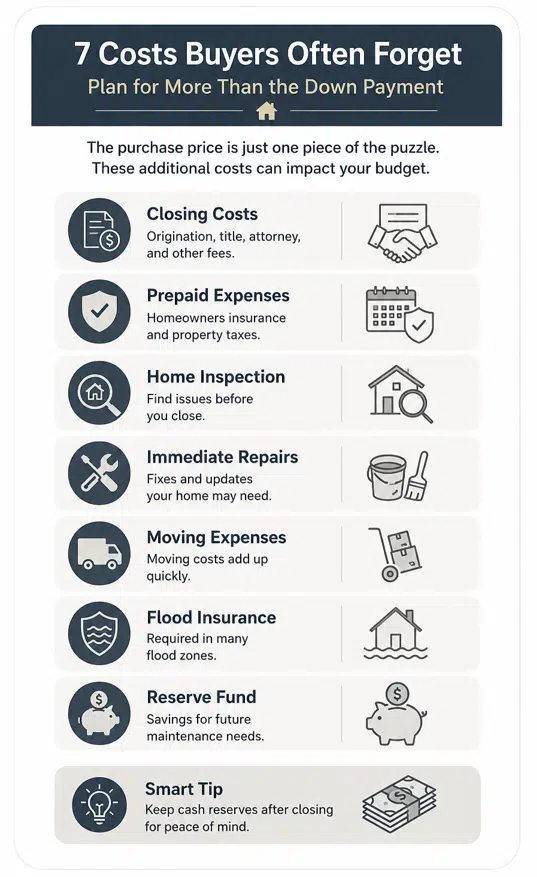
According to the latest joint report from the U.S. Census Bureau and HUD, the median price of a new home sold in June 2026 was $398,300, and available new home inventory represented 9.3 months of supply at the current sales pace.
That price level makes cash planning especially important. Putting every available dollar into the purchase can leave you unprepared for repairs, furnishings, insurance deductibles, or an unexpected expense soon after closing.
I usually encourage buyers to protect some savings after the transaction. Owning the home is when the maintenance costs begin.
7. Compare Rate, APR, Points, Credits, and Cash to Close
A useful comparison looks at the complete cost, not only the interest rate.
Freddie Mac reported that the average 30 year fixed mortgage rate was 6.58% on July 23, 2026, while the 15 year average was 5.96%. These national averages provide market context, but your actual options depend on your financial profile, mortgage type, property, points, and lock period. Freddie Mac’s current mortgage rate data also shows why quotes from different dates shouldn’t be treated as direct comparisons.
Mortgage Cost Comparison Chart
| Weak Comparison | Better Comparison |
| Interest rate only | Rate and APR |
| Principal and interest | Complete monthly payment |
| Down payment | Total cash needed |
| Lowest advertised rate | Rate plus points and credits |
| First month payment | Short and long term cost |
Your Loan Estimate helps organize these numbers. The CFPB explains that it generally must be provided within 3 business days after the required application information is submitted.
8. Understand That the Property Must Qualify Too
Approval isn’t based only on your income and credit. The property may also require an appraisal, acceptable insurance, clear title, and compliance with the selected mortgage program.
Condos can require additional association documents. Flood exposure may affect insurance. A low appraisal can change the maximum amount available or require the buyer and seller to reconsider the price.
9. Respond Quickly During Underwriting
Underwriting verifies income, employment, assets, debts, credit, insurance, and property information.
You may receive conditions requesting an updated bank statement, explanation letter, insurance document, proof of a deposit, or another record. This is a normal part of the mortgage underwriting process.
In my experience, the fastest applications aren’t always the simplest. They’re often the ones where documents are complete and questions receive quick answers.
When you’re ready to submit your information securely, you can begin through our application portal.
10. Keep Your Finances Stable Until Closing
Avoid major financial changes while the application is being reviewed.
Financial Stability Chart
| Strong Move | Risky Move |
| Keep employment stable | Change jobs without discussion |
| Pay bills normally | Miss a payment |
| Preserve documented savings | Make a large purchase |
| Ask before moving money | Transfer funds repeatedly |
| Maintain existing credit | Open several new accounts |
Don’t finance furniture, buy a vehicle, co-sign debt, or deposit unexplained cash without first discussing the possible effect.
The process generally follows this path:
Preparation → Application → Loan Estimate → Processing → Appraisal → Underwriting → Closing Disclosure → Closing
The CFPB states that the Closing Disclosure generally must be provided at least 3 business days before closing, giving you time to compare the final terms and costs with earlier estimates.
Pros and Cons
Applying for a new home loan after preparing carefully can make the process smoother, but buyers should still understand the work and uncertainty involved.
| Pros | Cons And Realities |
| You understand your realistic price range | Approval still isn’t guaranteed |
| Financial problems may be found earlier | Documentation can feel extensive |
| You can compare mortgage programs clearly | Rates and costs may change |
| Sellers may view your offer more seriously | The property must also qualify |
| Fewer issues may appear near closing | Financial flexibility is limited until closing |
The biggest advantage is clarity. You can shop with a better understanding of your payment, cash needs, and available mortgage choices.
The biggest limitation is that preapproval doesn’t freeze every part of the transaction. Your income, credit, assets, insurance, appraisal, and property information may still require review.
Myths Vs Facts
| Myth | Fact |
| You need 20% down to buy a home | Several mortgage programs allow much smaller down payments |
| Preapproval guarantees final approval | Your finances and the property remain subject to review |
| The lowest rate is always the cheapest option | Points, credits, insurance, and closing costs affect value |
| You can use new credit after approval | New debt can change your qualification |
| Self employed buyers can’t qualify | Several documentation options may be available |
| Every mortgage application follows the same path | Income, property, program, and credit details affect the process |
The 20% down myth causes many buyers to postpone homeownership unnecessarily. Some buyers may benefit from making a larger down payment, but others may be better served by protecting savings for closing costs, repairs, and emergencies.
Common Mistakes
Avoiding a few common mistakes can protect your approval, budget, and closing date.
- Applying before reviewing your credit
- Shopping without a verified price range
- Comparing only interest rates
- Forgetting taxes, insurance, and association fees
- Using all available savings for the down payment
- Delaying requests for financial documents
- Moving money without keeping records
- Opening new credit before closing
- Making a large purchase during underwriting
- Assuming preapproval guarantees every property will qualify
Another common mistake is hiding a concern because you’re worried it will hurt the application. It’s usually better to discuss income changes, credit issues, unusual deposits, or employment questions early.
In my experience, problems are much easier to solve when we find them before a closing deadline is approaching.
Key Facts
- Preparation should begin before completing the application
- Your complete housing payment matters more than principal and interest alone
- Credit can affect rates, mortgage insurance, and available programs
- Preapproval helps establish a realistic shopping range
- Different mortgage programs offer different costs and qualification standards
- Closing costs require money beyond the down payment
- A Loan Estimate helps organize mortgage terms and estimated costs
- The property must meet the selected program’s requirements
- Underwriting may request updated or additional documents
- Major financial changes can affect approval before closing
- The Closing Disclosure should be reviewed carefully before signing
How Can The Doce Mortgage Group Help You Apply With Confidence?
We help buyers understand the mortgage process before small questions become expensive surprises. Our team can review your financial situation, compare available programs, explain estimated costs, and help you prepare for underwriting and closing.
Alex Doce has spent more than 38 years helping buyers navigate mortgage decisions, and our customer reviews reflect experiences involving communication, preparation, and problem solving.
The Doce Mortgage Group was also recognized by WalletHub as “one of the best mortgage brokers in several cities throughout Florida.” This recognition includes other respected mortgage professionals, so it doesn’t suggest that we were named the only or exclusive best choice in the state.
When you’re ready to compare your possible mortgage options, you can get a free quote from our team.
When you’re ready to move forward, you can Get Started Now, or connect with a loan officer live at 305-661-3434.