

For many Florida buyers, mortgage insurance is the difference between buying now and waiting years to save 20% down. It adds to the cost of financing, but it can also reduce the cash needed upfront, so the right question isn’t simply how to avoid it, but whether paying it makes sense for your overall financial plan.
Alex’s Professional Insights
I worked with a Florida buyer who was determined to wait until she had 20% down because she viewed mortgage insurance as wasted money. When we compared the extra cash she would need with the monthly cost of buying sooner, she realized waiting wasn’t automatically the cheaper choice. Keeping more savings after closing also gave her a much stronger emergency cushion.
My advice is to compare the complete picture. Look at the payment, mortgage insurance, cash required at closing, reserves left afterward, and how long you expect to keep the mortgage. Sometimes avoiding mortgage insurance is the right move. Sometimes paying it temporarily creates more financial flexibility.
What Is Florida Mortgage Insurance?
Florida mortgage insurance protects the mortgage program against part of the financial loss if a borrower defaults, it doesn’t protect the homeowner against damage to the property.
That distinction matters because buyers often confuse 3 different products:
- Mortgage insurance protects against borrower default
- Homeowners insurance protects the home and belongings
- Flood insurance covers qualifying flood-related damage
Conventional financing generally uses private mortgage insurance, commonly called PMI. FHA financing uses Mortgage Insurance Premiums, usually called MIP. VA financing doesn’t require monthly PMI, and USDA financing uses guarantee fees rather than traditional PMI.
When Is Private Mortgage Insurance Required?
Private mortgage insurance is commonly required on conventional financing when the loan-to-value ratio is above 80%.
For a purchase, loan-to-value compares the mortgage amount with the property value used for the transaction. A smaller down payment creates a higher LTV.
| Down Payment | Starting LTV | Typical PMI Situation |
|---|---|---|
| 3% | 97% | Usually required |
| 5% | 95% | Usually required |
| 10% | 90% | Usually required |
| 15% | 85% | Usually required |
| 20% | 80% | Usually not required |
Current Fannie Mae mortgage insurance requirements generally require qualifying mortgage insurance or another approved form of credit enhancement on many conventional first mortgages above 80% LTV.
The common 20% assumption can create unnecessary delays. This is one of the top down payment myths and it shows why buyers should compare actual program requirements instead of assuming that 20% is mandatory.
How Much Does PMI Cost In Florida?
PMI doesn’t have 1 universal Florida price, the premium depends on the risk characteristics of the individual mortgage.
Pricing can be affected by:
- Credit score
- Down payment
- Loan-to-value ratio
- Mortgage amount
- Occupancy
- Property type
- Mortgage structure
For a useful Florida example, Florida Realtors reported a $432,000 statewide median single-family sale price for June 2026, up 4.9% from a year earlier.
Florida Down Payment Comparison On A $432,000 Home
| 3% | ███ | $12,960 |
| 5% | █████ | $21,600 |
| 10% | ██████████ | $43,200 |
| 20% | ████████████████████ | $86,400 |
A buyer putting 5% down would use $64,800 less cash than a buyer putting 20% down. The smaller down payment would normally create a higher mortgage balance and may add PMI, but preserving tens of thousands of dollars can matter for emergency reserves, repairs, moving expenses, and other goals.
You can compare different down payments and see how mortgage insurance affects your estimated monthly cost using our Mortgage Payment Calculator.
How Does FHA Mortgage Insurance Work?
FHA financing uses an upfront Mortgage Insurance Premium and an annual Mortgage Insurance Premium rather than conventional PMI.
HUD currently sets the standard upfront MIP for most FHA purchase mortgages at 1.75% of the base mortgage amount. Most buyers finance this charge into the mortgage rather than paying the entire amount in cash at closing.
For many FHA mortgages longer than 15 years with an original LTV above 95%, the annual MIP is currently 0.55%. That annual amount is divided into monthly installments and included in the mortgage payment.
FHA mortgage insurance can make a smaller down payment possible, but its cancellation rules are very different from conventional PMI. That difference becomes especially important when deciding whether FHA or conventional financing produces the better long-term cost.
How Long Does FHA Mortgage Insurance Last?
For most current FHA mortgages, annual MIP lasts either 11 years or for the full mortgage term, depending largely on the original loan-to-value ratio.
If the original LTV is 90% or lower, annual FHA mortgage insurance generally lasts 11 years. When the original LTV is above 90%, annual MIP generally remains for the mortgage term.
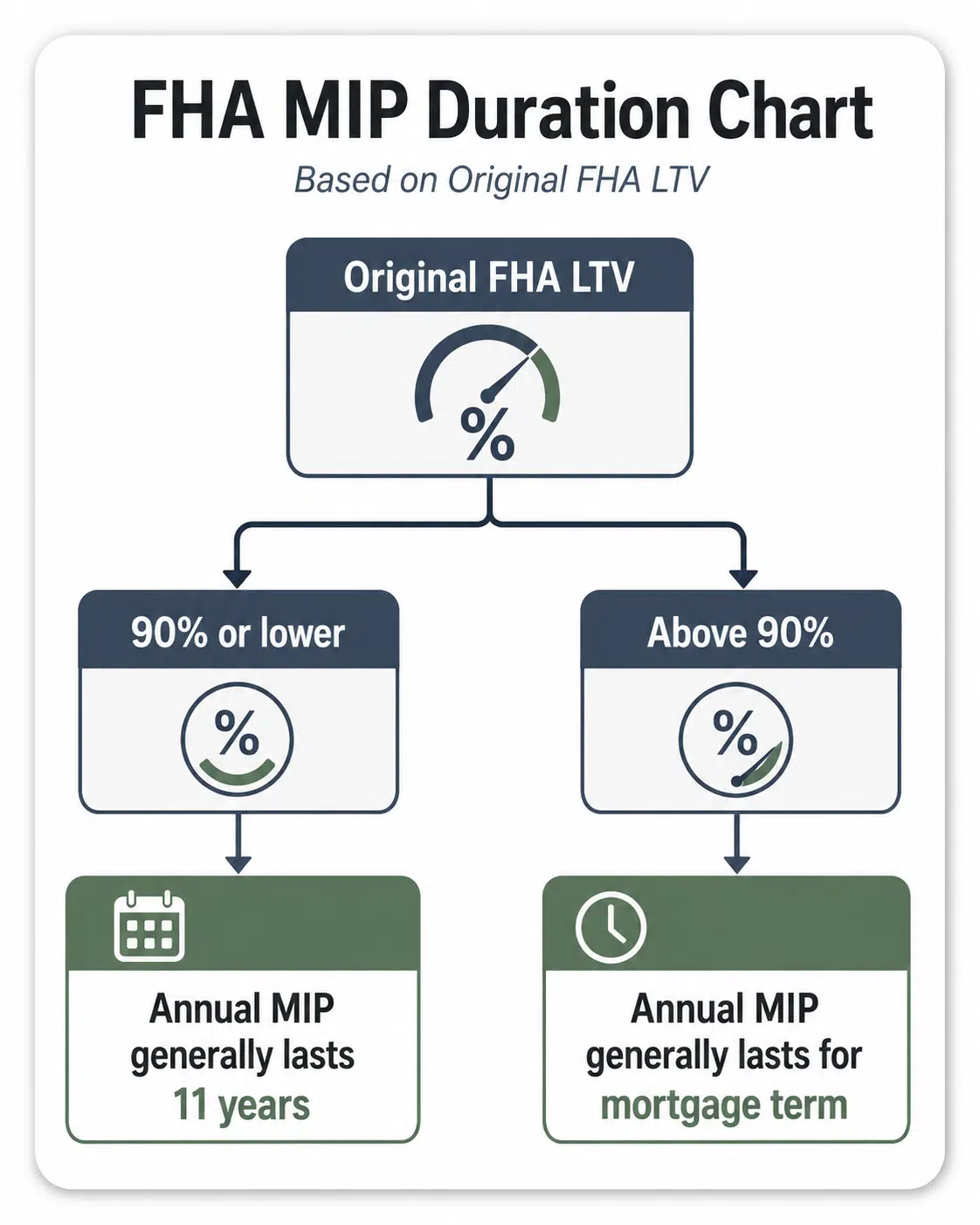
That means a typical buyer making FHA’s minimum 3.5% down starts with an LTV above 90%, so simply reaching 20% equity later doesn’t automatically eliminate the annual MIP.
I tell buyers to think about FHA as part of a longer financial plan. FHA may be an excellent way to purchase today, but if your credit and equity improve later, refinancing into conventional financing could potentially eliminate ongoing mortgage insurance. Future rates, home value, qualification, and closing costs must all be considered before assuming a refinance will make sense.
Can Conventional PMI Be Removed?
Yes, conventional PMI can often be removed without refinancing once certain equity and payment requirements are satisfied.
For many qualifying conventional mortgages, the CFPB’s PMI cancellation rules provide 2 important benchmarks:
- 80% of original value, you may generally request cancellation
- 78% of original value, PMI generally terminates automatically
Automatic termination normally requires that payments are current. A requested cancellation may also involve payment-history requirements and confirmation that the property hasn’t declined in value.
Some Fannie Mae and Freddie Mac mortgages may provide additional opportunities based on current property value and seasoning requirements.
This difference between conventional PMI and FHA MIP is one of the most important factors buyers should understand when comparing programs. The Doce Mortgage Group’s explanation of how mortgage insurance works also shows why the cheapest option at closing isn’t necessarily the cheapest option over several years.
Does A Higher Credit Score Lower PMI?
A stronger credit profile can reduce conventional PMI pricing because private mortgage insurance premiums are risk-based.
Two buyers purchasing identical $400,000 homes with identical down payments may receive different PMI costs based partly on their credit profiles.
Pricing can also depend on:
- Loan-to-value ratio
- Mortgage amount
- Occupancy
- Property type
- Mortgage term
- Insurance coverage level
This is why improving credit before closing can potentially produce savings in 2 places, mortgage pricing and PMI pricing.
Is Putting 20% Down Always Better?
No, putting 20% down isn’t automatically the strongest financial choice.
Avoiding PMI reduces your monthly cost, but putting an additional $40,000, $60,000, or more into a home can dramatically reduce your available savings.
| Consideration | 20% Down | Smaller Down Payment |
|---|---|---|
| Mortgage insurance | Usually avoided | May apply |
| Cash required | Higher | Lower |
| Starting equity | Higher | Lower |
| Emergency savings | May be reduced | Easier to preserve |
| Monthly payment | Usually lower | Usually higher |
Florida buyers should think carefully about reserves because homeowners insurance deductibles, hurricane preparation, repairs, moving expenses, and unexpected home costs can arise soon after closing.
I’d rather see a buyer pay manageable PMI while maintaining strong emergency savings than eliminate mortgage insurance by draining nearly every available dollar.
Does VA Financing Have Mortgage Insurance?
No, VA financing doesn’t require monthly PMI or FHA-style MIP.
Eligible veterans, active-duty service members, and certain surviving spouses may also qualify for VA financing with no down payment.
Instead of monthly mortgage insurance, many VA borrowers pay a one-time funding fee. According to the Department of Veterans Affairs’ June 2026 guidance, the funding fee for many first-use purchase borrowers is 2.15%, while subsequent use can reach 3.3%. Certain eligible borrowers are exempt.
The absence of monthly mortgage insurance is one reason VA financing can be especially valuable. Eligible Florida buyers can also compare VA and other zero-down homebuying options when determining how much cash they want to preserve.
What About USDA Mortgage Insurance?
USDA financing doesn’t use conventional PMI either. Instead, qualifying USDA mortgages generally include an upfront guarantee fee and an annual guarantee fee.
USDA can provide 100% financing for eligible buyers purchasing qualifying properties, but household income and property-location requirements apply.
The terminology may be different, but buyers should still compare the complete payment. A mortgage without something called “PMI” isn’t automatically cheaper than another option.
When you’re ready to compare conventional PMI, FHA MIP, VA financing, USDA fees, and your actual monthly costs, you can securely begin through our application portal.
When Does Paying Mortgage Insurance Make Sense?
Mortgage insurance can make sense when it allows you to buy responsibly without draining the savings you’ll need after closing.
A Florida buyer who can comfortably afford the complete payment may prefer putting 5% or 10% down instead of waiting until they reach 20%. The smaller down payment can preserve cash for repairs, moving expenses, insurance deductibles, and emergency reserves.
Waiting may still be smarter when your payment would feel tight, your income isn’t stable, or you expect to have a much larger down payment soon.
Market conditions matter too. Freddie Mac reported that the average 30-year fixed mortgage rate was 6.69% on August 6, 2026. Freddie Mac’s 2026 mortgage rate data Rates can move higher or lower, which means waiting solely to avoid PMI doesn’t guarantee a cheaper future mortgage.
I encourage buyers to compare actual numbers rather than treating mortgage insurance as automatically good or bad. The difference between 5% and 20% down can represent tens of thousands of dollars in available cash.
The idea that everyone must wait for 20% is one of the most common Florida down payment myths. The better question is whether the complete payment and remaining savings fit your finances.
Pros And Cons Of Mortgage Insurance
| Pros | Cons |
|---|---|
| Smaller down payment possible | Higher monthly housing cost |
| Preserves emergency savings | FHA MIP may last longer |
| May allow an earlier purchase | Conventional PMI pricing varies |
| Expands financing choices | Doesn’t protect the homeowner |
Mortgage insurance is most useful when the benefit of preserving cash outweighs its cost. It becomes less attractive when the payment is uncomfortable or you can reach 20% without weakening your emergency reserves.
Myths Vs Facts
Myth: Mortgage insurance protects the homeowner
Fact: It primarily protects the mortgage program against losses after default
Myth: Every buyer needs 20% down
Fact: Many qualifying mortgage programs permit considerably smaller down payments
Myth: PMI always lasts for 30 years
Fact: Conventional PMI can often be canceled after applicable requirements are met
Myth: FHA mortgage insurance disappears at 20% equity
Fact: FHA MIP duration depends largely on the original LTV
Myth: VA buyers pay PMI when putting 0% down
Fact: VA financing doesn’t require monthly PMI
Common Mistakes
Avoid these common Florida mortgage insurance mistakes:
- Waiting for 20% without comparing alternatives
- Comparing rates without including mortgage insurance
- Confusing PMI with homeowners insurance
- Assuming FHA MIP automatically disappears
- Ignoring credit before comparing PMI costs
- Using every dollar for the down payment
- Forgetting to request PMI cancellation
- Comparing programs only by down payment
One mistake I see frequently is focusing on a single monthly charge instead of the complete financial plan. Saving $150 per month is valuable, but not if eliminating that payment requires emptying an emergency account you may need for a major repair or Florida insurance deductible.
Key Facts
- Conventional PMI commonly applies above 80% LTV
- FHA uses MIP rather than PMI
- FHA typically includes upfront and annual MIP
- Conventional PMI may eventually be cancellable
- FHA MIP follows different removal rules
- VA financing has no monthly PMI
- Credit and LTV can affect PMI pricing
- Mortgage insurance can reduce upfront cash needs
How Can The Doce Mortgage Group Help You Compare Mortgage Insurance Costs?
We help Florida buyers compare conventional PMI, FHA MIP, VA financing, USDA fees, and other available options using the complete monthly payment rather than focusing on 1 isolated expense. With more than 38 years of experience, our team can show how credit, down payment, available savings, and property type affect Florida mortgage insurance costs.
Our customer reviews reflect the guidance we provide to Florida homebuyers making these decisions. The Doce Mortgage Group was also recently recognized by WalletHub as one of the best mortgage brokers in several cities throughout Florida.
You can get a free quote to compare mortgage insurance and financing options based on your actual situation.
When you’re ready to move forward, you can Get Started Now, or .