

Quick Answer
A great Florida Mortgage Broker should make your mortgage easier to understand, provide clear and accurate numbers, explain your options, respond quickly, identify problems early, and keep your purchase moving toward closing. You should understand what you’re paying, why a particular option was recommended, and what happens next.
Choosing a mortgage involves much more than finding an attractive interest rate. You’re trusting someone to help guide you through a major financial transaction involving your income, credit, savings, property, insurance, deadlines, and closing costs.
That raises an important question for any homebuyer. How can you tell whether your Florida Mortgage Broker is really doing a great job for you?
The answer isn’t based on 1 rate quote or how friendly someone sounds on the phone.
A Personal Story from Alex
I’ve learned that some of the best mortgage work happens before a client ever realizes there could’ve been a problem. I remember working with a buyer in Miami who needed to close quickly because another offer was competing for the property. We had to move fast, but speed couldn’t come at the expense of accuracy. We completed the transaction quickly, and the client specifically appreciated getting to closing without surprise fees.
Experiences like that have reinforced something I’ve seen throughout my career. A good mortgage professional shouldn’t just answer questions after problems appear. We should be looking ahead, explaining the numbers, watching the deadlines, and identifying possible obstacles while there’s still time to solve them.
What Are the Clearest Signs Your Florida Mortgage Broker Is Doing a Great Job?
The clearest signs are transparency, preparation, responsiveness, useful advice, and consistent execution.
You shouldn’t have to become a mortgage expert yourself. You should, however, understand what’s happening with your mortgage and why important decisions are being made.
A strong Florida Mortgage Broker should make sure:
- You understand why a particular mortgage was recommended
- Your payment and estimated costs are clearly explained
- You know what documents are needed and why
- Potential problems are identified early
- Important deadlines don’t catch you by surprise
- Your questions receive direct answers
- You’re shown meaningful alternatives when they exist
Here’s a simple way to compare strong service with potential warning signs.
| Area | Great Job | Warning Sign |
| Communication | Updates arrive before you ask | You’re constantly chasing answers |
| Costs | Numbers are explained early | Changes appear without explanation |
| Options | Alternatives are compared | You’re shown only 1 path |
| Preparation | Issues are identified early | Problems surface near closing |
| Timeline | Deadlines are actively tracked | Important dates become emergencies |
A great mortgage experience doesn’t mean nothing will ever change. Rates move, appraisals can create questions, insurance costs can change, and new information about the borrower or property may affect the transaction.
What matters is whether those changes are identified quickly, explained clearly, and handled professionally.
Does Your Broker Explain the Numbers Before You Commit?
Yes, a great broker should make sure you understand the real cost of the mortgage before you make a major financial commitment.
One of the most useful documents for evaluating those numbers is your Loan Estimate. It gives you important information about the interest rate, estimated payment, closing costs, cash needed to close, and other major terms.
Under Consumer Financial Protection Bureau guidance, a Loan Estimate generally must be provided within 3 business days after you submit the information needed for a mortgage application.
Don’t judge the proposed mortgage by the interest rate alone. Your broker should be able to clearly explain:
- Interest rate and APR
- Points and credits
- Mortgage insurance
- Estimated property taxes
- Homeowners insurance
- Total estimated monthly payment
- Cash needed to close
- Whether your rate is locked
- When the rate lock expires
You should be able to look at your numbers and understand what you’re paying, what could still change, and why.
Confusion isn’t something you should simply accept because mortgages are complicated. Explaining complicated information in plain English is part of doing the job well.
How Should a Great Broker Compare Your Mortgage Options?
A great broker should compare realistic alternatives and explain why one option may fit your finances and goals better than another.
The lowest interest rate isn’t automatically the best choice. One option could require you to pay points upfront to obtain that rate. Another could carry a slightly higher rate while requiring less cash at closing. Different mortgage programs can also affect your down payment, mortgage insurance, qualification requirements, and long term costs.
The CFPB recommends making apples to apples comparisons when reviewing mortgage offers. Its mortgage shopping guidance recommends comparing offers with the same basic features so differences in pricing are easier to evaluate.
A useful comparison should consider:
| Compare | Why It Matters |
| Interest rate | Affects payment and borrowing cost |
| APR | Reflects certain financing costs |
| Points | Can lower rate but increase upfront cost |
| Credits | Can reduce some upfront costs |
| Monthly payment | Helps measure ongoing affordability |
| Cash to close | Shows what you’ll need upfront |
| Mortgage insurance | Can materially affect monthly cost |
| Rate lock | Determines how long pricing is protected |
The type of mortgage matters too. For example, Florida buyers considering conventional mortgage options may have different down payment, mortgage insurance, and qualification considerations than buyers using other programs.
The best recommendation also depends on how long you expect to own the home. Someone planning to stay for 20 years may evaluate paying points very differently from someone who expects to move in 4 years.
Your Florida Mortgage Broker shouldn’t simply tell you, “This is the best option.”
You should understand why it’s the best option for you.
Is Your Broker Preparing You for Florida Specific Costs?
Yes, a strong Florida Mortgage Broker should identify Florida specific housing expenses early because they can significantly change your monthly payment and cash needed at closing.
Florida buyers have costs that can vary dramatically by location and property type. Homeowners insurance is one of the biggest examples, but flood insurance, property taxes, condo association fees, HOA dues, and escrow requirements can also affect affordability.
These costs are especially important when comparing condos with single family homes. According to the latest Florida Realtors housing data, the statewide median single family home price was $432,000 in June 2026. Florida had a 4.5 month supply of single family homes compared with an 8.1 month supply of condos and townhouses.
A lower purchase price also doesn’t necessarily mean a lower monthly housing expense. A $350,000 condo with substantial association dues could potentially cost more each month than a higher priced single family home.
| Florida Cost | Why It Matters | When To Check |
| Homeowners insurance | Can significantly change monthly costs | Before finalizing affordability |
| Flood insurance | May add another insurance expense | During property review |
| Property taxes | Affect the total monthly payment | Before making an offer |
| Condo fees | Add directly to housing costs | Before choosing a condo |
| HOA dues | Affect affordability and qualification | Before making an offer |
| Escrow requirements | Affect payment and cash needs | Before closing |
A good broker should ask about these costs rather than plugging generic estimates into your payment.
You can test different scenarios using our Florida Mortgage Payment Calculator. I recommend including realistic estimates for taxes, insurance, mortgage insurance, and association fees so the payment reflects more than principal and interest.
What Should Great Communication Look Like From Preapproval to Closing?
Great communication means you know what’s happening, what you need to do next, and whether anything could threaten your closing timeline.
You shouldn’t have to repeatedly call or email just to find out whether your mortgage is moving forward.
Strong communication should happen throughout major stages of the process:
- Preapproval
- Offer acceptance
- Document collection
- Appraisal
- Underwriting
- Final review
- Closing preparation
The quality of those updates matters too. Being told “everything looks good” isn’t nearly as helpful as knowing what’s already completed, what’s still outstanding, and whether you need to take action.
A thorough Florida mortgage preapproval can establish that communication before you even start making offers.
When you’re ready to submit your financial information, you can begin securely through our mortgage application portal.
How Can You Tell Whether Your Broker Is Staying Ahead of Underwriting?
A strong broker identifies potential approval problems early instead of discovering them a few days before closing.
Many buyers are surprised by the amount of documentation that can become important during a mortgage transaction. Potential issues may involve:
- Self employment income
- Large bank deposits
- Recent employment changes
- New debts
- Gift funds
- Credit changes
- Property condition
- Appraisal concerns
- Condo documentation
The goal isn’t to guarantee that nobody will ever ask another question. The goal is to recognize likely issues early enough to provide the required documentation without creating a last minute emergency.
Preparation is especially valuable when you’re competing for a Florida property and the seller expects a fast closing. A more thorough verified preapproval can help some buyers identify potential qualification issues before they’re working against a purchase contract deadline.
Does Your Broker Protect Your Closing Timeline?
Yes, protecting important deadlines is one of the clearest signs that your broker is actively managing your mortgage.
A purchase contract creates important dates. Instead of waiting for each deadline to arrive, your broker should work backward from the targeted closing date and make sure important steps are completed with enough time to handle unexpected problems.
Mortgage Timeline Chart
| Stage | What Strong Management Looks Like |
| Preapproval | Financial information reviewed early |
| Contract | Important dates identified immediately |
| Appraisal | Ordered and monitored promptly |
| Underwriting | Conditions addressed as they appear |
| Final review | Outstanding items checked before deadlines |
| Closing | Final numbers reviewed before signing |
The Consumer Financial Protection Bureau explains that borrowers generally must receive their Closing Disclosure at least 3 business days before closing. That period gives you time to review your final mortgage terms and costs before signing.
A good broker shouldn’t treat the Closing Disclosure as paperwork you simply sign.
You should have enough time to compare the final numbers with earlier estimates and get a clear explanation for any meaningful changes.
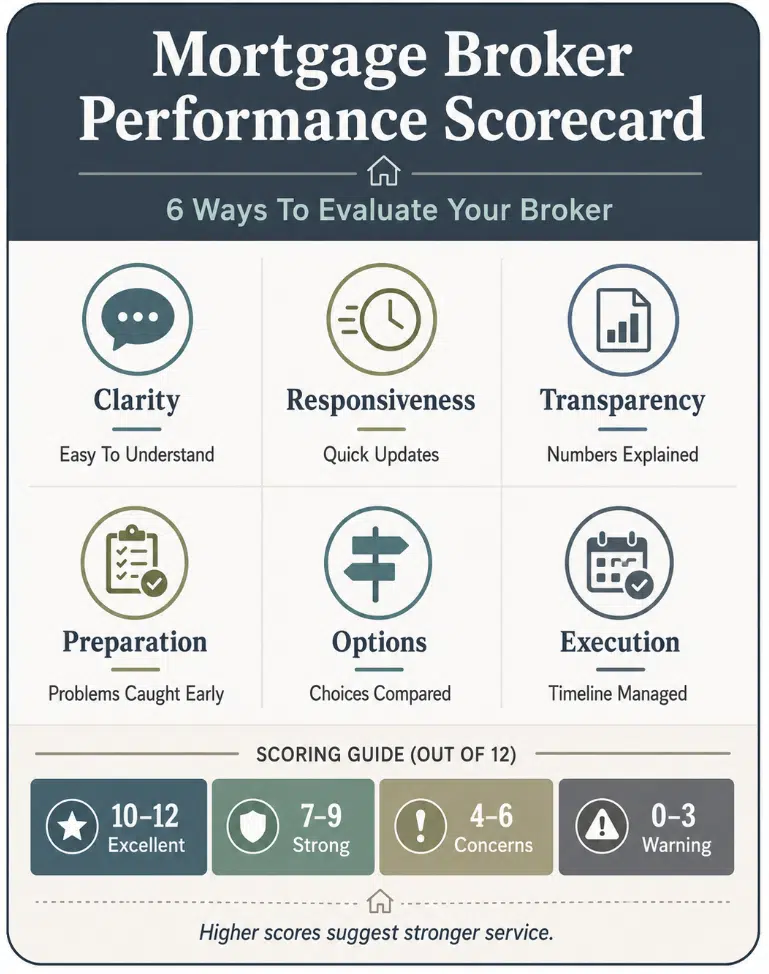
The Mortgage Broker Performance Scorecard
You can evaluate your Florida Mortgage Broker by scoring 6 areas that directly affect the quality of your experience.
| Category | 0 Points | 1 Point | 2 Points |
| Clarity | Frequently confusing | Usually understandable | Consistently clear |
| Responsiveness | Difficult to reach | Usually responsive | Proactively communicates |
| Transparency | Costs remain unclear | Most costs explained | Numbers explained early |
| Preparation | Problems appear late | Some issues anticipated | Issues identified early |
| Options | Little comparison | Some choices discussed | Meaningful options compared |
| Execution | Deadlines feel uncertain | Process generally stays moving | Timeline actively managed |
Add the points from all 6 categories.
10 to 12 points: Excellent performance
7 to 9 points: Generally strong, but ask about weaker areas
4 to 6 points: Several concerns deserve attention
0 to 3 points: Serious warning signs
This scorecard isn’t meant to suggest that every mortgage transaction will be perfect. Complications can occur even when everyone is doing their job well.
The difference is how those complications are handled.
Great service should produce results you can actually recognize. You should understand your mortgage, know what happens next, receive useful advice, and feel that someone is actively managing the transaction rather than reacting to problems after they become urgent.
Warning Signs That Deserve Attention
Some warning signs should make you stop and ask more questions, especially when they involve unexplained costs, poor communication, or repeated last minute problems.
Watch for situations where:
- Costs change repeatedly without clear explanations
- You can’t get important numbers in writing
- Nobody explains why a particular mortgage was recommended
- Calls or messages go unanswered during important deadlines
- Insurance, taxes, HOA fees, or condo costs are overlooked
- Document problems repeatedly appear at the last minute
- Final numbers are materially different from earlier estimates without explanation
Not every change is a sign of poor service. Rates, insurance premiums, appraisals, property details, and your financial situation can legitimately affect the numbers.
The important question is whether your broker explains what changed, why it changed, and what your options are.
Reviews, Experience, And Local Knowledge
Experience and customer reviews can help you judge a Florida Mortgage Broker, but look beyond the average star rating.
Read recent reviews and look for patterns involving communication, transparency, problem solving, closing speed, and unexpected costs. The Doce Mortgage Group, for instance, currently has more than 1,500 five star client reviews and has worked with more than 7,000 clients.
Local experience matters too. Florida transactions can involve condos, flood considerations, homeowners insurance, association requirements, and property issues that may be less common elsewhere.
Pros and Cons
Working with a strong Florida Mortgage Broker can provide meaningful advantages, but you should still evaluate the individual professional handling your mortgage.
| Pros | Cons To Consider |
| Multiple mortgage options can be compared | More choices can require more discussion |
| Guidance can simplify complex decisions | Quality and experience vary |
| Problems may be identified earlier | You still need to review your documents |
| Communication can help protect deadlines | No professional can prevent every complication |
| Local knowledge can help with Florida issues | The lowest advertised rate isn’t always available |
Myths Vs Facts
Myth: The lowest interest rate automatically means the best mortgage.
Fact: Points, credits, closing costs, mortgage insurance, and cash needed at closing can change the overall value.
Myth: A great broker shouldn’t need additional documents.
Fact: Additional documentation can be completely normal, especially when income, deposits, employment, or property details require clarification.
Myth: Changing numbers always means somebody made a mistake.
Fact: Some costs legitimately change as new information becomes available.
Myth: Great service is mostly about being friendly.
Fact: Communication matters, but preparation, accuracy, transparency, and execution matter just as much.
Common Mistakes
One of the biggest mistakes mortgage shoppers make is focusing on a single number instead of evaluating the entire transaction.
Avoid these common mistakes:
- Comparing rates quoted on different days
- Ignoring points and credits
- Looking only at principal and interest
- Waiting until closing to question costs
- Choosing someone solely because they’re personable
- Failing to compare estimated cash needed at closing
Understanding typical mortgage closing costs in Florida can also make it easier to recognize which expenses are normal and which deserve additional questions.
Key Facts
- Great service should make your mortgage easier to understand
- Competitive pricing should be evaluated with costs and terms
- Florida insurance and association expenses can materially affect affordability
- Loan Estimates make side by side comparisons easier
- Strong preparation can reduce avoidable closing problems
- Freddie Mac reported a 6.58% average 30 year fixed mortgage rate on July 23, 2026
- Reviews are useful when they reveal consistent patterns of service
- You should understand meaningful changes before signing closing documents
People Also Ask
What makes a mortgage broker good?
Clear communication, competitive options, transparency, preparation, and reliable execution are some of the strongest indicators.
What questions should I ask a mortgage broker?
Ask about rates, APR, points, closing costs, cash needed, mortgage options, rate locks, timelines, and possible qualification issues.
How quickly should a mortgage broker respond?
Urgent questions involving offers, documents, rate locks, and deadlines should receive prompt attention.
What should a mortgage broker explain before closing?
You should understand your final payment, interest rate, closing costs, cash needed, and any important differences from earlier estimates.
How can I compare 2 mortgage offers fairly?
Compare the same mortgage type, amount, term, lock period, points, credits, monthly payment, and estimated cash needed.
Why Work With The Doce Mortgage Group?
Alex Doce has spent more than 38 years helping people navigate mortgage decisions with a focus on clear communication, preparation, and avoiding last minute surprises. Our goal isn’t simply to get you to closing. We want you to understand the mortgage you’re choosing and feel confident about the decision.
Our customer reviews include more than 1,500 five star reviews, and WalletHub currently recognizes Alex Doce among its best mortgage brokers in Fort Lauderdale for 2026, alongside other highly rated Florida professionals.
When you’re ready to compare your options, you can also get a free quote from our team.
When you’re ready to take the next step, you can Get Started Now, or connect with a loan officer live at 305-661-3434.