

Quick Answer
An asset depletion mortgage in Florida can convert eligible savings, investment, and retirement assets into monthly qualifying income, allowing some buyers to qualify without relying primarily on employment income.
Key Takeaways
- Eligible assets can be converted into monthly qualifying income
- Savings, investments, and retirement accounts may be treated differently
- We can compare asset depletion with other Florida mortgage options
An asset depletion mortgage in Florida can be especially useful when your financial strength is sitting in investment and savings accounts instead of appearing on a paycheck. Retirees, business owners, early retirees, and high net worth buyers may have substantial wealth while showing relatively little traditional income.
A Personal Story
I recently worked with a couple relocating from New Jersey who had more than $1,800,000 in investments but very little reportable income after retirement. They were financially strong, yet their income structure didn’t look like that of someone receiving a regular salary. We were able to help them qualify for their Florida home by using an asset depletion financing for high net worth Florida buyers without requiring them to change the way they were taking money from their investments.
That experience reinforces something I tell buyers often. Don’t assume that a small tax return or the absence of a paycheck tells the full story. If you have substantial liquid assets, let us evaluate those assets before deciding what you can or can’t qualify for.
What Is an Asset Depletion Mortgage in Florida?
An asset depletion mortgage in Florida uses eligible assets to create qualifying monthly income rather than depending only on wages, salary, or tax return income.
This type of financing is also commonly called an asset based or asset utilization mortgage. Asset based mortgage programs can consider assets such as checking accounts, savings, brokerage accounts, investments, and qualifying retirement funds.
The concept is fairly simple. Your usable assets are identified, any required reductions are applied, and the remaining eligible amount is divided across a defined number of months. The result is a monthly income figure that can be used when your mortgage application is evaluated.
That can make a major difference for someone who is wealthy on paper but intentionally keeps taxable income low.
It’s particularly relevant in Florida, where buyers may be arriving after selling a home in another state, retiring, or transitioning out of a business. The latest Florida Realtors August 2026 housing report placed the statewide median sale price of an existing single family home at $415,000, up 1.2% from August 2025. Buyers at higher Florida price points may have even greater reason to preserve investment capital instead of liquidating a portfolio to pay entirely in cash.
How Are Investments and Savings Converted Into Qualifying Income?
Eligible assets are converted into qualifying income by applying the program’s rules to the available balance and dividing the usable amount over a specified period.
The exact calculation varies by program. Age, asset type, accessibility, down payment, closing costs, reserves, credit profile, and other factors can all matter.
For example, our current asset based programs may use a shorter calculation period for certain retirement age buyers and a longer period for younger buyers. Different asset categories may also receive different percentages because cash is more stable than investments that can fluctuate.
Here’s a simplified example showing the basic concept.
How Asset Depletion Can Create Monthly Income
| Financial Step | Illustrative Amount | How It Is Used |
|---|---|---|
| Eligible assets | $1,200,000 | Starting usable asset balance |
| Cash needed for purchase | $120,000 | Removed from assets available for depletion |
| Remaining qualifying assets | $1,080,000 | Amount available for income calculation |
| Calculation period | 84 months | Example program period |
| Monthly qualifying income | $9,000 | $1,080,000 divided by 84 |
This is an educational example, not a universal formula. Another program might apply reductions to investment or retirement balances before completing the calculation.
One point buyers sometimes miss is that the money used for the home purchase may reduce the assets available to create qualifying income. If you have $1,000,000 but need $250,000 of that money for the down payment and closing, the calculation may start with a smaller usable balance.
Once we determine a reasonable qualifying income figure, you can test how it translates into Florida purchasing power using our Home Affordability Calculator. I recommend including realistic property taxes, homeowners insurance, flood coverage when applicable, and HOA or condo dues rather than looking only at principal and interest.
The goal isn’t to make your portfolio appear larger than it is. It’s to document the financial strength you already have in a way that accurately reflects your ability to support the mortgage.
Which Assets Can Help You Qualify?
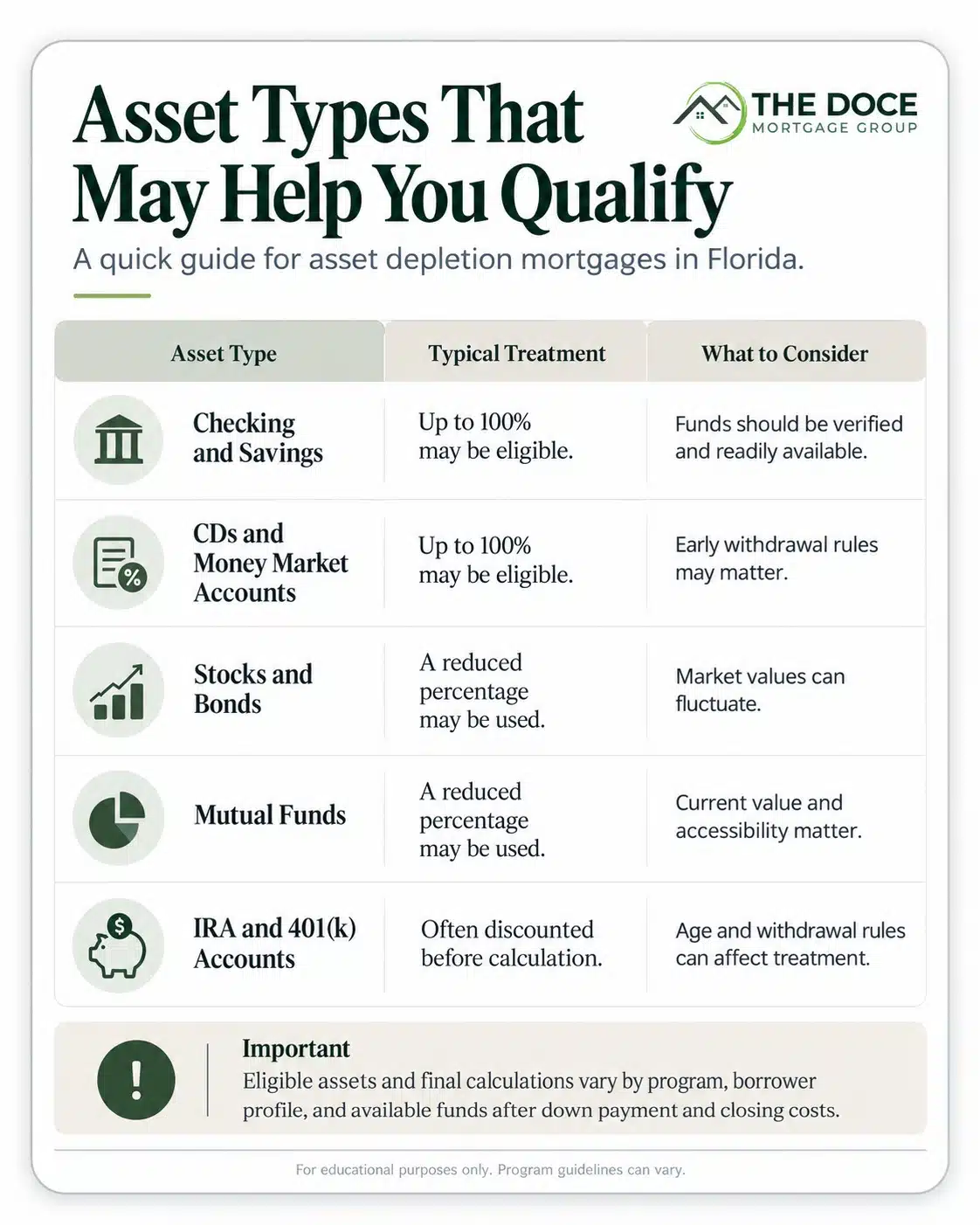
Several types of liquid and investment assets may help you qualify for an asset depletion mortgage in Florida, but they aren’t always counted at the same percentage.
Cash accounts are generally the easiest to evaluate because their value doesn’t change with the market. Brokerage and retirement accounts can also be valuable, although a portion of the balance may be excluded to account for market fluctuations, taxes, penalties, or accessibility.
Our current Florida asset based mortgage programs may consider assets such as:
- Checking accounts
- Savings accounts
- Money market accounts
- Certificates of deposit
- Stocks and bonds
- Mutual funds
- Brokerage accounts
- Traditional IRAs
- Roth IRAs
- 401(k) accounts
- Certain vested investment accounts
Real estate equity usually isn’t treated the same way as liquid financial assets unless the property is sold and the proceeds become available. Likewise, business assets can require additional analysis because money needed to operate your business isn’t necessarily available to support your personal housing expenses.
One thing I’ve learned from working with asset-rich buyers is that the total account balance isn’t the number that matters most. I want to know how much of that money is accessible, how stable it is, and how much must remain available after the purchase.
Can Retirement Accounts Be Used for Asset Depletion?
Yes, retirement accounts can often support asset depletion qualification when the funds meet the program’s accessibility and documentation requirements.
This is particularly important in Florida because many buyers are already retired or approaching retirement when they purchase a primary residence or second home.
A traditional IRA, Roth IRA, 401(k), or similar account may be considered, but retirement funds aren’t always counted dollar for dollar. Our current programs, for example, may apply a percentage reduction to retirement balances before converting those assets into monthly qualifying income.
Standard conventional rules can also recognize certain employment-related assets under more limited circumstances. Current Fannie Mae guidelines for employment-related assets include specific rules involving occupancy, loan purpose, asset ownership, and loan-to-value limits.
That distinction matters. Asset depletion isn’t one single national program with one formula. Conventional rules may work well for one buyer, while a more flexible non-QM asset-based option may better fit someone else’s portfolio.
This is why I look at the whole financial picture before recommending a structure. For a retiree, taking larger monthly distributions simply to document income may not always be the most attractive approach. Asset depletion may allow the portfolio itself to demonstrate financial capacity.
Florida retirement mortgage options can also work alongside Social Security, pensions, retirement distributions, and other retirement resources.
Is Asset Depletion Better Than Standard Income Qualification?
Asset depletion can be better when your assets tell a stronger financial story than your tax returns or employment income, but standard qualification may still be preferable when your regular income already supports the mortgage.
The standard route may make sense if salary, pension income, Social Security, investment distributions, or other established income comfortably supports the payment.
Asset depletion becomes especially useful when you have substantial wealth but don’t want to manufacture taxable income simply to qualify.
Business owners are another good example. Tax deductions can lower reported income even when the business owner has accumulated significant personal savings and investments. In that situation, we may compare asset depletion with our Florida bank statement mortgage options rather than assuming one approach automatically works best.
If you’d like us to compare those options using your actual asset profile, you can request our free mortgage quote and we’ll review which structure makes the most sense.
Why Do Current Mortgage Rates Matter to Asset-Rich Buyers?
Mortgage rates still matter because even a financially strong buyer needs to decide whether financing or using more cash produces the better overall strategy.
As of September 24, 2026, Freddie Mac’s Primary Mortgage Market Survey reported an average 30-year fixed rate of 7.03%, compared with 6.30% a year earlier. That survey tracks conventional conforming loans and shouldn’t be treated as a quote for an asset depletion mortgage, but it provides useful context for the broader financing environment.
I’ve worked with buyers who could easily pay cash but preferred not to sell a large investment position at an inconvenient time. Others decided that reducing the mortgage amount was more important than keeping every dollar invested. Asset depletion gives you another way to evaluate those choices without assuming that paying cash is automatically the best answer.
Pros and Cons of an Asset Depletion Mortgage
Asset depletion can provide valuable flexibility, but it isn’t right for every buyer.
Pros include preserving investments instead of liquidating a portfolio, qualifying without relying primarily on employment income, combining assets with other acceptable income, and creating options for retirees or business owners with complex finances.
Potential drawbacks include higher down payment requirements on some programs, discounted treatment of certain assets, additional documentation, and potentially different pricing compared with standard conventional financing.
The best approach is to compare the mortgage structure with your larger financial plan. A mortgage shouldn’t force you to make an investment or retirement decision that works against your long-term goals.
Myths Vs Facts
Myth: You must sell your investments before they can help you qualify.
Fact: Eligible investments can sometimes be converted into qualifying income without being liquidated.
Myth: Every $1 in an investment account counts as $1 of usable assets.
Fact: Some investments and retirement accounts may be discounted before the income calculation.
Myth: Asset depletion mortgages are only for retirees.
Fact: Retirees use them frequently, but business owners, investors, executives, and other asset-rich buyers may also qualify.
Common Mistakes
The biggest asset depletion mistakes usually happen when buyers focus on their total net worth instead of the assets that can actually be used for qualification.
One common mistake is assuming every investment dollar will count. Some programs discount stocks, mutual funds, or retirement accounts before converting them into monthly income. Another is forgetting that money needed for the down payment, closing costs, and required reserves may have to be removed from the asset balance first.
I’ve also seen buyers move or liquidate investments shortly before applying without realizing that the new transactions can create additional documentation. If you’re planning a Florida purchase, I prefer to review the accounts before major transfers are made.
Other mistakes include:
- Assuming home equity counts the same as cash or brokerage assets
- Using an account that you don’t fully own or control
- Forgetting withdrawal restrictions on retirement accounts
- Ignoring Florida homeowners insurance, flood coverage, taxes, or condo fees
- Comparing only interest rates instead of the complete mortgage structure
If traditional income documentation is the bigger obstacle, buying a Florida primary home without traditional income verification may involve other non-QM options that are worth comparing with asset depletion.
Asset Depletion Preparation Chart
| Before You Apply | Why It Matters |
|---|---|
| Identify liquid and investment accounts | Shows which assets may be available for qualification |
| Estimate purchase cash needed | Closing funds may reduce assets available for depletion |
| Review account ownership | You generally need documented access to qualifying funds |
| Avoid unnecessary transfers | A clean paper trail can simplify documentation |
| Estimate total Florida housing costs | Insurance, taxes, HOA fees, and flood coverage affect affordability |
Key Facts
- An asset depletion mortgage in Florida can turn eligible assets into qualifying monthly income
- You generally don’t have to spend the assets simply because they’re used for qualification
- Checking, savings, brokerage, and retirement accounts may qualify
- Different asset types can receive different percentage adjustments
- Purchase funds and required reserves may reduce the balance available for calculation
- Asset depletion can sometimes be combined with Social Security, pensions, or other acceptable income
- Conventional and non-QM asset calculations don’t necessarily use the same rules
- Florida property expenses still affect how much home you can reasonably support
Florida housing values also provide useful context for buyers deciding how much of their investment portfolio to preserve. The FHFA’s Q2 2026 House Price Index showed Florida prices 0.96% higher than a year earlier and 37.47% higher than 5 years earlier.
People Also Ask
Is an asset depletion mortgage the same as an asset based mortgage?
The terms are often used together, but programs can differ. Asset depletion generally describes the method of converting eligible assets into calculated monthly income.
Can stocks and mutual funds qualify?
Yes, they can qualify under many programs. Because market values fluctuate, only a percentage of the current balance may be usable.
Can I qualify if my tax returns show very little income?
Possibly. Asset depletion can be valuable when your assets demonstrate financial strength more clearly than your tax returns. Self-employed buyers may also have bank statement or other non-QM alternatives.
Is an Asset Depletion Mortgage Right for Your Florida Home Purchase?
An asset depletion mortgage may be a strong option if you have substantial savings or investments but your traditional monthly income doesn’t fully reflect your financial strength.
Our job is to look at the complete picture. We can evaluate your cash, brokerage accounts, retirement assets, other qualifying income, down payment, debts, and expected Florida housing costs. Then we can compare asset depletion with conventional, bank statement, portfolio, and other available options rather than assuming one program is automatically best.
I especially like doing this analysis before a buyer liquidates investments. Sometimes using additional cash makes sense. In other situations, preserving a portfolio and financing more of the purchase may better fit the buyer’s goals. We can show you the mortgage options, while you and your financial or tax professionals decide what fits your broader investment strategy.
We’re also proud that The Doce Mortgage Group recently received the prestigious WalletHub Award for being one of the best mortgage brokers in several cities throughout Florida. WalletHub currently lists The Doce Mortgage Group among its Fort Lauderdale mortgage providers, and our customer reviews include more than 1,500 5-star reviews across multiple platforms.
If your savings and investments are stronger than the income shown on your tax returns, we’ll help you determine whether asset depletion can turn those assets into a workable Florida home financing strategy, you can Get Started Now, or connect with a loan officer live at 305-661-3434.