

Quick Answer
Yes. You can buy a home in Florida using trust income when the distributions meet the documentation, history, stability, and continuation requirements of the mortgage program you’re using.
Key Takeaways
- Trust distributions can qualify as mortgage income when properly documented
- Fixed and variable trust payments are evaluated differently
- We can compare standard and alternative mortgage options for your trust income
Buying a Florida home with trust income is more common than many people realize. The key isn’t simply having money in a trust. What matters is whether you’re receiving qualifying distributions, how predictable those payments are, how long they’ve been received, and whether they’re expected to continue.
A Personal Story
I’ve talked with buyers who initially thought their trust created a problem because they weren’t earning a traditional paycheck. Once we looked at the actual trust documents and distribution history, the picture was very different. Stable trust payments can sometimes be treated much like other recurring income when they’re documented correctly.
My advice is to review the trust before you start making offers. I’d rather identify exactly how the income can be counted early than discover after you’ve found a house that one missing document or an unusual distribution schedule changes your buying power.
Can You Use Trust Income to Qualify for a Florida Mortgage?
Yes, trust income can be used to qualify for a Florida mortgage when it meets the requirements of the mortgage program.
For many buyers, the first place we look is a conventional mortgage, particularly when the trust provides established, recurring income. Fannie Mae specifically recognizes trust income as a potential qualifying income source.
Under Fannie Mae’s 2026 trust income requirements, the documentation needs to establish important details such as the amount of income, how frequently it’s paid, what type of income it is, and when the trust was created.
The important distinction is between owning assets inside a trust and actually having income available to you. A trust containing $2,000,000 doesn’t automatically give you $2,000,000 of usable qualifying income. The mortgage analysis focuses on your rights to the money, the distribution structure, and the likelihood that the income will continue.
This is especially relevant for retirees and financially independent buyers who may combine trust distributions with Social Security, pensions, IRA withdrawals, or other retirement income.
What Counts as Trust Income for Mortgage Qualification?
Trust income generally needs to represent money that you’re legally entitled to receive under the trust and that can be documented as a stable source of income.
Examples can include fixed monthly distributions, quarterly distributions, annual distributions, or variable payments generated by investments, rental property, or other assets held by the trust.
The source of the trust payments matters because it can affect how continuation is evaluated. For example, recurring income generated by an underlying asset may be treated differently from fixed distributions that gradually reduce a pool of trust assets.
I always want to understand 2 things early, where the trust payment is coming from and whether the current payment structure can reasonably continue.
That distinction can change the documentation required and, ultimately, how much qualifying income can be used.
Florida buyers also need to think about how that income translates into purchasing power. In August 2026, the statewide median sale price for an existing single-family home was $415,000, up 1.2% from the previous year, according to Florida Realtors.
You can enter your expected qualifying income, debts, down payment, taxes, insurance, and HOA expenses into our Home Affordability Calculator to see how those numbers may affect your potential price range.
How Does Trust Income Need to Be Documented?
Trust income normally needs documentation showing both your right to receive the money and evidence that the distributions are actually occurring.
Depending on the situation, documentation may include the trust agreement, a trustee’s statement, trust tax returns, or a letter from an accountant or attorney who reviewed the trust documents.
Evidence of actual receipt may also be required, such as a bank statement, cancelled check, or electronic payment record.
This is one reason I don’t recommend waiting until the last minute to review a trust. A 70-page trust agreement can contain exactly what we need, but finding the relevant distribution language early can save time once the home is under contract.
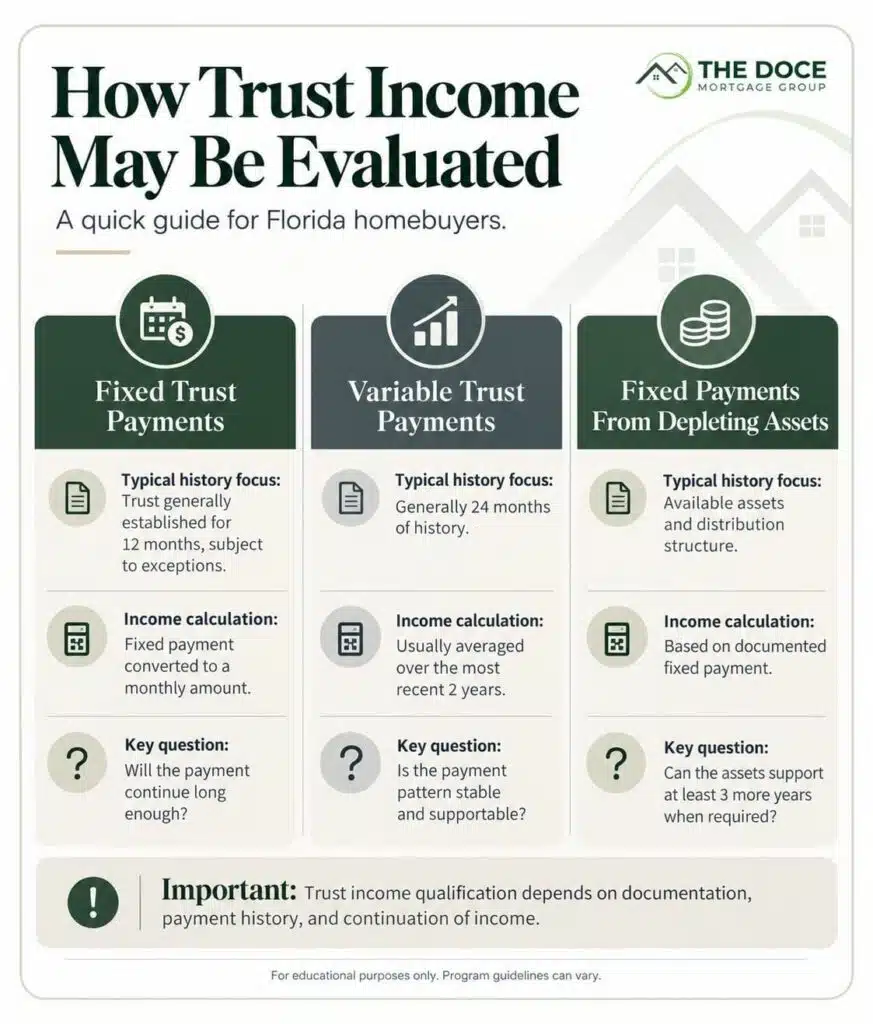
Does Fixed or Variable Trust Income Make a Difference?
Yes. Fixed and variable trust payments can have significantly different history and calculation requirements.
Fannie Mae’s current guidelines generally require a longer documented history for variable trust payments, while qualifying fixed payments may be based on the payment amount established by the trust documents.
Trust Income Qualification Chart
| Income Type | Typical History Focus | Income Calculation | Key Continuation Question |
|---|---|---|---|
| Fixed trust payments | Trust generally established for 12 months, subject to exceptions | Fixed payment converted to a monthly amount | Will the payment continue long enough? |
| Variable trust payments | Generally 24 months of history | Usually averaged over the most recent 2 years | Is the payment pattern stable and supportable? |
| Fixed payments from depleting assets | Available assets and distribution structure | Based on documented fixed payment | Can the assets support at least 3 more years when required? |
Variable income deserves particular attention. A trust that distributed $4,000 one month, $12,000 another month, and nothing during several other months can require a different analysis from a trust that pays exactly $8,000 every month.
That doesn’t automatically make variable trust income unusable. It simply means we need to understand the history before deciding how much of it can reasonably be counted.
Which Florida Mortgage Options Work With Trust Income?
Trust income can work with several Florida mortgage options, depending on how the trust pays you, your credit profile, the property, and the rest of your finances.
For many buyers, a conventional mortgage is the first option to evaluate because documented trust distributions may be used as qualifying income when they meet program requirements.
But a standard mortgage isn’t always the best fit. If you’re a trust beneficiary with substantial liquid wealth but irregular distributions, we can also evaluate an asset-based mortgage. Instead of relying mainly on recurring personal income, these programs can convert eligible checking, savings, investment, or retirement assets into monthly qualifying income.
That can be especially useful for retirees, business owners, or high-net-worth buyers. Asset depletion loans can preserve flexibility when your balance sheet is stronger than your monthly income suggest
If you’re buying an investment property, trust income may not even need to be the central qualification issue. Florida DSCR loans are designed around the property’s rental income rather than traditional personal income documentation.
What If Your Trust Income Doesn’t Fit Standard Rules?
You may still have options if your trust distributions are too new, too irregular, or structured in a way that doesn’t fit standard guidelines.
This is where looking at the entire financial picture matters. A buyer could have a strong trust, significant brokerage assets, excellent credit, and a large down payment, yet still have difficulty showing a predictable monthly distribution. In that situation, reviewing our asset-based loan options may make more sense than forcing the trust into a standard income calculation.
I’ve seen financially strong buyers assume they couldn’t qualify simply because their income didn’t arrive like a salary. My approach is to identify what actually makes the buyer financially strong, then compare the programs designed to document that strength appropriately.
If you want us to review your trust income and overall financial profile before you shop, you can begin with our mortgage application portal.
How Do Florida Housing Costs Affect Qualification?
Florida housing costs can affect qualification significantly because the monthly housing payment includes more than principal and interest.
Property taxes, homeowners insurance, flood insurance when required, condo or HOA dues, and other property-specific expenses can all change the amount of mortgage you can support with the same trust income.
In August 2026, single-family inventory was 13% lower than a year earlier, according to Florida Realtors. Condo and townhouse inventory was down 11.5%. Those statewide numbers don’t predict a particular neighborhood, but they reinforce the importance of evaluating the complete monthly payment before choosing a price range.
I pay particular attention to insurance, HOA, and condo costs in Florida. A buyer may qualify comfortably for one $500,000 property and have a much tighter calculation on another $500,000 property because the recurring housing expenses are very different.
Florida Housing Costs That Affect Qualification
| Cost | Why It Matters |
|---|---|
| Mortgage principal and interest | Usually the largest part of the monthly housing expense |
| Property taxes | Vary by property, location, exemptions, and assessed value |
| Homeowners insurance | Can materially change the monthly payment in Florida |
| Flood insurance | May be required depending on the property and flood risk |
| HOA or condo dues | Generally included when evaluating recurring housing obligations |
Pros and Cons of Using Trust Income
Using trust income can make homeownership possible without depending on traditional employment income, but the structure of the trust matters.
Pros
- Trust distributions may provide substantial qualifying income
- Fixed distributions can be easier to document than irregular payments
- Trust income can sometimes be combined with retirement or employment income
- Strong assets may create additional qualification options
Cons
- Variable distributions may require more history
- Trust documents may need detailed review
- Some income may not be usable if continuation can’t be established
- Florida insurance, taxes, and HOA costs can reduce purchasing power
Myths Vs Facts
Myth: You need a regular job to buy a Florida home.
Fact: Qualifying income can come from documented sources such as eligible trust distributions and retirement income.
Myth: If a trust contains millions of dollars, the full balance counts as income.
Fact: Trust assets and trust income aren’t the same thing. The usable amount depends on the trust structure and mortgage program.
Myth: Irregular trust payments automatically prevent you from qualifying.
Fact: Variable trust income can sometimes qualify with sufficient history, and substantial liquid assets may create other options.
Common Mistakes
Trust income can be a strong qualifying income source, but small planning mistakes can make the process harder than it needs to be.
One common mistake is assuming the trust balance and trust income are interchangeable. They aren’t. A trust may hold substantial assets while providing relatively small distributions, or it may provide large distributions from assets that are gradually being depleted.
Another mistake is changing the distribution schedule shortly before applying. If you’ve historically received irregular payments and suddenly begin receiving fixed monthly distributions, additional documentation may be needed to understand the change.
Buyers also sometimes use trust assets for a large down payment without considering how that withdrawal affects the assets supporting future income. Under Fannie Mae’s current trust-income rules, trust assets being used for the down payment, closing costs, or reserves must be subtracted when those same assets are being evaluated to determine whether income can continue.
I also recommend keeping a clear paper trail. Moving large amounts between multiple accounts right before buying can create unnecessary documentation work.
Finally, don’t choose a property based only on its purchase price. Florida insurance, property taxes, flood coverage, condo fees, and HOA dues can materially change the monthly housing expense. Understanding what happens during mortgage underwriting can help you see why income, assets, debts, and the property itself all matter.
Trust Income Readiness Chart
| Your Situation | What We Would Review First | Likely Next Step |
|---|---|---|
| Fixed monthly trust distribution | Trust terms and payment history | Evaluate standard mortgage options |
| Variable trust distributions | 24-month income history and current receipt | Determine usable average income |
| New fixed-payment trust | Creation date, grantor, payment terms, first distribution | Check whether current rules allow qualification |
| Large assets with limited distributions | Accessible investment and retirement assets | Compare asset-based qualification |
| Trust beneficiary buying a rental | Property rent and investment structure | Compare conventional and DSCR options |
Key Facts
- Trust income can potentially qualify for a Florida home purchase
- Fixed and variable trust payments aren’t evaluated the same way
- Variable trust income generally requires more history
- Fixed payments may require proof that the trust has existed for at least 12 months, subject to current exceptions
- Income from depleting trust assets may need to continue for at least 3 years
- Trust assets used for closing may reduce assets available to support continuing income
- Trust income can sometimes be combined with Social Security, pension, employment, or other qualifying income
- Asset-based programs may help buyers whose wealth is easier to document than recurring income
- Property taxes, insurance, flood coverage, and HOA expenses affect Florida purchasing power
Florida home values also remain much higher than they were several years ago. The Federal Housing Finance Agency reported that Florida single-family home prices were 0.96% higher in the second quarter of 2026 than a year earlier and 37.47% higher than 5 years earlier. That makes careful payment planning particularly important for buyers relying primarily on investment or trust income.
People Also Ask
Does trust income count as taxable income for mortgage qualification?
Mortgage qualification and tax treatment aren’t the same question. Some trust distributions may be taxable and others may receive different tax treatment depending on the trust and the nature of the distribution. Your mortgage professional can determine how documented income is treated for qualification, while tax questions should be reviewed with a qualified tax professional.
Can a trustee write a letter verifying my trust income?
Yes, a trustee’s statement may be acceptable documentation in certain situations. Fannie Mae also identifies documents such as the trust agreement, trust tax returns, or a letter from an accountant or attorney who reviewed the trust documents. Additional evidence of actual payments may also be required.
What if I have plenty of money in a trust but don’t receive regular distributions?
You may still have alternatives. Depending on how the assets are held and whether they’re accessible, we can evaluate whether an asset-based program could convert eligible assets into qualifying monthly income. If you’re purchasing an investment property, a DSCR program may offer another approach based primarily on the property’s rental income.
Ready to Buy a Florida Home With Trust Income?
Yes, trust income can open the door to buying a Florida home, but the right strategy starts with understanding exactly how your trust is structured.
Our goal is to look beyond a single income number. We review the trust documents, payment history, available assets, other income, debts, down payment, and the actual costs of the Florida property you’re considering. Then we can compare the programs that fit your financial situation rather than trying to force you into one approach.
We’re also proud that The Doce Mortgage Group recently received the prestigious WalletHub Award for being one of the best mortgage brokers in several cities throughout Florida. Our customer reviews also reflect the experiences of more than 1,500 clients who have given us 5-star reviews.
If you’re receiving trust income and wondering how much home you may qualify to buy in Florida, we’ll help you understand your options before you make an offer, you can Get Started Now, or connect with a loan officer live at 305-661-3434.