

Quick Answer
An interest only jumbo mortgage in Florida can make sense when you have strong reserves, uneven income, and a realistic principal repayment plan. It’s a poor fit if only the introductory payment makes the home affordable.
In This Article
Buying a waterfront home in Fort Lauderdale or a larger property in Naples can raise a practical question: should you pay down your mortgage every month or keep more cash available? An interest only structure changes that timing. Understanding what happens later matters just as much as knowing your first payment.
A Personal Story
I helped a buyer interested in a waterfront condo who initially focused on the offer price. Once we examined the building’s finances, insurance, and reserves, the decision became more involved. The buyer’s income and credit were only part of the picture. The property needed just as much attention.
My advice is to apply that same care when comparing mortgage payments. With jumbo condo and waterfront financing, a smaller initial payment doesn’t remove the building’s expenses. Before choosing interest only financing, account for association dues, insurance, and potential assessments. Keeping cash available helps only when your overall budget still works.
What Is an Interest Only Jumbo Mortgage in Florida?
It’s a mortgage above your county’s conforming loan limit that allows interest payments without required principal payments for a defined period.
For 2026, FHFA sets the single-unit conforming limit at $832,750 in Miami-Dade and $990,150 in Monroe County. The limit concerns your loan amount, not the home’s price. These thresholds determine the size boundary for mortgages eligible for purchase by Fannie Mae and Freddie Mac.
The Doce Mortgage Group offers interest only home loans with 5, 7, or 10 year interest only periods, subject to program eligibility. Available structures can include jumbo financing for primary homes, second homes, and investment properties.
Interest only describes how you repay. Fixed or adjustable describes how your rate behaves. Don’t assume your rate stays fixed throughout the interest only period.
How Much Can the Initial Payment Change?
The difference depends on your balance, interest rate, and the repayment term you’re comparing.
Consider a hypothetical $1,000,000 mortgage at 7%, with a 30 year total term and 10 years of interest only payments. This rate illustrates the math, not a current offer. Assume no extra principal payments and no rate changes.
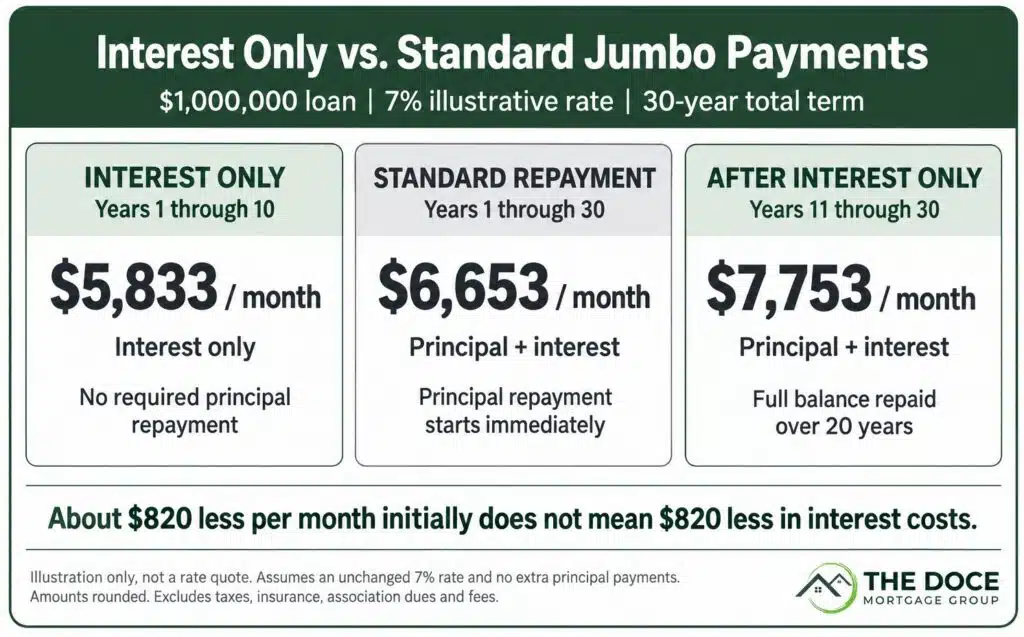
The initial difference is about $820 monthly. It’s deferred principal repayment, not an $820 reduction in interest expense. When repayment begins, the same balance must be paid over 20 remaining years.
The CFPB explains that payments can increase even when the interest rate stays unchanged. An adjustable rate could add another increase.
These figures exclude taxes, insurance, association dues, and fees. You can use our Mortgage Payment Calculator to estimate a standard repayment comparison with ownership expenses. It doesn’t model the interest only transition, which needs a separate calculation.
Who Might Benefit From This Structure?
Buyers with substantial reserves and reliable income that arrives unevenly may benefit from the initial payment flexibility.
A business owner might receive quarterly distributions. An executive might receive a salary plus an annual bonus. Keeping cash accessible can be useful, but expected income isn’t guaranteed income.
Interest Only Suitability at a Glance
| Potentially Suitable | Needs Closer Review | Poor Fit |
|---|---|---|
| Strong reserves after closing | Income depends heavily on bonuses | Savings exhausted at closing |
| Clear purpose for retained cash | Plans to sell before repayment begins | Depends on rising home prices |
| Can afford later payments | Investments would fund repayment | Cannot afford later payments |
I’d compare the later payment against today’s dependable income before counting on raises or investment gains. If that payment feels uncomfortable, a smaller purchase or a traditional jumbo structure may be a better starting point.
What Happens When Interest Only Payments End?
Your payment usually increases because you must begin repaying principal over the remaining loan term.
That transition is separate from an interest rate adjustment. With an adjustable rate mortgage, your rate follows its own schedule. The rate could change before, during, or after the switch to principal repayment, depending on your contract.
Before signing, confirm the first adjustment date, adjustment frequency, rate caps, and how the future rate is calculated. Also confirm whether your agreement requires full repayment through monthly installments or includes a balloon payment, meaning a large balance becomes due at once.
Your Payment Planning Timeline
| Before Closing | During Interest Only Payments | When Principal Repayment Begins |
|---|---|---|
| Review the complete payment schedule | Maintain accessible reserves | Budget for principal plus interest |
| Check rate adjustment terms | Review your repayment plan annually | Account for any rate adjustment |
| Test the later payment against income | Consider optional principal payments | Confirm the remaining payoff schedule |
Selling or refinancing might be part of your plan, but neither should be your only backup. A sale takes time, and refinancing requires a new approval based on your finances, the property’s value, and available programs.
I’d want your mortgage plan to work even if your next bonus arrives late or your home takes longer to sell.
What Does It Take to Qualify?
You’ll generally need strong credit, documented repayment ability, a suitable down payment, and money remaining after closing.
There isn’t a universal qualification checklist for an interest only jumbo mortgage in Florida. Requirements vary by loan amount, property, occupancy, and income documentation.
The Doce Mortgage Group describes an ideal interest only borrower profile that includes a credit score of 700 or higher, 20% to 30% down, and 12 to 24 months of reserves. Those are planning guidelines, not guaranteed approval terms or requirements for every available program.
Reserves are qualifying assets left after your down payment and closing costs. Retirement accounts and investments may receive different treatment from cash, so don’t assume every dollar counts equally.
Your Florida mortgage documentation may include income records, account statements, debt information, and property details. The smaller introductory payment doesn’t mean qualification is based only on that amount.
Standard documentation often relies on pay records and tax returns. For eligible business owners, The Doce Mortgage Group offers bank statement financing, which may provide another way to document qualifying income. Confirm whether that option can be combined with the interest only terms you want.
A traditional jumbo mortgage should remain part of the comparison. Also, an advertised low down payment jumbo option doesn’t automatically carry the same requirements as an interest only program.
Florida Ownership Costs Beyond the Mortgage
Florida’s property expenses can change the value of a lower initial mortgage payment.
In August 2026, Florida Realtors reported a statewide median existing single-family home price of $415,000 and a condo-townhouse median of $298,000. These statewide figures provide context, but they don’t establish the value or resale outlook of a particular luxury property.
For a coastal home in Naples or Palm Beach, obtain property-specific insurance quotes early. Review wind coverage, hurricane deductibles, flood coverage, and any exclusions. A deductible can create a substantial cash need even when you’ve budgeted for the annual premium.
Estimate property taxes for your purchase circumstances instead of carrying forward the seller’s bill without checking it. For a Miami Beach condo, review association dues, reserve funding, building reports, and pending special assessments.
My priority would be keeping enough cash available for both scheduled bills and unexpected property costs. Money reserved for a roof repair shouldn’t also be counted as your future principal repayment fund.
Pros and Cons
The main benefit is flexibility in when you repay principal. The main tradeoff is carrying that debt longer.
Interest Only Jumbo Benefits and Tradeoffs
| Potential Benefit | Tradeoff to Consider |
|---|---|
| Lower required initial payment | Higher required payment when principal repayment starts |
| More cash available after each payment | No balance reduction from interest only payments |
| Flexibility around uneven income | Bonuses and distributions can fall short |
| Ability to retain investments | Investment returns may not cover borrowing costs |
| Optional principal payments, subject to terms | Extra payments reduce cash available for other needs |
At the same rate, deferring principal generally increases total interest over the full loan term. Compare actual rates, fees, and your expected ownership period before deciding.
We can prepare a free mortgage quote that compares available structures, including the initial payment, later payment, and cash needed at closing.
Myths Vs Facts
Interest only financing is easier to evaluate when you separate payment flexibility from actual borrowing costs.
Interest Only Mortgage Reality Check
| Myth | Fact |
|---|---|
| Myth: A smaller payment means cheaper financing | Fact: Delaying principal repayment can increase total interest |
| Myth: Interest only payments build equity | Fact: They don’t reduce principal, although property values can change |
| Myth: Refinancing solves the future payment increase | Fact: Refinancing depends on qualifying again under available terms |
| Myth: Interest only means unpaid interest accumulates | Fact: Paying all required interest doesn’t add that interest to principal |
The CFPB cautions that selling or refinancing might not be available when payments increase. Your finances could change, or the property could lose value. A workable repayment plan accounts for those possibilities.
Common Mistakes
A common mistake is treating retained cash as extra spending money. If you choose interest only financing to preserve reserves, decide where those reserves will stay and what they’re intended to cover.
Another mistake is comparing offers with different assumptions. Use the same loan amount and ownership period, then compare rates, points, closing costs, and projected balances. A lower advertised rate can come with higher upfront charges.
Don’t confuse flexible qualification with relaxed repayment expectations. A Florida portfolio mortgage may accommodate certain financial situations, but it doesn’t automatically offer interest only payments or easier approval.
I’d also check prepayment terms before planning a large principal payment. Ask whether a penalty applies, how extra payments are credited, and whether reducing principal changes your required payment.
You can begin through our secure application portal, and we’ll review your income, assets, property, and preferred repayment structure.
Key Facts
- Jumbo status depends on loan size and the applicable county limit
- Interest only periods postpone required principal repayment
- Fixed rates and interest only payments describe different loan features
- Property taxes, insurance, and association expenses still apply
- Future refinancing and home appreciation aren’t guaranteed
- Compare the later payment, total costs, and remaining balance before choosing
People Also Ask
Is an interest only jumbo mortgage a balloon loan?
Not necessarily. Some loans switch to scheduled principal and interest payments. Others may require a large balance at maturity. Your agreement determines which structure applies.
Can an investment property qualify based on rental income?
Eligible properties may qualify through The Doce Mortgage Group’s DSCR loan options, including available interest only structures. These programs evaluate rental income relative to qualifying property expenses and debt payments. They aren’t intended for your primary residence.
What happens if my home loses value?
Your mortgage balance doesn’t fall with the property’s value. Lower equity can make selling or refinancing harder, especially when you haven’t been reducing principal.
Our Approach to Your Florida Jumbo Mortgage
At The Doce Mortgage Group, we’ll help you compare an interest only jumbo mortgage in Florida with other available options using your actual numbers. Our focus is the complete picture: cash at closing, monthly expenses, future payments, and your plan for repaying principal.
We want you to understand why a structure fits your goals before you choose it. Our customer reviews share borrowers’ experiences working with our team.
We’re also proud that The Doce Mortgage Group recently received the prestigious WalletHub Award, recognizing us as one of the best mortgage brokers in several cities throughout Florida.
When you’re ready to compare your options with our team, you can get started now, or connect with a loan officer live at 305-661-3434.