
Quick Answer
The best Florida Mortgage Insurance Premiums depend on your mortgage type, down payment, loan-to-value ratio, credit profile, and how long the insurance will remain. FHA MIP follows HUD rules, while conventional PMI pricing varies more by borrower and transaction.

Florida Mortgage Insurance Premiums can change both your cash needed at closing and your monthly payment. The smartest comparison isn’t simply which option has the lowest monthly insurance charge. You also need to consider upfront insurance, how long the premium may last, your interest rate, and how much cash you want to keep after closing.
A Personal Story
I worked with a buyer who was deciding between FHA and conventional financing and initially focused only on the interest rate. FHA looked attractive at first, but once I compared the upfront MIP, monthly MIP, conventional PMI, down payment, and likely insurance duration, the difference became much clearer.
My advice is to compare the entire cost over the period you realistically expect to keep the mortgage. A slightly lower monthly premium doesn’t automatically win if another option requires more cash upfront or keeps mortgage insurance in place much longer.
What Are Florida Mortgage Insurance Premiums?
Florida Mortgage Insurance Premiums are charges tied to certain mortgage programs when the financing structure requires protection against borrower default.
The 2 terms buyers hear most often are FHA Mortgage Insurance Premium, or MIP, and conventional Private Mortgage Insurance, or PMI. They aren’t the same thing.
FHA MIP follows a published HUD structure. Conventional PMI is privately priced and can vary based on factors such as credit, LTV, occupancy, property type, and mortgage structure.
Mortgage insurance is also completely different from homeowners insurance. Mortgage insurance protects the financing side of the transaction. Homeowners insurance protects the property against covered losses.
Our explanation of how mortgage insurance works goes deeper into that distinction.
How Is FHA Upfront Mortgage Insurance Calculated?
Standard FHA purchase financing generally charges upfront mortgage insurance equal to 1.75% of the base mortgage amount.
HUD’s current FHA mortgage insurance structure confirms the 1.75% upfront rate for standard purchase and refinance transactions.
Using the July 2026 statewide median single-family sale price of $425,000 reported by Florida Realtors as an example:
$425,000 purchase price
3.5% down = $14,875
Base FHA mortgage = $410,125
1.75% upfront MIP = about $7,177
The upfront premium can usually be financed rather than paid entirely in cash. That reduces the amount needed at closing, but it also increases the balance being financed.
You can test your own purchase price and down payment using our FHA Loan Calculator, which estimates upfront MIP, annual MIP, taxes, insurance, and the full payment.
How Is FHA Annual MIP Calculated?
FHA annual MIP is based mainly on the mortgage term, original LTV, and applicable mortgage amount category, then collected through monthly installments.
For a common 30-year FHA purchase with more than 95% LTV, HUD currently uses a 0.55% annual MIP rate in the standard mortgage-size category.
Using the same $410,125 base mortgage, a simple first-year planning estimate looks like this:
$410,125 × 0.55% = about $2,256 annually
$2,256 ÷ 12 = about $188 monthly
The actual monthly amount changes as the mortgage amortizes, so this is a planning estimate rather than a permanent fixed charge.
FHA Mortgage Insurance Cost Snapshot
| Factor | Amount |
|---|---|
| HOME PRICE | $425,000 |
| DOWN PAYMENT | $14,875 |
| BASE FHA MORTGAGE | $410,125 |
| UPFRONT MIP | $7,177 |
| ANNUAL MIP RATE | 0.55% |
| EST. MONTHLY MIP | ~$188 |
How Does Your Down Payment Change FHA Mortgage Insurance?
A larger FHA down payment can change both the annual premium structure and how long annual MIP remains.
For many current FHA mortgages, the key dividing line is an original LTV of 90%.
FHA Down Payment And MIP Duration
| Original FHA LTV | Approximate Down Payment | Typical MIP Duration |
|---|---|---|
| Above 90% | Less than 10% | Mortgage term |
| 90% or below | At least 10% | 11 years |
That means a buyer putting 3.5% down generally shouldn’t assume FHA MIP will disappear simply because the property later reaches 20% equity. By contrast, starting at 90% LTV or lower generally limits annual MIP to 11 years under current HUD rules.
This is one reason I like to compare the down payment and insurance timeline together. Putting more down may reduce long-term insurance, but tying up extra cash isn’t automatically the better financial move.
The Doce Mortgage Group’s Florida FHA loan options can help buyers compare the low-down-payment advantages of FHA with the insurance costs that come with that structure.
How Is Conventional PMI Calculated?
Conventional PMI is priced according to the risk characteristics of the mortgage, so there isn’t 1 universal percentage that applies to every Florida buyer.
Unlike FHA MIP, conventional PMI doesn’t use a single government-set premium schedule. Pricing can change based on:
- Credit profile
- Loan-to-value ratio
- Down payment
- Mortgage term
- Property type
- Occupancy
- Mortgage insurance coverage level
- Other transaction characteristics
Current Fannie Mae mortgage insurance requirements generally apply mortgage insurance coverage to qualifying conventional first mortgages above 80% LTV.
That means 2 buyers purchasing identical $425,000 homes with the same 5% down payment could still receive different PMI pricing if their credit profiles or other transaction details differ.
Which Factors Can Reduce Conventional PMI?
A stronger credit profile and lower LTV are 2 of the most important factors that can reduce conventional PMI costs.
Putting more money down lowers the percentage of the home’s value being financed. Improving credit may also reduce the risk reflected in PMI pricing.
Conventional PMI Pricing Factors
| Factor | Lower-Cost Direction | Higher-Cost Direction |
|---|---|---|
| Credit Profile | Stronger | Weaker |
| LTV | Lower | Higher |
| Down Payment | Larger | Smaller |
| Property Profile | Standard | Higher Risk |
| Occupancy | Primary Residence | Investment |
| Mortgage Structure | Lower Risk | Higher Risk |
Fannie Mae’s 2026 pricing framework also shows how credit score and LTV can interact when mortgage insurance coverage and related pricing are evaluated.
I don’t automatically recommend putting another $20,000 or $30,000 into a home just to reduce PMI. If the monthly savings are modest, keeping that cash available for emergencies, repairs, or other financial goals may be more valuable.
When Can Conventional PMI Be Removed?
Conventional PMI may often be removed once applicable equity, payment-history, and other requirements are satisfied.
The CFPB’s PMI cancellation guidance explains 2 especially important thresholds. A qualifying homeowner can generally request PMI cancellation when the scheduled principal balance reaches 80% of the home’s original value. Automatic termination generally occurs when the scheduled balance reaches 78%, provided applicable requirements are met and payments are current.
Fannie Mae also has circumstances where current property value may support earlier cancellation after applicable seasoning and LTV requirements are satisfied.
This potential exit is one of the biggest differences between conventional PMI and FHA MIP.
Is FHA Or Conventional Mortgage Insurance Cheaper?
Neither FHA MIP nor conventional PMI is always cheaper, because the better option depends on your credit, down payment, mortgage amount, and how long you expect to keep the financing.
FHA MIP Vs Conventional PMI
| Feature | FHA MIP | Conventional PMI |
|---|---|---|
| Pricing method | HUD schedule | Risk-based |
| Upfront insurance | Usually 1.75% | Usually none |
| Monthly insurance | Most FHA mortgages | Generally above 80% LTV |
| Credit sensitivity | Less direct | Can be significant |
| Removal | Based mainly on original LTV | Often cancellable |
| 20% down | MIP may still apply | PMI generally avoided |
A buyer with moderate credit and 3.5% down may find FHA attractive because the mortgage insurance pricing isn’t driven as heavily by credit. A buyer with excellent credit and 5% or 10% down may find conventional PMI more competitive, especially because it may eventually be removed without refinancing.
The details matter more than the labels. The Doce Mortgage Group’s explanation of how FHA loans work in Florida shows why FHA can be attractive for smaller down payments and more flexible qualification, while our conventional mortgage options may provide a different insurance and equity strategy.
You can begin through our secure application portal so we can compare actual FHA and conventional scenarios using your credit, down payment, property, and expected ownership period.
What About VA, USDA, And Other Mortgage Insurance Structures?
VA and USDA financing handle this expense differently, so buyers shouldn’t assume every low-down-payment mortgage uses PMI or FHA-style MIP.
VA financing doesn’t require monthly PMI. A VA funding fee may apply, although qualifying borrowers can be exempt.
USDA financing uses an upfront guarantee fee and an annual guarantee fee rather than conventional PMI.
The important lesson is that a mortgage advertised as having “no PMI” isn’t automatically the cheapest choice. Interest rate, upfront charges, recurring fees, down payment, and how long you expect to keep the mortgage should all be compared together.
How Should You Compare Monthly And Upfront Insurance Costs?
You should compare mortgage insurance over the period you realistically expect to keep the mortgage, not simply compare the first monthly premium.
Consider a buyer purchasing a $425,000 Florida home. FHA may require less cash upfront than another option, but it also includes the 1.75% upfront MIP discussed earlier. Conventional financing may avoid that upfront insurance charge while using monthly PMI instead.
The comparison should include:
- Down payment
- Upfront mortgage insurance
- Monthly mortgage insurance
- Interest rate
- Complete monthly payment
- Cash remaining after closing
- Expected insurance duration
- Expected time in the home
I tell buyers to put a time frame on the decision. If you expect to own the home for 5 years, compare the likely 5-year cost. A mortgage that looks cheaper in month 1 may not remain cheaper over 60 payments.
The assumption that every buyer should simply put 20% down is one of the common Florida down payment myths. Preserving cash can sometimes be worth paying temporary mortgage insurance.
Can Refinancing Reduce Or Eliminate Mortgage Insurance?
Refinancing can sometimes eliminate mortgage insurance, but the new financing needs to save enough money to justify its costs.
A homeowner with FHA financing may eventually build enough equity to qualify for conventional financing without PMI. Refinancing could then eliminate ongoing FHA MIP.
Before making that decision, compare:
- Current interest rate
- New interest rate
- Remaining MIP
- New PMI, if any
- Closing costs
- Property value
- Break-even period
Suppose refinancing removes $188 per month of FHA MIP but costs $6,000. If nothing else changed, it would take almost 32 months to recover those costs.
The real calculation is more complicated because the interest rate and monthly principal-and-interest payment may also change.
I’ve seen homeowners become so focused on eliminating mortgage insurance that they overlook a higher replacement rate. Removing MIP isn’t a savings strategy if the new mortgage costs more overall.
When Does Mortgage Insurance Stop?
Mortgage insurance stops according to very different rules depending on the mortgage program.
Mortgage Insurance Exit Comparison
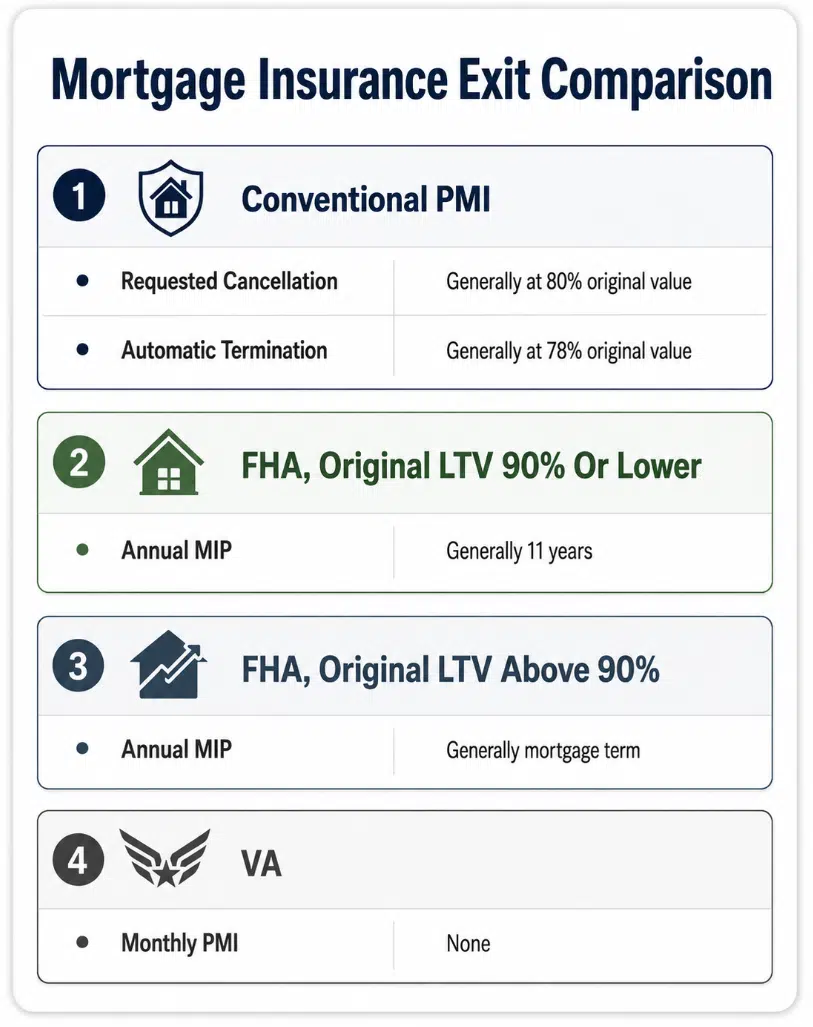
The CFPB’s PMI cancellation rules explain the 80% request and 78% automatic termination standards for qualifying conventional mortgages.
This is why insurance duration should be part of the comparison from the beginning.
Pros And Cons Of Mortgage Insurance
| Pros | Cons |
|---|---|
| Allows smaller down payments | Raises monthly housing costs |
| Can preserve emergency savings | FHA includes upfront MIP |
| May allow buying sooner | FHA MIP may remain long term |
| FHA offers credit flexibility | Conventional PMI varies by profile |
| Conventional PMI may be removed | Insurance doesn’t protect the homeowner |
Mortgage insurance isn’t automatically good or bad. Its value depends on what you receive in exchange for the added cost.
Myths Vs Facts
Myth: Mortgage insurance protects your home
Fact: It primarily protects against losses related to mortgage default
Myth: You always need 20% down
Fact: Many mortgage programs allow much smaller down payments
Myth: FHA MIP disappears when you reach 20% equity
Fact: FHA MIP duration depends mainly on original LTV
Myth: Conventional PMI lasts for 30 years
Fact: Qualifying PMI can often be canceled much earlier
Myth: The lowest monthly premium means the cheapest mortgage
Fact: Rate, upfront costs, duration, and total payment all matter
Common Mistakes
- Comparing only the interest rate
- Ignoring FHA upfront MIP
- Confusing FHA MIP with PMI
- Assuming FHA MIP automatically disappears
- Missing PMI cancellation opportunities
- Putting down extra cash without calculating savings
- Ignoring credit before comparing conventional PMI
- Comparing monthly payments without cash-to-close costs
Key Facts
- Standard FHA upfront MIP is 1.75%
- Many 30-year FHA buyers pay 0.55% annual MIP
- FHA MIP duration depends on original LTV
- Conventional PMI commonly applies above 80% LTV
- Conventional PMI pricing is risk-based
- PMI may eventually be canceled
- VA doesn’t require monthly PMI
- Lowest premium doesn’t always mean lowest total cost
How Can The Doce Mortgage Group Help You Compare Mortgage Insurance?
We’ve spent more than 38 years helping Florida buyers compare mortgage options based on the complete financial picture. We can calculate FHA upfront and annual MIP, obtain actual conventional PMI pricing, compare different down payments, and show how long each insurance expense may remain.
Our goal is to help you determine which combination of down payment, monthly cost, cash reserves, and mortgage insurance makes the most sense for you. You can see what clients have said about working with us through our customer reviews.
The Doce Mortgage Group was also recognized as one of the best mortgage brokers in several cities throughout Florida. You can get a free quote from our team to compare your actual Florida Mortgage Insurance Premiums.
When you’re ready to move forward, you can Get Started Now, or connect with a loan officer live at 305-661-3434.