
Quick Answer
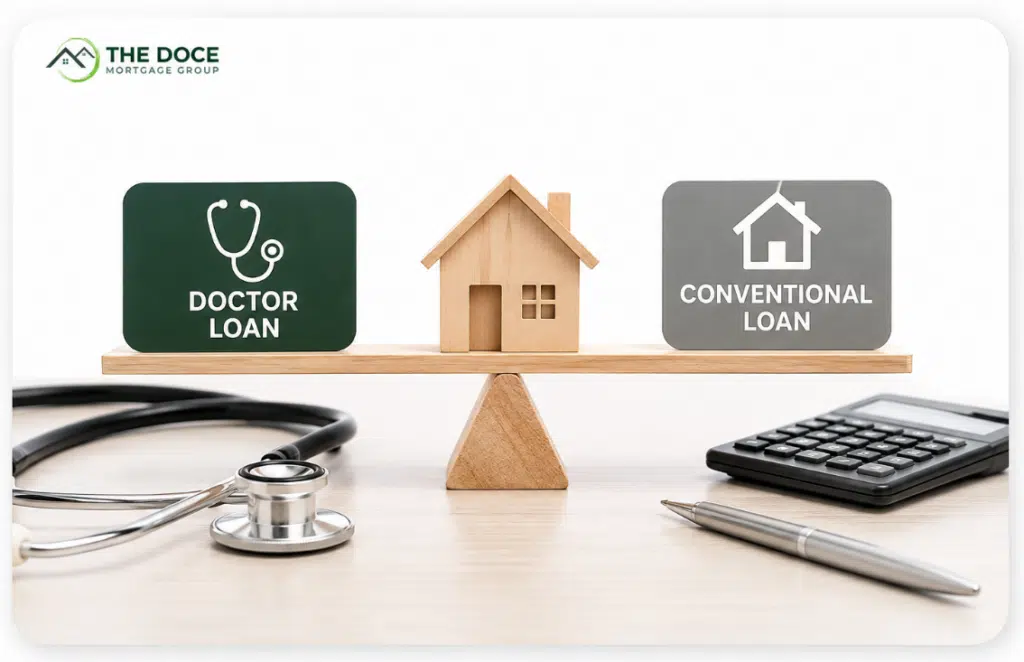
Neither option is always better. A doctor loan can be especially valuable for physicians with limited savings, significant student debt, or a new employment contract, while a conventional loan may cost less for an established doctor with strong credit and substantial cash available.
Florida physicians often have an unusual financial profile. A resident finishing training may have a signed $300,000 employment contract but relatively little cash and $250,000 in student loans. An established surgeon may have the same income but substantial savings and minimal debt.
Comparing a doctor loan vs conventional loan in Florida means looking at where you are in your career, not simply choosing the mortgage with the lowest advertised rate.
A Personal Story
There was a physician who was preparing to start a much higher-paying position but assumed he should wait another year before buying. His income was about to increase dramatically, yet years of medical training had left him with significant student debt and less down payment savings than his future salary might suggest.
I advised him to compare the cost of waiting with the cost of financing now. That’s something I encourage doctors to do often. Preserving $100,000 or more in cash can be valuable during a relocation or career transition, but sometimes putting more down and choosing conventional financing produces the better long-term result.
How Do Doctor Loans and Conventional Loans Differ?
Doctor loans are designed around the unusual career and financial circumstances of medical professionals, while conventional mortgages use broader qualification guidelines that apply to the general homebuying population.
The Doce Mortgage Group’s current Florida Doctor Loan program offers qualifying medical professionals up to $2,000,000 with 0% down and financing up to $3,000,000 with 10% down. Qualified doctor loan options also eliminate private mortgage insurance and can offer more favorable treatment of student debt and future employment contracts.
By comparison, Florida conventional mortgages generally follow Fannie Mae and Freddie Mac guidelines. Qualifying first-time buyers may have options starting at 3% down, while putting less than 20% down will commonly mean paying private mortgage insurance.
That distinction can matter considerably in Florida. According to Florida Realtors’ July 2026 housing market data, the statewide median price for existing single-family homes was $425,000. Physicians purchasing in higher-cost areas such as Miami, Fort Lauderdale, Boca Raton, Palm Beach, Naples, or certain waterfront communities can easily be shopping well above that statewide midpoint.
Doctor Loan Vs Conventional Loan at a Glance
| Feature | Doctor Loan | Conventional Loan |
|---|---|---|
| Medical profession required | Yes | No |
| Minimum down payment | Potentially 0% | Can start at 3% |
| PMI | None on qualifying Doce programs | Common below 20% down |
| Student debt treatment | More flexible | Standard guidelines |
| Future employment contract | Often accepted | More restrictive |
| Higher loan amounts | Specialized options available | Conforming or jumbo structure |
| Investment property use | Generally no | Available |
Specific requirements and terms vary by program, borrower profile, property, and current market conditions.
One of the biggest mistakes I see is assuming 0% down automatically makes the doctor loan better. It may, but you still need to compare the interest rate, amount financed, available cash, PMI savings, and how long you expect to keep the mortgage.
Preserving cash can be particularly important for doctors transitioning from residency or fellowship into practice.
Who Qualifies for a Florida Doctor Loan?
Eligibility generally depends on your medical credentials, employment status, credit profile, income, and the specific doctor loan program being used.
The Doce Mortgage Group currently has physician mortgage options that may cover professionals such as MDs, DOs, DDSs, DMDs, DVMs, PharmDs, DPMs, and certain other medical professionals. Residents and fellows can also qualify under some programs.
That can be particularly useful for doctors relocating within Florida to join hospital systems, private practices, dental groups, veterinary practices, or specialty medical organizations. A physician moving to South Florida, Tampa, Orlando, Jacksonville, or Naples may be purchasing a home before the first paycheck from the new position arrives.
The medical degree alone doesn’t guarantee qualification. Credit, employment documentation, assets, property type, purchase price, and overall financial strength still matter.
Where Each Loan Has The Advantage
| Borrower Situation | Doctor Loan Advantage | Conventional Advantage |
|---|---|---|
| Limited down payment savings | Strong | Limited |
| Large student loan balance | Strong | Limited |
| New physician employment | Strong | Limited |
| 20% down readily available | Moderate | Strong |
| Established income history | Moderate | Strong |
| Wants broad property flexibility | Limited | Strong |
| Wants to preserve liquid cash | Strong | Moderate |
This comparison is a general starting point, not an approval guide. Actual advantages depend on the terms available to the individual borrower.
If you’re trying to compare different down payments, PMI, and monthly costs, you can run the numbers using our Mortgage Payment Calculator.
Which Loan Requires Less Cash Upfront?
A doctor loan can require substantially less cash upfront than a conventional mortgage for an eligible Florida physician.
The Doce Mortgage Group’s physician mortgage options currently offer qualifying medical professionals up to $2,000,000 with 0% down and financing up to $3,000,000 with 10% down. That can be important for a physician who has a strong income but doesn’t want to empty savings after years of medical school, residency, or fellowship.
Conventional financing can also offer relatively low down payments. Some qualifying first-time buyers may purchase with 3% down, while 5%, 10%, and 20% structures are common depending on the borrower and property.
Consider a physician buying a $750,000 Florida home:
Cash Required on A $750,000 Purchase
| Down Payment | Cash Toward Down Payment |
|---|---|
| 0% | $0 |
| 3% | $22,500 |
| 5% | $37,500 |
| 10% | $75,000 |
| 20% | $150,000 |
These figures only illustrate the down payment. Closing costs, prepaid expenses, reserves, insurance, and other costs may still apply.
I don’t automatically tell a doctor to put down as little as possible. If putting down $150,000 still leaves substantial emergency and investment reserves, conventional financing could be attractive. But if that same $150,000 represents most of the physician’s liquid savings, preserving the cash may have real value.
How Are Student Loans and Future Income Treated?
Doctor loans can offer more flexibility with medical-school debt and future employment than conventional financing.
This difference can be especially important for residents, fellows, and physicians moving to Florida for a new position. A doctor may have $200,000 or $300,000 in student debt while also having a signed employment contract showing that income will soon increase substantially.
Certain physician mortgage programs offered through The Doce Mortgage Group can use documented income-driven student loan payments rather than relying on a less favorable hypothetical payment. Some programs can also accommodate deferred or $0 income-driven payments under qualifying circumstances.
Future employment can be equally important. A physician relocating to Miami, Tampa, Orlando, Jacksonville, Fort Lauderdale, Naples, or another Florida medical market may want to close on a home before beginning the new job. Some doctor loan programs can qualify an eligible borrower using a fully executed employment contract when the start date falls within the program’s permitted timeframe.
I focus on the payment that will actually be used in qualification, not simply the size of the student loan balance. A $300,000 balance sounds intimidating, but the qualification impact can differ dramatically depending on how that payment is calculated.
This flexibility is also one reason jumbo doctor loans for Florida physicians can be useful when a new position comes with high income but the physician hasn’t yet accumulated the cash typically associated with a luxury-home purchase.
Which Loan Has Better Rates and Long-Term Costs?
Conventional financing may have better pricing in some situations, but the lowest interest rate doesn’t automatically make it the less expensive choice.
According to Freddie Mac’s Primary Mortgage Market Survey, the average 30-year fixed conventional mortgage rate was 6.65% on August 20, 2026. That national average is useful market context, but it isn’t a quote for either a doctor loan or a conventional mortgage.
A useful comparison should include:
- Interest rate
- Down payment
- PMI
- Amount financed
- Closing costs
- Monthly payment
- Cash remaining after closing
- Expected time in the home
A conventional mortgage with 10% down might carry a lower rate but also require PMI. A doctor loan could eliminate PMI and preserve $75,000 of cash on that same $750,000 purchase, while potentially carrying different pricing.
What Actually Determines The Better Financial Deal
| Cost Factor | Why It Matters |
|---|---|
| Interest rate | Changes monthly interest expense |
| Down payment | Determines cash tied up |
| PMI | Can increase conventional payment |
| Loan balance | Affects total interest expense |
| Cash reserves | Preserves financial flexibility |
| Time in home | Changes long-term cost comparison |
For physicians, I think liquidity deserves more attention than it often receives. New doctors may face relocation costs, practice expenses, vehicle replacement, childcare costs, or simply the need to rebuild savings after training.
When Is a Conventional Loan The Better Fit?
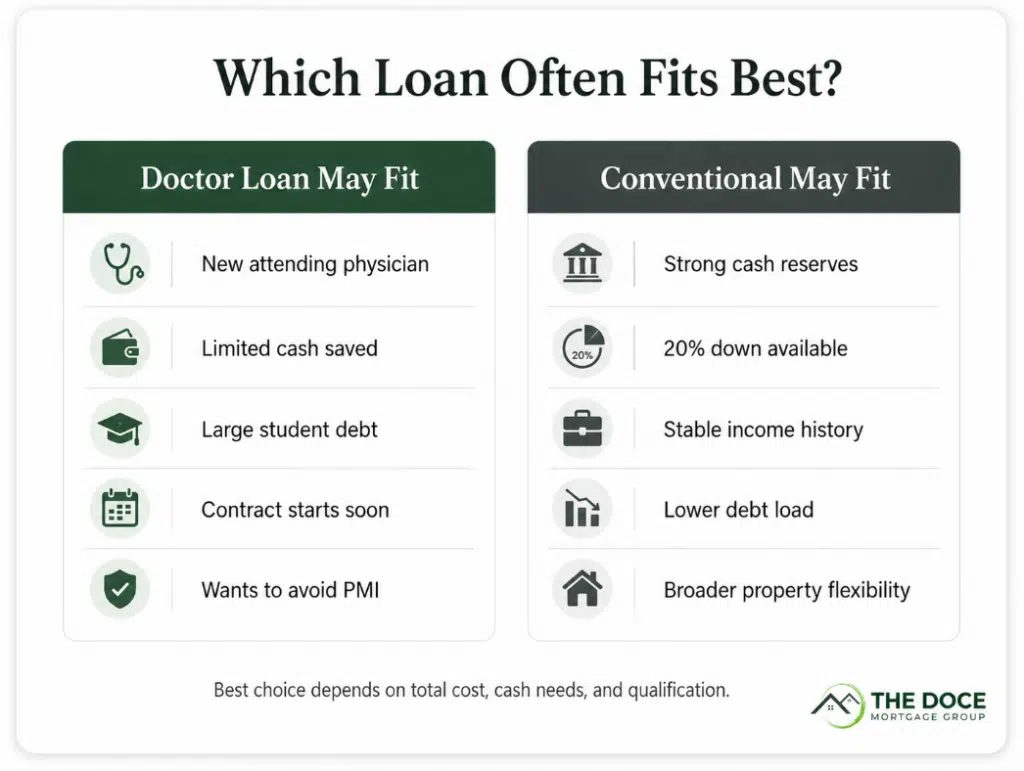
A conventional loan can be the better choice when a physician has established income, strong credit, ample savings, and little need for doctor-specific qualification flexibility.
For example, an established Florida physician who can comfortably put 20% down while retaining strong reserves may eliminate conventional PMI anyway. If conventional pricing is also more favorable, there may be little reason to pay for flexibility that isn’t needed.
Conventional financing can also offer broader options for second homes and investment properties. That matters for physicians who already own their primary residence and are purchasing another Florida property.
The key is comparing both options using identical assumptions. If you’re ready to see how your income, student debt, down payment, and employment situation affect the comparison, you can complete our secure mortgage application, and we can evaluate both structures using your actual numbers.
Pros And Cons
Both doctor loans and conventional mortgages can work well for Florida physicians, but they solve different problems.
Doctor loan advantages include:
- Little or no down payment
- No PMI on qualifying programs
- Flexible student debt treatment
- Future employment contract options
- Higher financing amounts
- Ability to preserve cash reserves
Doctor loan disadvantages include:
- Limited to eligible medical professionals
- Rates may sometimes be higher
- Program requirements can vary
- Usually focused on primary residences
- Putting little down creates more leverage
Conventional loan advantages include:
- Potentially lower interest rates
- Broad availability
- More property-use options
- Standardized qualification guidelines
- PMI can eventually be removed
- Attractive pricing for established physicians
Conventional loan disadvantages include:
- Student debt can affect qualification more
- Future employment rules may be less flexible
- PMI commonly applies below 20% down
- Conforming loan limits can matter
For context, FHFA’s 2026 conforming loan limits set the baseline 1-unit limit at $832,750. That can become relevant for physicians buying higher-priced homes in South Florida, Naples, Tampa, Orlando, or other expensive Florida markets.
Myths Vs Facts
Myth: Doctors should always choose a doctor loan
Fact: Conventional financing may be better for an established physician with substantial savings and little need for specialized qualification
Myth: You need 20% down for a conventional mortgage
Fact: Some conventional programs allow qualified buyers to purchase with much less
Myth: High medical-school debt automatically prevents homeownership
Fact: Qualification depends partly on how the specific mortgage program calculates the required student loan payment
Myth: A 0% down doctor loan means there are no upfront costs
Fact: Closing costs, prepaid expenses, insurance, and reserve requirements may still apply
Common Mistakes
One of the biggest mistakes is comparing only the interest rates. A physician should compare the complete financial effect of both options.
Other common mistakes include:
- Assuming a doctor loan is automatically cheaper
- Putting 20% down without considering liquidity
- Ignoring PMI in the conventional comparison
- Overlooking student loan calculation differences
- Buying at the maximum qualifying amount
- Underestimating Florida homeowners insurance
- Comparing mortgages using different assumptions
- Waiting until relocation to seek approval
- Ignoring condo or property restrictions
Florida physicians purchasing in Broward, Palm Beach, or Miami-Dade should also consider how local home prices can push purchases toward the upper end of conventional financing. Understanding conventional home loans across South Florida can help put those financing choices into context.
Key Facts
- Doctor loans are designed for qualifying medical professionals
- Some Doce doctor programs allow 0% down
- Qualifying doctor loans can eliminate PMI
- Conventional financing may begin with 3% down
- Student debt calculations can differ significantly
- Future employment contracts may help doctor loan qualification
- Conventional financing may offer better pricing
- Doctor loans can help preserve liquid savings
- Florida insurance affects total housing costs
- The lowest rate isn’t always the lowest-cost option
Which Financial Profile Points Toward Each Option?
| Financial Profile | Often Worth Comparing First |
|---|---|
| New attending with limited savings | Doctor loan |
| Resident with signed future contract | Doctor loan |
| Large student loan balance | Doctor loan |
| 20% down and strong reserves | Conventional |
| Established physician with limited debt | Conventional |
| Purchase above conforming limits | Doctor or jumbo |
| Unsure which costs less overall | Compare both |
This is a starting point rather than an approval guide. The better choice depends on the actual pricing, cash available, debts, employment, property, and long-term financial plan.
People Also Ask
Can doctors qualify for conventional mortgages with student loans?
Yes. Student debt doesn’t automatically prevent conventional qualification, but the required payment can affect your debt-to-income calculation.
Can I refinance a doctor loan into a conventional mortgage later?
Potentially. Some physicians use specialized financing early in their careers and later refinance when income, equity, or market conditions change.
Are doctor loans available for Florida condos?
Some doctor loan programs allow qualifying condos, but the borrower, property, and condominium project must meet applicable program requirements.
How Can We Help You Compare Doctor and Conventional Loans?
We can compare both options using your actual salary, employment contract, student debt, credit, available cash, purchase price, and Florida property costs. Our goal isn’t to automatically steer every physician toward a doctor loan. We want to identify which structure produces the better combination of payment, cash requirements, flexibility, and long-term cost for you.
You can request a free mortgage quote and review our customer reviews to see what borrowers say about working with our team.
We’re also proud that The Doce Mortgage Group recently received the prestigious WalletHub Award and was recognized as one of the best mortgage brokers in several cities throughout Florida.
When you’re ready to compare your options, you can Get Started Now, or connect with a loan officer live at 305-661-3434