
Quick Answer
Florida condotel loans finance individually owned condo units located in projects that operate partly like hotels or resorts. Because many condotels don’t meet standard Fannie Mae or Freddie Mac condo requirements, buyers often need specialty condo, portfolio, DSCR, jumbo, or Non-QM financing.
Condotels are common in Florida markets where tourism, second homes, and short-term rentals overlap, including Miami Beach, Fort Lauderdale, Orlando, Naples, the Florida Keys, and Gulf Coast resort communities. They can be attractive because you own the unit while potentially benefiting from hotel-style amenities and rental demand, but financing one can be very different from financing an ordinary condominium.
A Personal Story
A buyer found a Florida condo that looked completely ordinary in the listing. The unit had its own deed, kitchen, balcony, and HOA. Then we looked deeper and found an onsite registration desk, short-term stays, hotel-style services, and a rental-management operation. Those details changed the financing conversation immediately.
That experience is why I tell buyers to identify the project structure before focusing on the interest rate. With a condotel, the building can matter as much as your own finances. Knowing how the property operates early can save you from choosing a mortgage that simply won’t work for that project.
What Are Condotel Loans?
Florida condotel loans are specialty mortgages used to finance individually owned condominium units located in buildings that have significant hotel, resort, or transient-rental characteristics.
A condotel, short for condominium hotel, can look much like a traditional Florida condo. You own your individual unit and usually share common areas through an association. The difference is that the project may also provide hotel-style services or cater heavily to short-term guests.
Common characteristics can include:
- Front desk or registration services
- Daily or weekly rentals
- Onsite rental management
- Housekeeping services
- Resort amenities
- Centralized reservation systems
- Rental revenue-sharing arrangements
- Limits on an owner’s personal use
Not every condo that allows Airbnb or vacation rentals is automatically a condotel. That distinction matters.
Under Fannie Mae’s current 2026 condo project rules, projects operated or managed as hotels, motels, resorts, or similar transient housing can be ineligible for standard conventional financing. Characteristics such as required rental pooling, hotel operations, daily cleaning, occupancy restrictions, or revenue sharing can all affect the classification.
Condotel vs Standard Condo
| Feature | Typical Condotel | Typical Residential Condo |
|---|---|---|
| Individually owned unit | Yes | Yes |
| HOA | Usually | Usually |
| Hotel-style operation | Often | Usually no |
| Short-term guests | Common | Varies |
| Front desk services | Possible | Uncommon |
| Rental management | Often available | Usually independent |
| Conventional eligibility | Frequently difficult | More commonly available |
Why Are Condotel Loans Harder to Finance?
Condotel loans can be more difficult to finance because the property’s hotel and rental characteristics can make the project ineligible for standard conventional mortgage programs.
The issue isn’t necessarily the buyer’s credit, income, or assets. A financially strong borrower can still run into trouble if the building itself doesn’t meet standard project requirements.
That’s especially relevant in Florida because tourism and condominium ownership overlap so heavily. According to VISIT FLORIDA’s 2026 tourism data, Florida welcomed approximately 39.88 million visitors during the first quarter of 2026 alone. That enormous visitor market helps explain why condo-hotel and vacation-oriented properties are so common in the state.
The Doce Mortgage Group works with both warrantable and non-warrantable Florida condo financing, which can become important when a project falls outside ordinary agency guidelines.
What Makes a Condotel Financing Scenario More Complex?
| Project Characteristic | Financing Impact | Why It Matters |
|---|---|---|
| Hotel registration desk | High | Signals transient operation |
| Mandatory rental program | High | Limits owner control |
| Daily rentals | Moderate to High | May indicate hotel use |
| Revenue sharing | High | Can trigger project restrictions |
| Resort management | Moderate to High | Requires closer review |
| Owner-use restrictions | High | Can affect project eligibility |
| Independent rentals only | Lower | May preserve more options |
This is a general comparison. The entire project’s legal documents, operations, rental structure, and property characteristics need to be reviewed.
What Financing Options Work for a Florida Condotel?
Specialty condo, portfolio, DSCR, jumbo, and Non-QM financing can sometimes work when a Florida condotel doesn’t qualify for standard conventional financing.
The right option depends heavily on how you’ll use the property.
An owner buying a second home may need a different structure than an investor placing the unit into short-term rental management. A high-net-worth buyer purchasing a $2,000,000 Miami Beach condotel may also have very different options from an investor purchasing a $450,000 Orlando resort unit.
The standard path is often conventional condo financing when the project qualifies. When it doesn’t, The Doce Mortgage Group can explore specialty Florida condo loan options, portfolio financing, jumbo programs, and investment-focused alternatives.
For investment properties, Florida DSCR financing may also be worth evaluating because qualification can focus on the property’s rental income rather than traditional personal-income documentation. However, project eligibility still matters, so a DSCR structure doesn’t automatically make every condotel financeable.
I’ve learned that the fastest approach is to start with the exact property address. Once we know the building, rental operation, occupancy plan, HOA structure, and purchase price, we can narrow the financing choices quickly instead of guessing.
The additional rules that apply to Florida condo mortgages are especially important with hotel-style projects because association finances, insurance, structural requirements, and project operations can all affect eligibility.
If you already have a condotel in mind, you can submit the details through our secure mortgage application. Our team can evaluate the property and financing structure around your actual purchase plans.
Can Rental Income Help You Qualify for a Florida Condotel Loan?
Yes, rental income can help with some Florida condotel loans, but the amount and type of income that can be used depends on the financing program and how the unit will operate.
This is one reason condotel financing requires more careful planning than a standard condo purchase. An investor may look at a Miami Beach unit producing $70,000 per year in short-term rental revenue and assume that entire amount will be used for qualification. Mortgage programs don’t necessarily work that way.
Depending on the program, qualifying rental income might come from:
- Existing rental history
- Current leases
- Appraiser-supported market rent
- Short-term rental performance
- Third-party market projections
- Property management records
I always separate projected gross revenue from qualifying income. A property can generate strong booking revenue and still have significant HOA fees, insurance, taxes, management costs, and seasonal vacancies.
That distinction is especially important in Florida. According to Florida Realtors’ July 2026 condo and townhouse market data, statewide condo and townhouse sales increased 11% from the previous year, while inventory remained relatively high at a 7.8-month supply. That combination can give buyers more properties to choose from, but it also makes careful property-level analysis important.
How Do DSCR Loans Work for Florida Condotels?
DSCR financing can allow an investor to qualify primarily from the rental property’s income rather than traditional personal income documentation.
DSCR stands for Debt Service Coverage Ratio. The basic calculation compares qualifying monthly rental income with the property’s required monthly housing expense.
For example, if qualifying rent is $5,000 per month and the applicable monthly property expense is $4,000, the DSCR would be:
$5,000 ÷ $4,000 = 1.25
A 1.25 ratio means the qualifying rent equals 125% of the applicable monthly housing expense.
The Doce Mortgage Group’s Florida DSCR loan programs can be particularly useful for business owners, experienced investors, and borrowers whose tax returns don’t accurately reflect their available cash flow.
For qualifying investment properties, current Doce programs can offer financing as high as 85% loan-to-value. Condotels can require different structures because the project itself still has to meet the applicable program requirements.
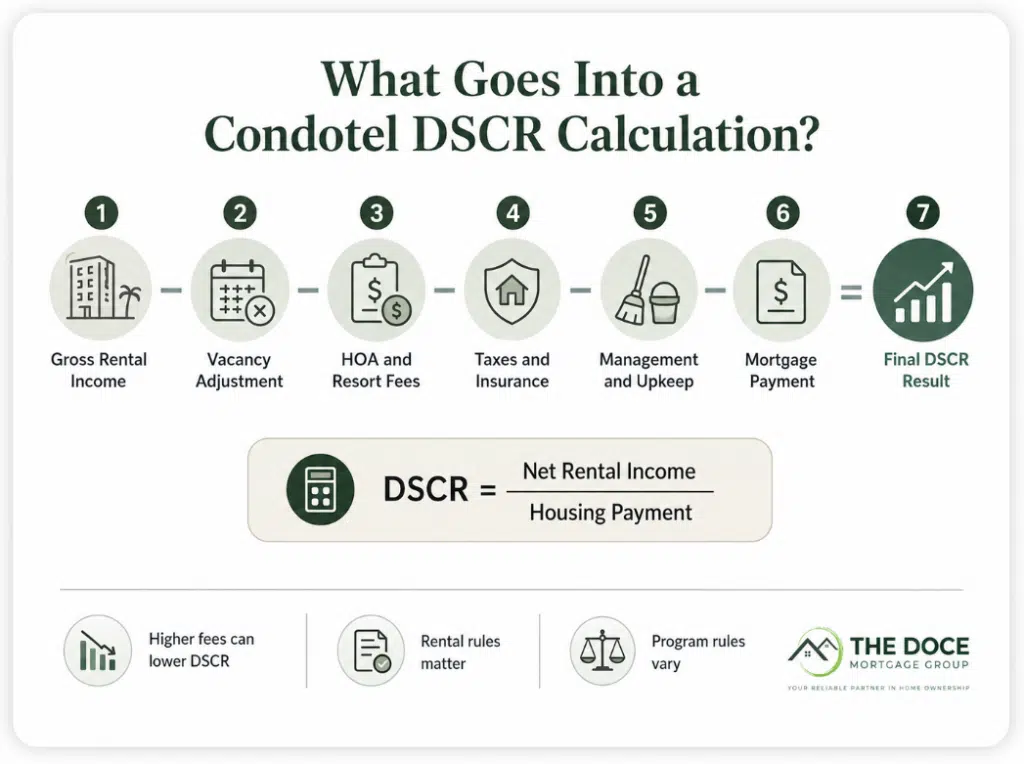
This is a simplified illustration. Actual DSCR calculations and qualifying rental income depend on the specific program and property.
If you’re evaluating an investment condotel, our DSCR Loan Calculator lets you enter rent, taxes, insurance, HOA expenses, down payment, and financing terms to see how the ratio changes.
How Much Cash and Reserves Might You Need?
Condotel buyers should generally expect specialty financing to require more cash than a standard owner-occupied condo mortgage, although exact requirements vary widely.
Down payments of 20% to 30% are common in many specialty investment scenarios. Some qualified programs may allow less, while a difficult building, weaker rental performance, foreign-national borrower, or higher-risk property can require more equity.
Cash reserves matter too. A program may want to see that you still have liquid assets after closing rather than using virtually every dollar for the down payment.
I think that’s especially important with condotels because expenses can fluctuate. A major HOA assessment, slower rental season, insurance increase, or HVAC replacement can quickly consume several months of cash flow.
What Florida Expenses Can Change a Condotel Investment?
Insurance, HOA fees, property taxes, management expenses, and rental restrictions can completely change the economics of a Florida condotel.
HOA fees deserve particular attention because resort-style buildings often provide pools, valet parking, security, front desk operations, gyms, beach services, or other amenities. Those services can make the property appealing to guests while also creating substantial monthly expenses.
Insurance can be equally important in coastal locations. Wind exposure, flood zones, building age, reserves, and association coverage can affect both the unit owner’s costs and the project’s overall financial health.
Short-term rental rules also vary dramatically. Miami Beach, Fort Lauderdale, Orlando-area resort communities, Naples, the Florida Keys, individual municipalities, and individual condo associations can have very different restrictions.
If you’re considering Financing an Airbnb or short-term rental property in Florida, it’s important to evaluate rental regulations, occupancy assumptions, HOA rules, and operating expenses along with the mortgage.
I’ve seen investors become focused on the nightly rental rate while overlooking a $1,400 monthly HOA fee. With Florida condotel loans, I want to know the net economics of the unit, not just what guests might pay during peak season.
What Should You Check Before Buying a Florida Condotel?
Before buying a condotel, verify how the building operates, whether short-term rentals are permitted, what the HOA covers, and which financing programs will accept the project.
I’d start with the project rather than the unit. A beautiful condo with strong rental demand can still be difficult to finance if the building has mandatory rental programs, unusual owner-use restrictions, hotel-style operations, litigation, inadequate reserves, or major insurance concerns.
Important items to review include:
- Condo declaration and bylaws
- Rental-management agreement
- Owner-use restrictions
- HOA budget and reserves
- Special assessments
- Master insurance coverage
- Flood zone
- Rental licensing requirements
- Historical occupancy
- Management fees
- Hotel or resort services
Florida’s condo environment deserves extra attention because structural inspections, reserve requirements, insurance costs, and association finances can all affect project eligibility. Buyers should also check the property’s location using FEMA flood maps and confirm the actual insurance costs before closing.
I’ve found that the best condotel purchases are usually the ones where the buyer understands both sides of the property, the real estate itself and the hospitality business operating around it.
Pros and Cons
Florida condotels can provide access to desirable resort locations and rental income, but they also carry additional financing and operating risks.
Pros include:
- Prime vacation-market locations
- Potential short-term rental income
- Hotel-style amenities
- Professional rental management options
- Personal use when permitted
- Potential appreciation
Cons include:
- Fewer standard mortgage options
- Higher HOA fees
- Management fees
- Seasonal rental income
- Owner-use restrictions
- Insurance exposure
- Project-level financing requirements
- Potential special assessments
Myths Vs Facts
Myth: Any Florida condo allowing short-term rentals is a condotel
Fact: Project operations, hotel services, rental structure, and owner restrictions help determine classification
Myth: Strong credit guarantees condotel approval
Fact: The building itself must also qualify under the selected financing program
Myth: DSCR financing works for every condotel
Fact: DSCR can help with income qualification, but project eligibility still matters
Myth: Gross rental income equals investment profit
Fact: HOA fees, insurance, management, vacancies, taxes, and repairs reduce net income
Common Mistakes
One of the biggest mistakes is making an offer before confirming that financing exists for the specific building.
Other common problems include:
- Assuming every condo program accepts condotels
- Using peak-season rents year-round
- Ignoring management commissions
- Underestimating HOA expenses
- Failing to review special assessments
- Ignoring owner-use restrictions
- Assuming Airbnb use is automatically allowed
- Overlooking flood and wind insurance
- Using all available cash at closing
- Not reviewing the rental agreement
Being able to finance a Florida Airbnb or short-term rental will depend heavily on vacation-rental income.
Key Facts
- Condotels combine condo ownership with hotel characteristics
- Standard conventional financing may not work
- Project eligibility matters as much as borrower qualification
- DSCR may help investment buyers qualify
- Short-term rental income can fluctuate
- HOA fees may be substantial
- Insurance costs can affect cash flow
- Mandatory rental programs require extra review
- Owner-use restrictions can affect financing
- Specialty condo and portfolio options may help
Which Condotel Buyer Profile Fits Which Financing Approach?
| Buyer Profile | Financing Worth Exploring |
|---|---|
| Second-home buyer | Specialty condo or portfolio |
| Short-term rental investor | DSCR or Non-QM |
| High-net-worth buyer | Jumbo or portfolio |
| Complex-income investor | DSCR or bank statement |
| Foreign-national investor | Specialty foreign-national program |
| Standard residential condo buyer | Conventional if project qualifies |
This is a general starting point. Actual availability depends on the property, occupancy, borrower profile, loan amount, and current program requirements.
People Also Ask
Is a condotel a good investment in Florida?
It can be when net rental income, location, expenses, financing, and personal-use goals all support the purchase.
Can you live full-time in a condotel?
Some projects allow it, while others restrict owner occupancy or personal-use periods.
Can a condotel be refinanced later?
Potentially. Refinancing options depend on the project, equity, property use, borrower profile, and programs available at that time.
How Can We Help Finance Your Florida Condotel?
We can review the specific project before you commit to a financing path and compare specialty condo, DSCR, portfolio, jumbo, Non-QM, bank statement, and other options based on how you’ll use the property.
Our team can also evaluate rental income, HOA costs, project restrictions, cash requirements, insurance considerations, and whether a particular building fits the available programs.
We’re proud that The Doce Mortgage Group recently received the prestigious WalletHub Award and was recognized as one of the best mortgage brokers in several cities throughout Florida.
You can review our customer reviews to see what borrowers say about working with us.
If you’re considering a Florida condotel, we can help determine which financing structure fits the building and your goals, and when you’re ready, you can Get Started Now, or connect with a loan officer live at 305-661-3434.