

Quick Answer
A Florida bridge loan is short-term financing that lets homeowners use equity in their current property to help purchase another home before selling. The loan is typically repaid when the existing home sells, allowing buyers to move without waiting for their sale to close.
Finding your next Florida home before selling your current one can create a difficult financial situation. You might have plenty of equity but not enough available cash for another down payment. A Florida bridge loan can help close that gap, giving you the flexibility to purchase your next property while preparing your existing home for sale.
A Personal Story
One situation I’ve encountered throughout my mortgage career involved a homeowner who found their ideal property before they’re ready to sell. They had substantial equity, steady income, and excellent credit, but most of their wealth was tied up in their current home. They worried about losing the new property while waiting for their existing one to sell.
My advice in situations like these is to explore financing options before listing your house. Sometimes bridge financing makes sense. Other times, a home equity line or a traditional mortgage provides better terms. What’s important is understanding the costs and having a realistic plan for selling.
What Is a Florida Bridge Loan and How Does It Work?
A Florida bridge loan is temporary financing designed to cover the period between purchasing a new property and selling an existing one.
Instead of waiting until your current home sells to access its equity, you may be able to borrow against that equity immediately.
Here’s how the process generally works:
- Your existing home’s market value and mortgage balance are evaluated
- You’re approved for short-term financing based on your equity, finances, and property details
- The funds help cover your next home’s down payment or other approved purchase expenses
- You purchase your new property while your previous home remains on the market
- When your existing property sells, you use the proceeds to repay the bridge loan
Bridge loans commonly have repayment periods of 6 to 12 months, although terms vary. Some require monthly interest payments, while others allow interest to accrue until repayment.
It’s important to understand that not every bridge loan works identically. Some provide a separate loan against your existing home, while others combine financing differently.
We can also help you evaluate whether our conventional mortgage options could support your purchase without specialized bridge financing.
Why Would You Buy a Florida Home Before Selling Your Current One?
Buying first can eliminate the pressure of coordinating 2 closings and arranging temporary housing.
Imagine living in Fort Lauderdale and finding your ideal property in Boca Raton. Your current home hasn’t sold, but the seller of the new property wants to close within 30 days.
Waiting could mean losing the opportunity.
Bridge financing may allow you to:
- Submit an offer without making it dependent on selling your current home
- Move directly into the new property
- Prepare and show your existing home after moving out
- Avoid temporary rentals and repeated moving expenses
- Take additional time to negotiate a reasonable sale price
These advantages can be particularly valuable when desirable properties become available unexpectedly.
According to Florida Realtors, Florida’s single-family housing inventory declined 13% in August 2026 compared with August 2025. That tightening supply can make timing especially important for buyers searching in particular neighborhoods.
I’ve found that removing the pressure of coordinating both transactions can be valuable, provided the temporary financing costs fit comfortably within the homeowner’s budget.
Understanding how to structure a competitive home purchase offer is another important part of buying before selling.
How Much Money Can You Borrow With a Bridge Loan?
The available amount depends primarily on your home’s value, outstanding mortgage balance, credit profile, and the financing program’s maximum loan-to-value ratio.
For example, suppose your existing home is worth $600,000, and you still owe $250,000.
Example Bridge Loan Equity Calculation
| Calculation | Amount |
|---|---|
| Current home value | $600,000 |
| Outstanding mortgage | $250,000 |
| Total existing equity | $350,000 |
| Illustrative maximum combined financing at 80% | $480,000 |
| Potential additional borrowing | $230,000 |
This example assumes an 80% combined loan-to-value limit. It’s an illustration, not a universal bridge loan requirement or guaranteed approval amount.
The actual amount available may be lower after accounting for fees, closing expenses, and program restrictions.
Before deciding how much to borrow, I recommend estimating the proceeds from your eventual sale. Our Seller Net Proceeds Calculator can help you account for your remaining mortgage balance and expected selling expenses.
Bridge Loan Financing Compared With Other Options
A traditional bridge loan isn’t the only way to buy before selling. The right approach depends on your equity, income, current mortgage, and how quickly you expect to sell.
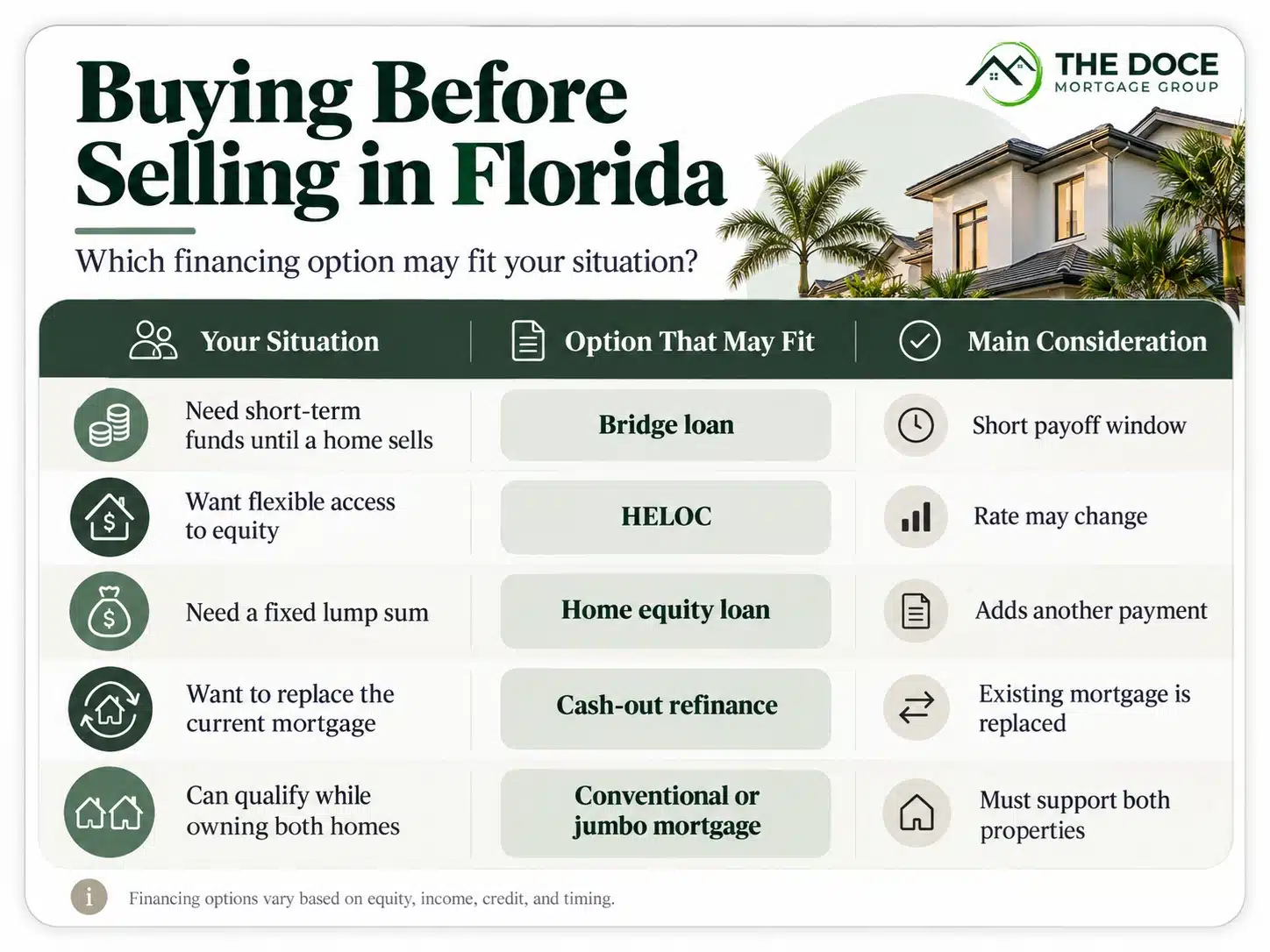
A HELOC can sometimes accomplish the same basic goal as bridge financing. However, it has different repayment terms and qualification requirements.
For homeowners comparing equity-based options, understanding HELOC and home equity loan repayment structures can help identify which arrangement fits their situation.
We can help you review your current mortgage, available equity, and future housing costs to determine which financing options may be available. You can also request a free mortgage quote to discuss your specific numbers before making an offer.
Who Qualifies for a Florida Bridge Loan?
Qualification usually depends on having enough equity in your current home, sufficient income or assets to support the temporary debt, acceptable credit, and a realistic plan for selling the existing property.
Your mortgage balance, estimated sale price, new home price, reserves, and monthly obligations may all affect how much financing is available. I also look closely at whether the homeowner can comfortably handle the period when both properties are still owned. I don’t like building a strategy that only works if the old home sells immediately.
At The Doce Mortgage Group, we can also compare conventional, jumbo, asset based, and other Florida home loan options when bridge financing isn’t the best fit.
What Does a Florida Bridge Loan Cost?
A Florida bridge loan generally costs more than long term mortgage financing because it’s designed for a short holding period.
Costs can include interest, origination charges, appraisal costs, title related expenses, recording fees, and other closing costs. The most useful comparison is the total dollar cost for the amount of time you realistically expect to keep the loan.
For context, Freddie Mac reported that the average 30 year fixed mortgage rate was 7.40% and the average 15 year fixed rate was 6.71% on October 15, 2026. A bridge loan isn’t priced the same way, but these rates help show why homeowners should compare the full cost of several financing strategies.
Illustrative Short Term Carrying Cost
| Example Item | Amount |
|---|---|
| Bridge loan balance | $200,000 |
| Hypothetical interest rate | 9.50% |
| Approximate monthly interest | $1,583 |
| Interest for 4 months | $6,333 |
| Other closing costs | Varies by program |
This is only an illustration. Actual rates, fees, payments, and payoff requirements vary.
Bridge Loans Versus HELOCs and Other Financing Solutions
The best alternative depends on whether you need temporary cash, want to preserve your current mortgage, or need a longer repayment period.
A HELOC can provide flexible access to equity while leaving your existing mortgage in place. A home equity loan provides a lump sum. A cash out refinance replaces the existing mortgage with a larger one, which may be less attractive when your current mortgage has a much lower rate.
Our guide to HELOCs and home equity loans explains how draw periods and repayment structures differ for Florida homeowners.
Buy Before Selling Financing Decision Chart
| Your Situation | Option That May Fit | Main Consideration |
|---|---|---|
| Need short term funds until a home sells | Bridge loan | Short payoff window |
| Want flexible access to equity | HELOC | Rate may change |
| Need a fixed lump sum | Home equity loan | Adds another payment |
| Want to replace the current mortgage | Cash out refinance | Existing mortgage is replaced |
| Can qualify while owning both homes | Conventional or jumbo mortgage | Must support both properties |
When I compare these choices, I look beyond the rate. I also consider how long the money will be needed and what happens if the sale takes longer than expected.
Pros and Cons of Buying Before Selling
Buying first can make a move easier, but the convenience needs to justify the added financial exposure.
Pros include:
- Move directly into the new home
- Potentially avoid a home sale contingency
- Prepare and show the old home while vacant
- Avoid temporary housing and an extra move
Cons include:
- Temporarily carrying 2 housing payments
- Added interest and closing costs
- Financial pressure if the sale takes longer
- Overlapping taxes, insurance, HOA charges, and maintenance
Florida homeowners should pay special attention to insurance and HOA costs, especially with coastal homes and condos.
What Happens if Your Current Home Doesn’t Sell Quickly?
You need a backup plan because a bridge loan has a defined repayment period.
If the sale takes longer than expected, you may need to keep making payments, adjust the asking price, use reserves, request an extension if available, or refinance the temporary debt.
If a homeowner expects a sale in 30 days, I still want to know what the budget looks like at 60, 90, or 120 days.
Before making an offer, you can use our secure application portal so we can review your income, assets, current mortgage, and estimated purchase price before you commit.
Myths Vs Facts
Myth: You must sell your current home before you can buy another one.
Fact: Some homeowners can purchase first through bridge financing, home equity, or a new mortgage while still owning the existing property.
Myth: A bridge loan eliminates the risk of owning 2 homes.
Fact: It solves a timing problem, but you still need a plan for carrying costs and a slower sale.
Myth: The option with the lowest advertised rate is automatically the cheapest.
Fact: Total cost matters more, including fees, interest, repayment timing, and what happens to your existing mortgage.
Common Mistakes to Avoid
The biggest mistake with a Florida bridge loan is assuming your current home will sell exactly when you expect.
A strong plan should account for a slower sale, an appraisal issue, inspection negotiations, or a buyer backing out. Other mistakes include borrowing the maximum available instead of what you actually need, underestimating closing costs, and forgetting that you may temporarily pay taxes, insurance, utilities, HOA fees, and maintenance on 2 properties.
Timing also depends on the local market. According to 2026 Florida housing market research from Florida Realtors, Miami buyers during the projected November 29 through December 5 buying window may see 7% more active listings than an average week and 35.4% less competition than the annual peak. Local conditions like these can affect both your purchase and your sale.
How Can You Prepare for a Successful Bridge Loan?
You can prepare by knowing your equity, expected sale proceeds, monthly carrying costs, and backup plan before making an offer.
Start with realistic numbers. Estimate what your current home could sell for, subtract the existing mortgage and selling expenses, then determine how much equity may actually be available.
You should also review the full Florida home buying process before committing to your next property. Inspection deadlines, appraisal requirements, insurance, title work, HOA documents, and closing dates can all affect how smoothly the 2 transactions fit together.
I also recommend keeping extra cash available rather than putting every available dollar into the next purchase. A little breathing room can make a major difference if your current property takes an extra month or 2 to sell.
Bridge Loan Readiness Chart
| Stronger Position | Needs More Planning | Why It Matters |
|---|---|---|
| Significant home equity | Limited available equity | Determines potential borrowing capacity |
| Strong cash reserves | Little money left after closing | Helps cover overlapping expenses |
| Realistic sale price | Sale depends on an unusually high price | Reduces timing risk |
| Flexible moving timeline | Both closings must occur perfectly | Creates less pressure |
| Backup financing plan | Sale is the only repayment strategy | Provides another option if plans change |
Key Facts
- Bridge financing is generally intended to be temporary
- Your available equity may be less than your total home equity
- Owning 2 homes temporarily can mean overlapping housing expenses
- HELOCs and home equity loans may offer alternatives
- Florida insurance, HOA, and property costs should be included in your budget
- A backup strategy is important if your current home takes longer to sell
Move First With a Financing Plan That Fits
Buying your next Florida home before selling your current one can give you more control over your move, but I don’t believe anyone should use bridge financing simply because it’s available. We want to compare the numbers, understand your timeline, look at your existing equity, and make sure the strategy still works if your home takes longer than expected to sell.
Our clients can also review more than 1,500 five star customer reviews from people who have worked with us on home financing throughout Florida.
We’re also proud that The Doce Mortgage Group recently received prestigious recognition from WalletHub as one of the best mortgage brokers in several cities throughout Florida. That recognition reflects the same approach we bring to bridge financing, conventional mortgages, and more complex transactions, clear answers, careful planning, and financing structured around the individual buyer.
If you’re considering buying before selling, we’ll help you compare your available options and determine whether a Florida bridge loan or another mortgage strategy makes more sense for your situation. When you’re ready, you can Get Started Now, or connect with a loan officer live at 305-661-3434.