
Quick Answer
Hard Equity Lending in Florida is short-term, property-backed financing that places heavy emphasis on real estate value, available equity, and the repayment plan. It can be useful when speed, unusual property conditions, or nontraditional finances make standard mortgage financing difficult.

Hard equity financing fills a very specific gap in Florida real estate. It can help an investor purchase a distressed property, complete renovations, bridge a temporary financing problem, or close when a slower mortgage process would cause the opportunity to disappear.
A Personal Story
I worked with an investor who found a property that needed substantial repairs and had to close quickly. Traditional financing wasn’t practical because of the property’s condition and the seller’s timeline. The investor had significant cash for the purchase and a clear renovation plan, which made a property-focused financing strategy much more realistic.
My advice with hard equity is always the same. Know how you’re getting out before you get in. Fast financing can solve an immediate problem, but the exit strategy, total costs, property value, and realistic renovation timeline need to make sense before you close.
What Is Hard Equity Lending In Florida?
Hard Equity Lending in Florida is a form of asset-based financing where the property’s value and available equity play a major role in determining whether the transaction works.
It’s also commonly called hard money financing. Rather than relying primarily on traditional employment income, tax returns, and debt ratios, the company providing the financing looks closely at the real estate securing the debt.
That doesn’t mean your finances are always ignored. Credit, experience, cash reserves, and documentation can still matter depending on the program. The major difference is the weight placed on the property.
Hard equity financing is generally designed for short-term situations rather than someone looking for a standard 30-year home mortgage.
What Hard Equity Financing Emphasizes
| PROPERTY VALUE | HIGH EMPHASIS |
| AVAILABLE EQUITY | HIGH EMPHASIS |
| EXIT STRATEGY | HIGH EMPHASIS |
| PROPERTY CONDITION | IMPORTANT |
| CASH RESERVES | OFTEN IMPORTANT |
| PERSONAL INCOME | PROGRAM DEPENDENT |
| CREDIT PROFILE | PROGRAM DEPENDENT |
| CLOSING SPEED | OFTEN PRIORITIZED |
Hard equity and traditional mortgage financing serve very different purposes. That difference makes hard equity financing especially useful when the property itself is strong, but the borrower’s income documentation, property condition, or closing timeline makes traditional financing less practical.
How Does Hard Equity Lending Work?
Hard equity financing works by evaluating the property’s value, the requested financing amount, your equity position, and how the debt will eventually be repaid.
For a purchase, the financing source may look at both the purchase price and the property’s current or projected value. For a property you already own, available equity becomes especially important.
The basic concept is loan-to-value, or LTV.
If a property is worth $500,000 and you’re requesting $300,000:
$300,000 ÷ $500,000 = 60% LTV
More equity provides a larger cushion between the financing amount and the property’s value.
Hard Equity Vs Traditional Mortgage Financing
| Feature | Hard Equity Financing | Traditional Mortgage Financing |
|---|---|---|
| Main focus | Property and equity | Income, credit, property |
| Typical purpose | Short-term opportunity | Long-term ownership |
| Property condition | More flexibility possible | Usually stricter |
| Documentation | Often streamlined | More extensive |
| Closing timeline | Can be faster | Usually longer |
| Cost | Usually higher | Usually lower |
| Repayment plan | Critical | Built into long term |
Speed can be one of the biggest advantages. The Doce Group currently describes certain hard money transactions as capable of closing in approximately 7 to 10 days, although actual timing depends on the property and documentation.
You can begin through our secure application portal if you want us to review the property and determine which financing structures may fit.
Who Uses Hard Equity Loans In Florida?
Hard equity loans are commonly used by investors and property owners who have a strong real estate asset but need more speed or flexibility than standard mortgage financing provides.
Typical situations include:
- Fix-and-flip purchases
- Distressed properties
- Properties requiring major repairs
- Time-sensitive acquisitions
- Auction opportunities
- Short-term bridge situations
- Borrowers with unusual income
- Owners with substantial equity
- Investors planning a quick refinance
This matters in an active Florida market. Florida Realtors reported that single-family closed sales increased just over 5% year over year in July 2026, while the statewide median sale price reached $425,000. citeturn682505search9
Why Do Florida Real Estate Investors Consider Hard Equity Financing?
Florida investors consider hard equity financing primarily because speed and property flexibility can sometimes be worth more than obtaining the lowest possible interest rate.
An investor purchasing a property significantly below its potential renovated value may care more about securing the opportunity than finding permanent financing on day 1.
Hard equity can also help when a property isn’t immediately suitable for standard financing because it needs a new roof, major structural work, plumbing repairs, electrical upgrades, or extensive interior renovation.
I look at hard equity as a bridge, not an automatic long-term solution. If the plan is to renovate and sell, the sale is the exit. If the plan is to keep the property, refinancing into longer-term investment property financing may eventually provide a more sustainable structure.
What Are The Benefits Of Hard Equity Lending?
The biggest benefits of hard equity lending are speed, property flexibility, and qualification that places greater emphasis on the real estate securing the financing.
Those advantages can be valuable when an investor is competing for a property that won’t wait through a lengthy mortgage process.
Common benefits include:
- Faster closing possibilities
- Flexible property-condition requirements
- Less reliance on traditional income documentation
- Financing for distressed properties
- Short-term bridge solutions
- Access to equity
- Greater flexibility for investors
Florida can provide plenty of situations where that flexibility matters. According to ATTOM’s June 2026 foreclosure data, Florida had the highest foreclosure rate among states that month, with 1 foreclosure filing for every 2,106 housing units.
Distressed properties can create opportunities, but they can also require fast decisions, significant repairs, and financing that works with the property’s current condition.
The benefit of speed shouldn’t be confused with permission to skip due diligence. I still want an investor to understand title issues, repair costs, insurance, realistic value, and the exit strategy before moving quickly.
What Are The Risks Of Hard Equity Lending?
The primary risks are higher borrowing costs, shorter repayment periods, and the possibility that your planned exit doesn’t happen on schedule.
Hard equity financing usually costs more than long-term mortgage financing because you’re paying for a different combination of speed, flexibility, and property-focused qualification.
Potential risks include:
- Higher interest rates
- Upfront fees or points
- Short repayment periods
- Extension fees
- Renovation overruns
- Falling property values
- Delayed sales
- Refinancing problems
- Higher carrying costs
Florida investors also need to think carefully about homeowners insurance, flood coverage where applicable, property taxes, utilities, HOA expenses, and maintenance while a property is being renovated or waiting to sell.
A project that looks profitable on the purchase price alone can become much less attractive after adding 8 months of financing and carrying expenses.
I always encourage investors to build extra time into the plan. If the project only works when everything goes perfectly, the margin is probably too thin.
How Are Hard Equity Loan Rates And Terms Determined?
Hard equity rates and terms are usually determined by the property’s value, LTV, transaction risk, property condition, borrower experience, and repayment strategy.
The exact combination varies by program, but these factors commonly matter:
Factors That Can Influence Hard Equity Terms
| Factor | Why It Matters |
|---|---|
| Property value | Establishes the asset supporting the financing |
| LTV | Shows how much equity protects the transaction |
| Property condition | Affects risk and potential resale value |
| Purchase price | Helps establish the investor’s basis |
| Renovation scope | Can affect total capital required |
| Experience | May matter on investment projects |
| Reserves | Help absorb delays and unexpected costs |
| Exit strategy | Shows how the debt is expected to be repaid |
An investor buying a $500,000 property with a $250,000 request creates a very different risk profile from someone requesting $425,000 against the same value.
That difference is why hard equity pricing shouldn’t be evaluated from an advertised rate alone.
Investment property financing like hard money, DSCR, conventional investment financing, and other options each serve different investor goals. That’s why choosing the right structure requires looking at the property, leverage, cash flow, renovation plan, and exit strategy together rather than assuming every investment loan will be priced the same way.
How Much Equity Do You Need For Hard Equity Lending In Florida?
There isn’t 1 universal equity requirement, but stronger equity generally improves the chances of finding workable hard equity terms.
Loan-to-value tells you how much of the property’s value is being financed.
For example:
$500,000 property value
$300,000 financing amount
60% LTV
40% equity cushion
Compare that with a $400,000 request against the same $500,000 property. That produces an 80% LTV and leaves only 20% equity.
How Equity Changes The Transaction
| MORE EQUITY | LOWER LTV | LARGER VALUE CUSHION | STRONGER POSITION |
| MODERATE EQUITY | MID-RANGE LTV | MODERATE CUSHION | MORE REVIEW |
| LESS EQUITY | HIGHER LTV | SMALLER VALUE CUSHION | FEWER OPTIONS |
These aren’t universal approval categories. They’re a simple way to understand why equity is so important.
For investors, putting more cash into a transaction isn’t automatically the correct answer either. Every additional $25,000 tied up in 1 project is $25,000 that can’t be used for renovations, reserves, another property, or unexpected expenses.
That’s why I look at both financing risk and capital efficiency.
Is Hard Equity Lending Better Than Traditional Mortgage Financing?
Hard equity financing is better when its speed and flexibility solve a problem that traditional financing can’t solve efficiently.
It’s generally not designed to replace inexpensive long-term financing when a borrower and property already qualify comfortably for that option.
Hard equity may make more sense when:
- The property requires substantial repairs
- A closing deadline is unusually short
- The investment will be sold quickly
- The property will be refinanced after renovation
- Traditional income documentation creates difficulties
- Significant equity supports the transaction
Traditional financing may make more sense when the property is already stabilized and your goal is long-term ownership.
I’ve seen investors use hard equity successfully to acquire and repair a property, then replace it with longer-term financing once the property is stabilized. The key is planning that second step before taking the first one.
If you have a Florida property or investment opportunity you’d like us to evaluate, you can get a free quote so we can compare the financing structure with your purchase, equity, and exit plan.
How Should You Plan Your Hard Equity Exit Strategy?
You should know exactly how you expect to repay or replace hard equity financing before you close.
Common exit strategies include:
- Selling the renovated property
- Refinancing after repairs
- Moving into DSCR financing
- Replacing short-term debt with long-term investment financing
- Paying the balance from another asset sale
Your backup plan matters too. If you expect to renovate a property in 4 months and sell it in month 6, run the numbers assuming it takes 9 or 12 months instead.
The broader borrowing environment can also change while you’re holding the property. The Federal Reserve’s August 2026 interest-rate data showed the bank prime rate at 6.75%. Hard equity pricing isn’t determined directly by prime, but changing market conditions can affect the permanent financing available when you’re ready to refinance.
Hard Equity Exit Strategy Stress Test
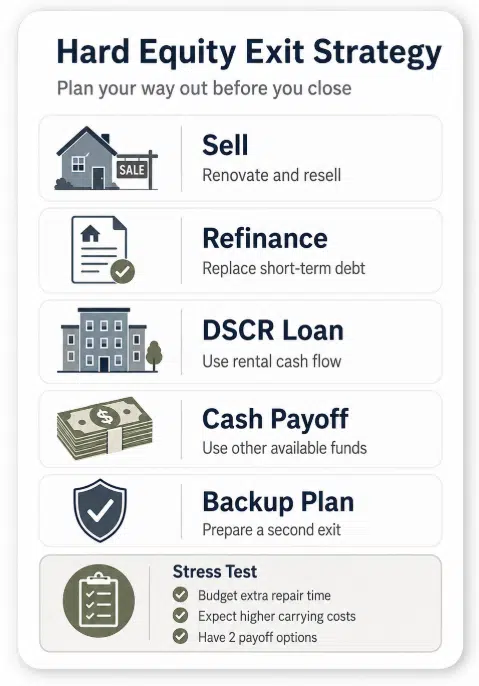
I like to see at least 2 realistic ways out of a hard equity transaction. One planned exit is a strategy. A second exit is protection when the first plan doesn’t happen on schedule.
Investors considering purchasing an investment property in Florida should evaluate ongoing costs including insurance, taxes, vacancies, repairs, and property management.
Pros And Cons Of Hard Equity Lending
| Pros | Cons |
|---|---|
| Potentially faster closing | Usually higher financing costs |
| Property-focused qualification | Shorter repayment periods |
| Flexible property condition | Points and fees may apply |
| Useful for renovations | Extension costs may apply |
| Can bridge financing gaps | Requires a strong exit strategy |
| Useful for investors | More expensive for long-term holding |
Hard equity works best when the flexibility creates enough value to justify the added cost.
Myths Vs Facts
Myth: Hard equity financing is only for people with terrible credit
Fact: Investors often use it because they need speed or property flexibility
Myth: Property value is the only thing that matters
Fact: Equity, condition, reserves, experience, and exit strategy may also matter
Myth: Hard equity is always too expensive to make sense
Fact: Higher costs can be worthwhile when they unlock a profitable opportunity
Myth: Hard equity should replace long-term mortgage financing
Fact: It’s usually better suited to shorter-term situations
Myth: A fast approval means you can skip due diligence
Fact: Property, title, insurance, repairs, and value still require careful review
Common Mistakes
- Borrowing without a clear exit strategy
- Assuming renovations will stay on schedule
- Underestimating repair costs
- Ignoring extension fees
- Overestimating the finished property value
- Forgetting Florida insurance costs
- Ignoring property taxes and HOA expenses
- Using every available dollar for the purchase
- Assuming refinancing will automatically be available
- Holding short-term financing longer than planned
One mistake I see repeatedly is building the entire deal around the best-case timeline. If 1 contractor delay or insurance problem destroys the projected return, there probably isn’t enough margin in the transaction.
Key Facts
- Hard equity financing is property focused
- Available equity is extremely important
- Closing can be faster than traditional financing
- Costs are generally higher
- Terms are usually shorter
- Property condition may receive more flexibility
- Investors commonly use hard equity
- Florida carrying costs need careful planning
- A realistic exit strategy is essential
- Permanent financing should be considered early
How Can The Doce Mortgage Group Help With Hard Equity Lending In Florida?
We help Florida investors look at hard equity financing as part of the complete investment strategy, not simply as a way to close quickly. Our team can review the property, available equity, renovation plan, financing costs, expected holding period, and exit strategy before you commit.
With more than 38 years of mortgage experience, we can also help you compare hard equity with DSCR, traditional investment-property financing, and other options that may make more sense once the property is stabilized. You can see what clients have said about working with us through our customer reviews.
The Doce Mortgage Group was also recognized as one of the best mortgage brokers in several cities throughout Florida.
When you’re ready to move forward, you can Get Started Now, or connect with a loan officer live at 305-661-3434.